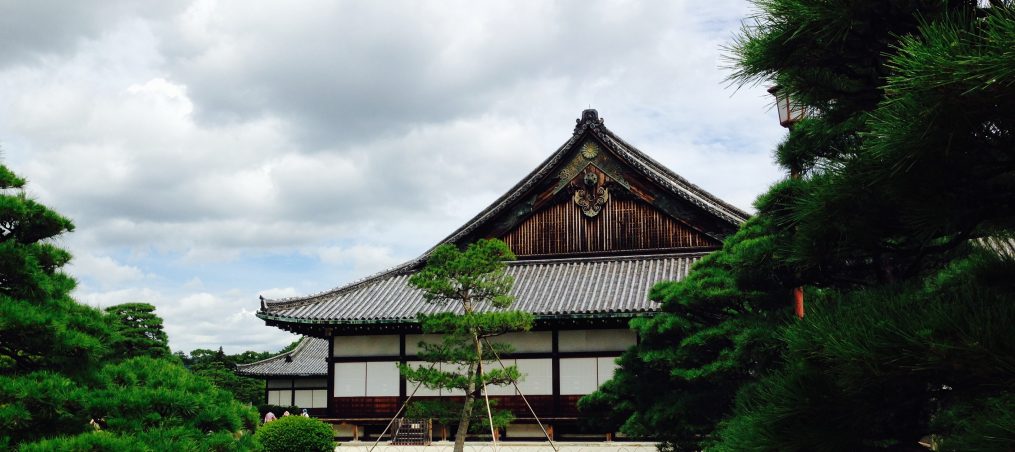
Winter is officially over today in the US on 3/20¹. The same can be said in Japan, as it ended on the day of shunbun (春分)². As Spring is now upon us, we all expect life of mother nature to revive as the weather gets warmer, and flowers start blooming. Those who follow traditions in Japan may eat specific snacks on the day of shunbun, such as botamochi (ぼた餅), which is a mashed rice cake covered in sweet red bean paste.

In accordance to the 1st day of Spring, this article will introduce a rather interesting fable from Yamagata Prefecture, which is about botamochi and terms used to describe it. These terms are enough to make anyone fear for their life…including a samurai!
Han Goroshi to Hon Goroshi³ (Half-Beating and Full-Beating)
There’s a story a long time ago, where a lone samurai from the Capital⁴ sets off on a journey, which takes him into the mountains⁵. He traverses through the mountains all day till late in the night, where he finds himself wandering around aimlessly, until he finally comes to a single mountain hut. He knocks on the door, which was then opened by an old man. The samurai requests to stay in the hut for the night. The old man sits in front of an open hearth next to an old lady who is his wife, and after consulting with her, they both agree as long as the samurai was okay with their shabby hut.
Given warm thin rice porridge as a meal by his hosts, the samurai eats his fill, then retreats to a room prepared for him to rest. He falls asleep almost instantly, as he was tired from his long trip. However, in the middle of the night, he wakes up to the low conversation between the elderly couple, which prompts him to eavesdrop for awhile. The part of the conversation he hears wakes him up completely.
“Should we give him one ‘half beating’ tomorrow? Or what about a ‘pounding by hand’?” Asks the old man.
“This samurai’s from Edo, right? A ‘half beating’ should be enough for him.” The old lady replies.
Hearing this dialogue, the samurai was shocked. He concludes that this plot to beat him, possibly to death, could only be that of mountain bandits, and he just so happened to fall into their den. No longer able to sleep with those troubling thoughts on his mind, he lays down on his bedding, clutching his sheathed sword tightly to him. He remained vigilant, staying on full alert to defend himself, all night long until sun rise.
With morning upon him, the samurai was sleep-deprived. Expecting an attack from his would-be assailants while they thought he was asleep, he was surprised that no such incident occurred. Still, despite being tired, he stayed alert, with his hand ready on the handle of his sword.

Just then, the samurai could hear sounds coming from the area around the open hearth, along with the voices of his hosts.
“Hey, you done with the ‘half beating’ yet?” The old man calls to the old lady from a different room.
“Not yet, wait a little longer.” She responds, sounding like she was beside the open hearth. From their conversation, the samurai was certain they were about to set their plan into motion and attack him at any moment. Wanting to get the upper hand, he gets up and quickly bursts out from his room, ready to strike his would-be assailants.
Surprised that the samurai was already awake, the old lady greets him in good spirits. The sleep-deprived warrior calms down as he analyzes what’s before him; the old lady sits down on a mat with a mortar beside her, while kneading something in her hands. As he looked confused, the old lady offered him something.
“We don’t have anything else here, but thought you could at least eat a ‘half-beating’.” In the old woman’s hand, a dark-colored mochi s presented to him. The samurai immediately recognizes it to be a botamochi.
“Wha…this ‘half-beating’ is actually an azuki bean⁶ mochi? Then, what’s a ’pounding by hand’?” He ask curiously.
“Ahh, ‘pounding by hand’? That’s our homemade soba noodles. And a ‘full-beating’ is for mochi⁷.” The old lady responds with a smile.
Realizing his misunderstanding, the samurai loses all power in his legs and collapses onto his bottom down on the floor.
~ The end ~
In the original tale, the terms that the samurai heard from the elder couple are the following:
- Te uchi (手打ち)
- Han goroshi (半殺し)
- Hon goroshi (本殺し)
Normally, these terms are of a violent context, which you would hear in relations to fighting. Te uchi means “to strike” or “to slap” someone with one’s bare hands, han goroshi means “to beat a person to the point where they’re on the brink of death”, and hon goroshi means “to certainly beat a person to death”. Anyone, especially a samurai who trains expecting death in combat, would immediately interpret such terms as dangerous, especially when applied towards someone. However, it seems that these terms have a unique usage in Yamagata when making treats or food. Since the samurai was from Edo and not from Yamagata⁸, hearing the colloquial use of those words that are normally used for violence alarmed him. From his perspective, one can understand how he felt. In present day, all countries have words that possess multiple meanings and usages, especially for cooking. In English, “beating” an egg is commonplace, but imagine a time when using such expression was unheard of.
ENDING
This concludes today’s article. The tale itself is light-hearted, and illustrates the unique culture of different prefectures in the past. Here’s looking to a fresh start on the 1st day of Spring!
1) I say this figuratively, for where I’m at it is wet & snowing outside.
2) Also known as “Shunbun no Hi” (春分の日), this year it falls on 3/19 in Japan, which slightly coincides with the US date of 3/20.
3) Title in Japanese is “半殺しと本殺し”. Here’s a version of the tale here.
4) The word “Capital” is not mentioned here, but later in the story it is, through the word “Edo”. Adding this for context purposes. Speaking of which, the Capital city at this time is Edo (Tōkyō), meaning that this tale takes place during Edo period, possibly as early as the late 1600s.
5) Most likely the samurai was on a musha shugyo (武者修行), or training journey.
6) Azuki (小豆) is the Japanese word for red bean.
7) In other words, mochi with nothing added to it is “hon goroshi”, with “hon” (本) indicating standard, or base.
8) Edo is present-day Tōkyō City, in the east. Yamagata is in the northeastern region of Japan, and is north of Tōkyō.