Bugei Jūhappan: The Multifaceted Listings of 18 Weapons

A rather popular list of martial disciplines in Japan is called “Bugei Jūhappan” (武芸十八般). Many martial schools, books, and the like talk about its significance, which has also made its presence to the West. What is the story behind this list? How old is this concept, and how consistent is it? This post will help answer questions like these, as well as provide an overall explanation about certain details that are not readily available in English.

For this post, there’s information both from Japanese sources as well as Chinese sources. A lot of cross-referencing and research was especially done to understand the Chinese information below, and I’m hoping there’s no glaring mistakes, although any corrections are welcomed. Here’s a list of some of the sources used:

ORIGIN AND ROOTS

Bugei Jūhappan loosely translates to “standard 18 martial skills”. Pretty self-explanatory, it is a list of 18 disciplines, primarily weapons, related to martial combat. This is a widely used method for noting what the average martial artists should aim for. However, understand that before this became popular in Japan, this concept was used first in China several centuries prior. 

A portrait of Hua Yue, author of “Cui Wei Bei Zhenglu” (翠微北征録, Northern Expedition of Cui Wei). From zwbk.org.

Within China’s martial and literature culture was the development of a conceptual grouping of 18 skills based on weapons generally called “Shi ba Ban bing qi” (十八般兵器)¹. The 1st source for this was through dramatic performances done from the Song Dynasty to the Yuan dynasty. Here, 18 weapons were mentioned in the lines done by two separate actors, Wang Huan and Jingde. This later would inspire it being used in a 12-volume documentation entitled “Cui Wei Bei Zhenglu” (翠微北征録, Northern Expedition of Cui Wei) by Hua Yue (華岳), which was completed in 1208. Next, several documentations were made during the Ming Dynasty (1368-1644) which featured their own versions of 18 weapons, which includes:

  • Fictional storybook “Shui hu Zhuan” (水滸傅, The Water Margin), by Shi Naian (施耐庵), sometime in 1300s
  • Illustrated encyclopedia “Sancai Tuhui” (三才圖會, Collected Illustrations of the Three Realms), by Wang Qi (王圻) and his son Wang Siyi (王思義), published in 1609
  • 16-volume “Wu za zu” (五雜俎, Five Miscellaneous Offerings) compiled by Xie Zhao-zhe (謝 肇淛), in 1619
  • 32-volume “Yong-chuang Xiao-pin”  (涌幢小品, Miscellaneous Notes from the Yong-chuang Pavilion) compiled by Zhu Guozhen (朱國禎), in 1621

There are also other sources with their own version of 18 weapons, including the famous Shaolin Temple². Below are examples of the different lists.

Shui hu Zhuan

  • 矛 = mao (spear with snake-like blade)
  • 錘 = chui (hammer)
  • 弓 = gōng (bow & arrow)
  • 弩 = nu (crossbow)
  • 銃 = chong (rifle)
  • 鞭 = bian (iron baton)
  • 鐧 = jian (metal truncheon)
  • 剣 = jian (double-edge sword)
  • 鏈 = lian (three-sectional staff)
  • 撾 = zhua (claw-mounted polearm)
  • 斧 = fu (Battleaxe)
  • 鉞 = yue (crescent moon knives)
  • 戈 = ge (dagger-axe)
  • 戟= ji (spear with 2 crescent blades on the side)
  • 牌 = pai (shield)
  • 棒 = bang (club)
  • 槍 = qiang (Spear)
  • 叉 = cha (Trident)

Wu za zu

  • 弓 = gong (bow & arrow)
  • 弩 = nu (crossbow)
  • 槍 = qiang (spear)
  • 刀 = dao (single-edge broadsword)
  • 剣 = jian (double-edge sword)
  • 矛 = mao (spear with snake-like blade)
  • 盾 = dun (shield)
  • 斧 = fu (battleaxe)
  • 鉞 = yue (crescent moon knives)
  • 戟 = ji (spear with 2 crescent blades on the side)
  • 鞭 = bian (Iron baton)
  • 鐧 = jian (metal truncheon)
  • 撾 = zhua (claw-mounted polearm)
  • 殳 = shu (three-edge spear)
  • 叉 = cha (trident)
  • 耙 = ba (rake)
  • 綿縄套索 = miansheng taosuo (brocade lasso)
  • 白打 = da bai (empty hands)

Here’s another, called “Nine Long & Short weapons of the 18 Weapons” (九長九短十八般兵器), starting with the 9 long weapons

  • 槍 = qiang (spear)
  • 戟 = ji (spear with 2 crescent blades on the side)
  • 棍 = gun (staff)
  • 鉞 = yue (crescent moon knives)
  • 叉 = cha (trident)
  • 钂 = tang (spear with two crescent prongs)
  • 鈎 = guo (hooked weapons, such as hook swords)
  • 槊 = shuo (long lance)
  • 鏟 = chan (spade)

Next, the short weapons

  • 刀 = dao (single-edge broadsword)
  • 剣 = jian (double-edge sword)
  • 拐 = guai (tonfa)
  • 斧 = fu (battleaxe)
  • 鞭 = bian (Iron baton)
  • 鐧 = jian (metal truncheon)
  • 錘 = chui (hammer)
  • 杵³ = huan (iron rings)
  • 棒 = bang (club)
Snapshot of the 18 weapons normally used in theatrical performances. From Arachina.com .

Differences in the lists are due to various factors, such as which were important depending on the time period, land area, groups that had any affiliations, etc⁴. Due to this, there is no one definitive listing, although there tends to be a consistency regarding specific weapons appearing on most of these lists.

18 SKILLS OF JAPAN

The concept of 18 weapons as essential disciplines didn’t arrive to Japan until the late mid-1600s, when Wu za zu was 1st published in Japanese. Later to follow were the other Chinese literature mentioned above, such as Sancai Tuhui and Shui hu Zhuan. Chinese literature still had value during this time, so they continued to have influence in Japanese culture.

Picture of Hirayama Kōzō. From the book “Edo no Kengō: Hirayama Kōzō” (江戸の剣豪 平山行蔵)

In 1806, a renown martial artist by the name of Hirayama Kōzō (平山行蔵) from Edo published a book called “Bugei Jūhappan Ryakusetsu” (武芸十八般略説), which served as an adaption of the 18 weapons from the Shui hu Zhuan, but in a way where it fitted with the Japanese methodology towards combat. More than just focusing on a “weapon” (兵器), Hirayama Kōzō used disciplines or skills (武芸) as a means to identify those areas necessary during warring times while on the battlefield, and during peaceful times while in towns and indoors. The development of such a list comes after Japan’s warring history, and during a more peaceful society where martial skills could be structured and represented in a more systematic format.

Just like in China, the listing of 18 skills in Japan is not an exclusive one. There are also variations, each a reflection on what was deemed important in what time period it was made, who was involved in developing such list, and so on. For example, Maki Bokusen (牧墨僊)⁵, an artist who was once a student of the famous Katsushika Hokusai, made a version represented through his ukiyo-e series entitled “Shashin Gakuhitsu” (写真学筆) in 1815. Below are several examples of the 18 weapons listings in Japan.

Bugei Jūhappan Ryakusetsu

  • 弓 = yumi (bow). One type that is iconic is kiyumi (木弓, wooden bow that was common even in early Japanese history).
  • 李満弓 = rimankyū. This represents short bows, such as kujirahankyū (鯨半弓) and kagoyumi (駕籠弓).
  • 弩 = ishiyumi (crossbow). There were 2 types, shudo (手弩, handheld crossbows) and ōyumi (大弓, siege crossbows).
  • 馬 = uma (horsemanship). Refers to bajutsu (馬術, equestrian).
  • 刀 = katana (sword). Refers to kenjutsu (剣術, sword techniques).
  • 大刀 = ōdachi (long sword). This includes nodachi (野太刀, long battlefield sword), and nagamaki (長巻, long sword with an extended handle).
  • 抽刀 = chūtō (drawing sword for cutting). More fitting label would be battōjutsu (抜刀術) or iaijutsu (居合術) .
  • 眉尖刀 = bisentō. Considered a polearm with a smaller blade, liken to a konaginata (小薙刀, small glaive)
  • 青竜刀 = seiryūtō. Considered a polearm with a larger blade, liken to an ōnaginata (大長刀, large glaive)
  • 槍 = yari. This is the spear, with variations including jumonji yari (十文字槍, crossbar spear) and saburi yari⁶(佐分利槍, a spear with prongs for hooking).
  • 鏢鎗 = hyōsō. This is known as nageyari (投槍, throwing spear) and hiya (火箭, fire arrows)
  • 棍 = kon. Generally called (棒, staff)
  • 鉄鞭 = tetsuben. Japanese equivalent would be tessen (鉄扇, iron fan) or jitte⁷ (十手, straight metal tool with a small prong used for arresting)
  • 飛鑓 = hiken (ひけん). Said to be related to fundō kusari⁸ (分銅鎖, chain with 2 weighted ends), kusarigama (鎖鎌, chain & sickle), and koranjō (虎乱杖, staff with a concealed chain)
  • 拳 = Yawara. Also known as jūjutsu (柔術, hand-to-hand)
  • 銃 = ju. Equivalents are teppō (鉄砲, gunnery) and taihō (大砲, artillery)
Select artwork of different weapons in use from the “Shashin Gakuhitsu”. From “Zuzetsu-Kobudōshi”.

Shashin Gakuhitsu

  • 弓術 = kyūjutsu (archery)
  • 馬術 = bajutsu (equestrian)
  • 水泳術 = suieijutsu (swimming techniques)
  • 槍術 = sōjutsu (spear techniques)
  • 鎖鎌術 = kusarigamajutsu (chain & sickle)
  • 薙刀術 = naginatajutsu (glaive techniques)
  • 剣術 = kenjutsu (sword techniques)
  • 居合 = (sword-drawing)
  • 補縄術 = hōjōjutsu (rope-tying a captured opponent)
  • 鼻ねじ = hananeji (baton with a rope used for arresting)
  • 手裏剣術 = shurikenjutsu (small bladed throwing weapons)
  • 鉄砲 = teppō (gunnery)
  • 石火矢 = ishibiya (cannons)
  • 柔術 = jūjutsu (hand-to-hand)
  • 騎射術 = kibajutsu (fighting while on horseback)
  • 甲冑伝 = kacchūden (understanding how to wear armor)
  • 打毬術 = dakyūjustu (cavalry game using a netted pole and a ball, similar to polo)
  • 水馬術 = suibajutsu (crossing rivers, lakes, etc. while on horseback)
An image of dakyū, as illustrated in the book “The Mikado’s Empire (ミカドの帝国)”. From Wikipedia.

Version from the Japanese Dictionary

  • 弓術 = kyūjutsu (archery)
  • 馬術 = bajutsu (horseback riding)
  • 槍術 = sōjutsu (spear techniques)
  • 剣術 = kenjutsu (sword techniques)
  • 水泳術 = suieijutsu (swimming techniques)
  • 抜刀術 = battōjutsu (sword drawing techniques)
  • 短刀術 = tantōjutsu (knife techniques)
  • 十手術 = jittejutsu (straight metal tool with a small prong used for arresting)
  • 手裏剣術 = shurikenjutsu (small throwing blades)
  • 含針術 = fukumibarijutsu (mouth-activated device that sends forth needles, blinding powder, and other concealed items)
  • 薙刀術 = naginatajutsu (glaive techniques)
  • 砲術 = hōjutsu (artillery)
  • 捕手術 = toritejutsu (restraining techniques through grappling)
  • 柔術 = jūjutsu (hand-to-hand techniques)
  • 棒術 = bōjutsu (staff techniques)
  • 鎖鎌術 = kusarigamajutsu (chain & sickle techniques)
  • 錑 (もじり) 術⁹ = mojirijutsu (techniques for subduing criminals by snagging their clothing with a polearm featuring many barbs on one end)
  • 隠形術 = ongyōjutsu (concealment and protection techniques)

This next one is considered a popular version at some point

  • 弓術 = kyūjutsu (archery)
  • 馬術 = bajutsu (equestrian)
  • 剣術 = kenjutsu (swordsmanship)
  • 短刀術 = tantōjutsu (knife techniques)
  • 居合術 = iaijutsu (sword-drawing)
  • 槍術 = sōjutsu (spear techniques)
  • 薙刀術 = naginatatjutsu (glaive techniques)
  • 棒術 = bōjutsu (staff techniques)
  • 杖術 = jōjutsu (short staff techniques)
  • 柔術 = jūjutsu (hand-to-hand)
  • 捕縄術 = hōjōjutsu (rope-tying a captured opponent)
  • 三つ道具 = mittsu dōgu (three arresting tools, which consists of sasumata [刺股], tsukubō [突棒], and sodegarami [袖絡み])
  • 手裏剣術 = shurikenjutsu (small throwing blades)
  • 十手術 = jittejutsu (straight metal tool with a small prong used for arresting)
  • 鎖鎌術 = kusarigamajutsu (chain and sickle)
  • 忍術 = ninjutsu (espionage and sabotage)
  • 水泳術 = suieijutsu (swimming)
  • 砲術 = hōjutsu (artillery)

SIGNIFICANCE IN THE NUMBER “18”

When reviewing these lists, or on a larger scale, how skills are categorized in Japanese martial systems, you’ll notice that there tends to be extra skillsets that are grouped in with others, either as a sub-skillset or a paired one. In reality, there was a much greater number of skills that were essential for warring times, as well as peaceful times. Looking at Hirayama’s list, there are extra weapons based on design, which affect their usage. Also, some categories are broad, and can incorporate more weapons. For starters, teppō is a general term for gunnery, which includes various types of firearms such as rifles, pistols, and the like.

What is the significance of the number ’18’? As far as it can be told, nothing has been discovered. Just how old is this concept when it was first becoming publicly known in China is uncertain; if it goes much further back before 18 weapons was mentioned in those performances, then it’s possible the the meaning has been lost. As it became a standard term among martial artists both in China and Japan, its usage was certainly to outline what a person should strive to be verse in if they wanted to become a complete warrior. Mastery of all 18 skills, along with others not mentioned on those lists, was not expected, since each culture held certain weapons with higher regard than others.

ENDING

This concludes our discussion on the origin of the Bugei Jūhappan, along with its numerous interpretations both in China and Japan. As a concept, it works as a reference to which weapons and skills were deemed important based on the time period. Even today, many martial schools not only reference the Bugei Jūhappan, but also build off of it to express to their students what martial skills are connected to what they are studying.


1) Also written as “Shi ba ban wu yi” (十八般武芸, the 18 skills or martial arts). There is another labeling in the form of “武芸十八事”, but this may be a generic, modernized label.

2) From what I can tell, the “18 weapons” of the Shaolin Temple is more figurative. In reality, the weapons focused on exceed 18.

3) Traditionally written as “環”

4) These weapons, while having historical ties with Chinese culture as a whole, have unique backgrounds for being dotted upon. For example, many of the longer weapons came from dealings with the Mongols, while the shorter weapons were designed for use in local areas like towns. Most of weapons that appear in the Chinese version of 18 weapons are pretty old, and may have been associated to specific families for many generations.

5) Also goes by the name “Gekkōtei Bokusen” (月光亭墨僊)

6) Actually, the proper name for this is kagiyari (鍵槍, hook spear). On the other hand, “saburi” is from the name of a style that specializes in the use of kagiyari, Saburi ryū sōjutsu (佐分利流槍術).

7) also can be pronounced as “jutte”

8) also called kusari fundō (鎖分銅) and manriki kusari (萬力鎖)

9) To speak a little further on this, the word mojiri means to “twist” or “wrench” something using some force. As a hobakugu (捕縛具, arresting tool), one can imagine using this in such manner to control someone if it snags firmly onto their clothing. Another name for sode garami (袖絡み), which has a similar meaning.

Phases of Martial Structuring: Buke shohatto

We’ve arrived to the last part regarding the martial structuring that took place during the generations when Japan still was under feudal rule. Today’s post will be on the “Buke shohatto” (武家諸法度), which was generally seen as a uniformed martial system recognized by all throughout Japan. Unlike the others discussed before, where different factions were influenced to adopt the latest weapons and strategies in order to defeat any opposition that may come their way, Buke shohatto was enforced by the ruling power upon those of the warrior class in a way where the whole populous was affected. In reality, it was but one of many different types of regulations imposed on the people during the Tokugawa shogunate. For this article, we’ll look at the roots of Buke shohatto, its components, and the pros & cons that came with it.

PURPOSE OF A LAW-DRIVEN GOVERNMENT
Buke shohatto is different from what one would expect of a so-called “martial system”. Instead of the more familiar, self-developed approach by groups with military strength to defend and fight against others for the sake of land or power, this defines the type of control one ruling power in a military state of a country would possess, and how that ruling power remains dominant, even without the dependency on all-out wars.

Artwork of Tokugawa Hidetada (1579-1632), 2nd Shogun during the Tokugawa shogunate. From Wikipedia.

Generally translated as “Laws of the Military Houses”, Buke shohatto is a set of 13 articles of rules. The groundwork for this was put into place by Tokugawa Hidetada in 1615, based on the command of his father Tokugawa Ieyasu. Tokugawa Ieyasu who, at the time had retired from being Shogun, had introduced these rules to the feudal lords who gathered at a meeting at Fushimi castle in the same year. This period with the 13 rules set place was labeled as Genna rei (元和令, order of Genna period).

Originally in 1611, after seizing power of Japan, Ieyasu created an edict with 3 articles of oaths that daimyō (大名, feudal lords), who claimed loyalty to him and the new bakufu (幕府, military government) that was put into place, had to agree to. Later, high-ranking scholars working for the shogunate had presented 10 more rules that daimyō should agree on, increasing the rules to 13. Buke shohatto did receive some revisions, amendments, and additions over time, primarily by shogun successors. In the end, these 13 articles of rules were very strict, and had to be followed lest one wished to pay the consequences.

Major objective for creating the Buke shohatto was the following:

  • A means to control both daimyō families and warriors alike (by the shogunate)
  • Give a framework of a lifestyle individuals were to operate in during an era that was being established
  • Prevent any one group from rising & opposing the shogunate


13 REGULATIONS
Below are the original 13 regulations of the Buke shohatto¹. These are several pics of the rules in Japanese, followed by a modern translation in English. The translation comes from the Buke shohatto English page on Wikipedia.


  1. The samurai class should devote itself to pursuits appropriate to the warrior aristocracy, such as archery, swordsmanship, horsemanship, and classical literature.
  2. Amusements and entertainments are to be kept within reasonable bounds and expenses for such activities are not to be excessive.
  3. The han (feudal domains) are not to harbor fugitives and outlaws.
  4. Domains must expel rebels and murderers from their service and from their lands.
  5. Daimyō are not to engage in social interactions with the people (neither samurai nor commoners) of other domains.
  6. Castles may be repaired, but such activity must be reported to the shogunate. Structural innovations and expansions are forbidden.
  7. The formation of cliques for scheming or conspiracy in neighboring domains must be reported to the shogunate without delay, as must the expansion of defenses, fortifications, or military forces.
  8. Marriages among daimyō and related persons of power or importance must not be arranged privately.
  9. Daimyō must present themselves at Edo for service to the shogunate.
  10. Conventions regarding formal uniform must be followed.
  11. Miscellaneous persons are not to ride in palanquins.
  12. Samurai throughout the realm are to practice frugality.
  13. Daimyō must select men of ability to serve as administrators and bureaucrats.

On a martial arts-related note, daimyō families were able to train in martial skills while getting adequate education. Despite this privilege, the reality was many were busy with actual work or recreational activities, with very little chance to hone their skills in true confrontations. While they could still be formidable with a sword in their hands, their actual skills paled in comparison to the warriors of the warring age.

HARDSHIPS OF THE DAIMYO
As stated earlier, many influential families were allowed to became daimyō and own land. Due to their background, these families were privileged with the title “buke”, or warrior families, thus placing them in the “samurai” class. Take note that the term buke (military families) was not directed towards vassals to the shogun, nor warriors of the many domains. The former were called hatamoto (旗本), whereas the latter were labeled as hanshi (藩士). There were specific rules for them to follow, which will be discussed later.

Back on topic, the Buke shohatto kept daimyō families in check. For example, daimyō families received pay from the government in the form of koku (石), or bushels of rice. This was also payment by the daimyō families to those who worked for them. However, these families had to pay the bakufu in taxes, which was rice harvested in each families’ domains. Depending on certain factors, if output of rice was too low, then more taxes was placed on those specific families. This was a huge burden on many daimyō families, which prevented them from becoming too financially strong.

Another example is their travels to Edo (present day Tokyo) and visits to the Shogun while doing work there. On a yearly basis, at least one trip had to be made per the head of the household’s responsibility. Cost for this trip was expensive, while no extra funds or compensation for making the journey were given. Furthermore, they had to follow certain protocols while making the trip to Edo. For instance, they could only be accompanied by a certain number of followers and horses according to their rank. This could pose a problem if their luggage, items, cargo, and so on were voluminous, while the traveling group consisted of too few members. The limitations put on the group member numbers was to prevent attempts to take over Edo, start a war, and so on.

WORKING AS A WARRIOR
As mentioned earlier, there were specific rules and regulations set aside for warriors that were not considered a “buke”. Some factors distinguished this, including receiving an income of jūman koku, or 100,000 bushels of rice. These rules are called Shoshi hatto (諸士法度), or otherwise known as Hatamoto hatto (旗本法度). This set of regulations surpasses the Buke shohatto in numbers, as there was 23 rules in total.

These regulations were first drafted in 1632, initially featuring 9 regulations. Later, this would be increased to 23 regulation in 1635 by Tokugawa Iemitsu, which is often the reason why most of the credit of its development goes to him. The intentions of the Shoshi hatto was to give warriors who worked for the shogunate and the daimyō families rules on how to conduct themselves in the new era being created by the Tokugawa shogunate, as well as give a framework of behavior and development they should aim for. In return, they receive an honest amount of compensation in the form of koku (rice). Of course, this gives warriors of all types an indication of the need to be employed in one way or another to benefit from this.

Two pages illustrating the regulations of the Shoshi hatto, from the book “Shiho Shiryo – Dai 170-go Tokugawa Kinreiko” (司法資料. 第170号 徳川禁令考)

Warriors that were employed as vassals (or otherwise known as retainers) directly under the Shogun were called hatamoto (旗本), while hanshi (藩士) that served directly under a daimyō were given the more proper title of gokenin (御家人). As one would expect, hatamoto are viewed as high-ranking warriors, since they answer directly to the shogun and can have an audience with him directly. gokenin are lower ranking warriors, as they don’t work directly with the Shogun. Also, hatamoto receive a higher stipend of koku than gokenin.

Having 23 regulations that needed to be observed and follow placed a lot of pressure on these vassal warriors. The general premise that these regulations imposed on are the following:

  • Upholding loyalty
  • Maintaining a level for military service
  • Being ready for use of weapons and tools for war
  • Starting a family through marriage
  • Being mindful of one’s actions and conduct
  • Keeping good communication
  • Avoiding unnecessary quarrels
  • Understanding who takes responsibility during fires
  • Dealing with wrong doers and law breakers
  • Responsibilities on one’s fief
  • Handling boundary disputes
  • Correct protocol in handling territorial matters relating to political issues and regular civilians
  • Family management as head of his family

As mentioned before, the Shoshi hatto was separate from the Buke shohatto up until around 1683, which afterwards it became obsolete. Most of the regulations placed on vassals were consolidated and merged with the Buke shohatto at a later date.


PROS & CONS OF BUKE SHOHATTO
Now, let’s take a broader view of the Buke shohatto and how well it worked in allowing the Tokugawa shogunate to maintain rule and suppress any possible threats. There was obviously good points that came of this.

PROS

  • Unnecessary wars and conflicts were almost quelled completely.
  • A push for social and economical development could be seen over a course of time as many found new ways to survive through the form of business and constructive work, especially through contact with and the adaptation of technologies from Western countries.
  • Certain main roads necessary for travel by daimyō, tax collectors, inspectors, and so on were ordered to be developed by the shogunate. These roads being made accessible contributed to smooth relay of communications, delivery of supplies, and so on. In turn, these same roads were safer (at least during the day) and more frequently used by others such as merchants, monks, and regular civilians.
  • Piracy, as well as monopoly of the waterways was prohibited. This also included the construction of very large ships. In the end, seaports were developed for fair use and labor/transportation purposes
Artwork entitled, “Suehiro gojūsan tsugi Totsuka” (末廣五十三次 戸塚), this is a visual interpretation of a procession to Kyōto along a main road called Tōkaidō by the 14th shogun Tokugawa Ieshige, on his way to see the Emperor. He is accompanied by around 3000 armed attendants. By Utagawa Sadahide, produced in 1865. From ukiyo-e.org.

CONS

  • Certain measures were put into place to ensure obedience from daimyō. While effective in the grand scheme of things, ethically they are questionable. For example, daimyō had to comply with a system called “Sankin Kotai” (参勤交代), which basically was an agreement where as they did work for the Shogunate, one or several of their close relatives, such as wife and kids, had to live in Edo. Since these relatives were under surveillance, they were essentially prisoners. Any rash actions from the daimyō would put their lives at risk, so they had no choice but to be obedient.
  • A restriction was placed on the number of castles daimyō could own. Under the regulation called “ikkoku ichijo rei” (一国一城令), they were permitted to own only one castle in each land area. The reasoning behind this was to prevent the growth of military strength by accumulating a large force, weapons, and supplies in a remote castle, or house them in a fort close by on their land. This was also to dissuade cooperation between different daimyō to join forces. In the process, many historical castles, forts, and the such had to be demolished.
  • On a larger scale, the Tokugawa Shogunate could not ensure complete peace and safety throughout Japan; while the Buke shohatto was to take care of this by leaving such management in the hands of the daimyō, in the long run there were still areas that were left unchecked or could not get full support just because the Shogunate wasn’t designed to do so.
  • As a balance measure for paying daimyō and others on a yearly basis, taxes were placed on everyone. These taxes came from the rice harvested in each area. Depending on their status, each daimyō had to deliver a certain amount. However, this did not take into consideration on certain factors, such as actual man-labor to produce the set amount, as well as if harvesting conditions were bad due to droughts and so on. This placed a lot of pressure on both the daimyō and the people on his land, which in turn influenced some to bribe tax collectors that would come visit their lands.
  • Lack of true financial support overall. For the most part, if areas needed any form of development, such as the construction of bridges, this was placed in the hands of the daimyō of that specific area.
  • Masterless warriors, such as rōnin (浪人) did not get the same support as retainers to the Shogun and daimyō did. In fact, they had to fend for themselves for the most part, with their focus being more on finding actual work. One route that could be taken was trying to set up their own legitimate martial arts system and open up a school in a particular area. For others, acquiring work by assuming positions that could use their talents, such as a bodyguard, guardsman of a manor, police, investigator, an instructor, and so on. Labor work was aplenty throughout Japan as many towns were growing, so if these warriors could make the journey to areas where large projects were being conducted, then there was a chance to gain employment, if only for a short period of time.

There are other cases, both positive and negative, but those will continue to carry us further off topic. At the same time, this shows the impact that the rule-heavy society created by the Tokugawa shogunate had as a whole, as its influences reached much further off of the battlefield and into the reality that was becoming of Japan from the Edo period onward.

CONCLUSION
Buke shohatto is the last form of martial system of Japan when it was still a military country. It ended once the Tokugawa shogunate was overthrown by those wanting to return power to the Emperor in the late mid-1800’s, ushering a new, modernized governing system. This here closes the series on the martial structuring in Japan’s history. Much time was spent researching each part of this series, so it took longer to bring to completion than expected. I thank everyone for their patience.


1) To view the different iterations of the Buke shohatto, Shoshi hatto, and other regulations devised within the Tokugawa Legislation in English, there is a web archive that is currently accessible here.

Attire and the Evolution of Martial Arts

Many organizations, groups, and clubs that study Japanese martial arts usually have specific training attires. Some, that are treated as uniforms, help to identify what is being studied, or the style/school everyone belongs to. Other attires may represent following a tradition  of strict rules, or modern schools that are more loose in structure. Training attire is more than just looks, but actually have an effect in the evolution of martial arts. For today’s post, I will focus on this point through the changes that took place in the martial style called jūjutsu (柔術)¹, which is the predecessor to today’s jūdō (柔道)².

FROM PAST TO PRESENT

The history of training attire is not as long as one would think. Before Japan’s peaceful times, there was no standard clothing one needed to wear. However, after the unification of Japan in the 1600s, there were several pushes for standardization. This is especially true once martial arts schools increased and, for the sake of business, having a modest sized student base was a desire.

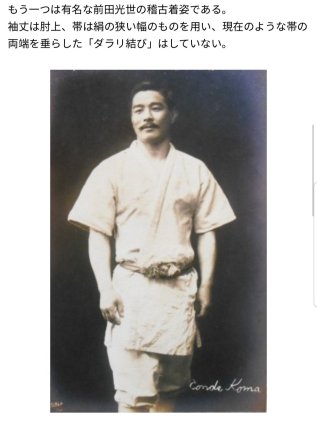
A pic of Maeda Mitsuyo. Although he is renown as a jūdōka (practitioner of jūdō), his training attire is reminiscent of the shorter sleeves and pants those who trained in jūjutsu would wear. Screenshot from International Suigetsujuku Bujutsu Association.

Jūjutsu became a well-established martial system from the Edo period onward due to the peaceful, yet regulated society everyone was living in. Despite the shift from battlefield confrontations, martial artists at the time still needed to rely on skills to defend against attacks in town, or to use for work. Jūjutsu of old is recognized for throwing and restraining techniques, but also utilized strikes and weapons. As a system that taught bearing a mindset for effectiveness in a fight, the training attire also reflected this.

Around the late 1800s, as a more competitive approach was taken in martial arts, a man by the name of Kanō Jigoro³ took a chance to transform jūjutsu in a way where it could be more accessible to many without the risk of serious injuries from the more combat-focus techniques, such as atemiwaza (当身技). Taking the nagewaza (投げ技), gatamewaza (固め技), and ashiwaza (足技) from various koryū jūjutsu he either studied or researched, Mr. Kanō developed a new approach for engaging in grappling in a more health-conscious & sports-centric fashion, which he called jūdō. Training attire also changed to cater to this new system, where the sleeves of the jacket was made longer, the pant legs reached lower, and the clothing was made baggy overall. As a sport, the larger uniforms encouraged more frequent attempts to grapple and apply techniques. Thus, jūdō is a martial art that is actively trained in by both men & women, and young & old.

LOOKING AT TRAINING ATTIRE

From what can be learned from antique koryū scrolls, jūjutsuka (柔術家, meaning those who train in jūjutsu) wore a short-sleeve jacket. An advantage of this was to avoid having your sleeves used against you, where it can be grabbed for control or get you thrown. Also, their hakama (袴, wide-leg pants) was at times shorter, where it reached slightly above the knees, or just generally slimmer. This allowed for less restriction in footwork. In other scrolls, robe-like attire with no pants may have also been worn during jūjutsu training. This has a look of what would’ve been worn indoors or during hot days.

2 pages from a book called “Jujutsu Kenbo Zukai Hiken” (柔術剣棒図解秘訣), where jūjutsu techniques are demonstrated by those wearing a much older style of training attire.

From these old pictures, you’ll notice that while these martial artists shared the same style of clothing, these were not quite fitting to the word “uniform”. Each jūjutsuka’s training attire was very much the same as common wear, boosting different designs and patterns. This does illustrate a sense of practicality, where one learns how to utilize their skills in the very type of clothing they’d be wearing in case a confrontation does arise.

Later in the years, this style of training attire standardized around the Meiji period. The jacket was similar as before, but was more of what is called a dōgi (道着, training uniform), where it was generally white and used primarily for martial arts training. As before, the jacket is “han-sode” (半袖, short-sleeve) style. Instead of a short hakama, a simple short pants called “han-zubon” (半ズボン), which is similar to what was worn under hakama, became part of this new uniform. Still the same mindset for jūjutsu was retained.

COMPARISON OF THEN & NOW

While it’s safe to say that jūjutsu was the forefather of jūdō, make no mistake that they’re not the same. Jūdō takes a different approach, from how techniques are performed to rules. To say it simply, the difference is generally stated as the following:

  • Jūjutsu = kata geiko (形稽古)
  • Jūdō = randori (乱取り)

Although this is a direct statement, it’s not so cut & dry. First, let’s look into the specifics between the two. when studying older martial systems that specialize in jūjutsu, kata geiko is used to learn the techniques, timing, and under what types of situations can a person perform what through kata (形, forms). Movements are generally specific, while grappling techniques applied (with strikes acceptable to assist) in a way to prevent an opponent from escaping or even taking ukemi (受身, breakfall). On the other hand, jūdō uses a great deal of randori to practice and learn techniques in a more active setting between 2 jūdōka (柔道家, a person who practices jūdō) who are frequently going for a clinch. This type of training is great for the adrenaline-fueled matches found in jūdō competition. In short, the training that takes place in randori is much more free form, while kata geiko puts emphasis on precision under structured scenarios.

A visual comparison between jūjutsu and jūdō. Notice the shorter sleeves and pant legs for the 2 jūjutsuka (left) compared to the longer versions for the 2 jūdōka (right). Left pic is a screenshot from International Suigetsujuku Bujutsu Association, while the left pic is from Wikipedia.

While it is true that jūjutsu does have a great dependency on kata geiko, this doesn’t mean that randori, or some form of free play, isn’t used as a training tool. This can also be said for jūdō, for there are kata used to teach, as well as to publicly demonstrate, how techniques are executed. The approach for both systems are different, but not so one-sided.

Another difference lies in the clothing. When engaging with a training partner in jūjutsu, areas to actually grapple are limit. Students are often limited to grabbing the collar and jacket of their partner, as there are no long sleeves. While the bare arms can be seized, it won’t be firm grip. In jūdō, not only are the long sleeves of their jackets available, but one can get a firm grip and stay latched on. Also, with wearing long pants, a student can attempt many types of throws that go to he ground due to the legs being completely covered. For those who practiced jūjutsu in the past, this is not the case, for greater care in execution had to be considered in order to avoid bruising one’s knees and exposed legs while wearing short pants.

CONCLUSION

Here ends a short look at training attire and how it may help influence the changes that take place in martial arts. While the connection between jūjutsu and judo was used to illustrate this point, many other Japanese martial systems have a similar history where evolving with the times was impacted from the need to conform with the change in clothing.


1) Jūjutsu is generally labeled a a “grappling system”, but it’s a little more than that. In essence, it’s a hand-to-hand martial system that utilizes grapples, strikes, and (small) weapons. Due to Japan’s history of engaging in activities where one displays their strength through a wrestling-like fashion, grapples do play a larger role in jūjutsu.

2) Jūdō is a modern adaption of jūjutsu, which takes a more philosophical approach, and focuses on the development of a healthy body and refining the spirit. Note that the word “jūdō” is not a modern term itself, as its use can be found in a much older document called “Nihon Shinbu no Den” (日本神武の伝).

3) The creation of jūdō is a credited to Kanō Jigoro (嘉納治五郎). After studying the jūjutsu of Tenshin Shinyō ryū (天神真楊流) and Kitō ryū (起倒流) during his youth, Jigoro researched various jūjutsu systems to understand how to devise a new system that could be beneficial to all. In 1882, he opened up his own training hall called “Kōdōkan” (講道館), and introduced his unique style called jūdō.

Phases of Martial Structuring: Bugei Yonmon

Continuing with the articles on Japan’s martial structuring process, we turn our attention to the one called “Bugei Yonmon” (武芸四門). Unlike the previous ones covered, this focuses on a specific number of skills vital for all warriors to cover. For this discussion, we’ll look into the history behind Bugei Yonmon, its significance in literature, and comparison to other similar listings. Sources used in writing this include (but not limited to) the following:

  • Zusetsu – Kobudoshi (図説・古武道)
  • Zukai Sengoku Gassen ga yoku wakaru Hon (図解戦国合戦がよくわかる本)

UNDERSTANDING THE BUGEI YONMON

Bugei Yonmon translates as “Four Specialties of Martial Arts”. As the name implies, there are four areas that are believed to be essential for any warrior to perform his duties. Realistically, there were more than just four areas of specialties that warriors learned, as well as was adept to. One could view this list as just pointing out the most important of those that truly displayed the strength, and measured the worth, of a warrior in order to step onto the battlefield.

The label Bugei Yonmon is said to have been 1st seen in the 23-volume war documentation of Kai Province (present-day Yamanashi Prefecture) called “Kōyō Gunkan” (甲陽軍鑑). In this, Bugei Yonmon refers to four specific skills¹, which are the following:

  • 馬 (uma) = Horse riding
  • 兵法 (hyōhō²) = military tactics & affairs
  • 弓 (yumi) = archery
  • 鉄砲 (Teppō) = gunnery
Pic of a section from Heihō Yukan, with “Yonkaku no Uchinarashi” highlighted

Kōyō Gunkan is a product of the military-centric activities that took place within the warlord Takeda Shingen’s territory during the later part of Sengoku period. Thus, this version of Bugei Yonmon reflects this. Another war documentation called “Kiyomasaki³” (清正記), which talks about a famous war commander by the name of Katō Kiyomasa, has a similar listing.

Is the idea of 4 specialties significant, and one that was a universal idea throughout Japan? It’s possible, but not much evidence revolving around the concept of four skills. The roots of this are also unknown. It is possible that there were other labels used to signify the same “four skills” idea, but that requires additional research to confirm. For example, from the document Heihō Yukan, there is the label “Yonkaku no Uchinarashi” (四格ノ内習), which means “4 Procedures of Preparations”. This document is also from the house of Takeda Shingen, just like the Kōyō Gunkan. Could it be that Yonkaku no Uchinarashi has the same meaning as Bugei Yonmon?

MORE THAN A NUMBER

Looking at the components of Bugei Yonmon, one can’t help but to think that it’s rather small. Truth is, there are sub categories to help flesh out the required skills. In the book “Zukai Sengoku Gassen ga yoku wakaru Hon”, a chart is provided that shows additional categories, which is provided below.

20200128_2336115924587974680936844.jpg
A chart of Bugei Yonmon derived from Kōyō Gunkan, consisting of the following: ① uma, ② hyōhō with katana and yari, ③ teppō, ④ yumi.

Under Hyōhō (#2 in the picture above) within the circle are 2 important components considered critical for conducting warfare during the late Sengoku period, which are the yari and the ken (written as katana in the pic)⁴:

  • YARI (槍, Spear): Considered the most dominating weapon on the battlefield due to its superior range, and impactful performance in group tactics
  • KEN (剣, Sword): Consisting of daisho (one long sword and short sword combinations, such as ōdachi and kodachi), yoroi dōshi, and other blades, swords were most effective close range for melee

There is another category in the picture to the far left that is occasionally associated to hyōhō , which is yawara, or labeled as jūjutsu (柔術) in the pic above.

  • Yawara (柔, Grappling): Despite considered a minor, was necessary for engaging with an opponent during yoroi kumiuchi (grappling while wearing armor).

There are several koryū bujutsu schools in Japan that express the use of yoroi kumiuchi, such as Kitō ryū (起倒流) and Takenouchi ryū (竹内流).

If the Bugei Yonmon is used as a basis while reviewing other military documentations, scrolls, and artworks that cover the activities during Sengoku period, one can see some connections to how it represents the military approach in Japan at that time. There are recorded tales and accounts (some more exaggerated than others) of individuals who demonstrated great use of each of these skills, like the yari by famous individuals such as Honda Tadakatsu and Hattori Hanzō, or the ken (aka swords) on the battlefield by war-harden survivors such as Ittō Ittōsai, Tsukahara Bokuden, and Yagyū Muneyoshi. Yumi and uma have always had a place in Japan’s history as they were utilized together a great deal, so there are no shortage of tales about exemplary works with these. Despite its use late during the warring times of Japan, teppō made a lasting impression, as it represents continuing modernization of warfare in Japan as demonstrated by the likes of Oda Nobunaga and his teppotai (鉄砲隊). Lastly, strategic approaches in conducting war by famous historical figures have always filled the pages of numerous literature, thus hyōhō has been a skill respected by many to the point that a good number of military manuals on strategies of war were compiled throughout the generations.

BASED ON THE TIMES

A section on Bugei Yonmon from “Zusetsu – Kobudōshi”

The idea of four specialty skills for warriors may not be as old as expected. There are different listings based on the era in question, but making these lists did come about after Sengoku period, and as early as Edo period.

One example of this is a version of Bugei Yonmon based off of the primary skills dotted on during 1100s, which was deciphered from entries in the war story called “Heike Monogatari” (平家物語). In “Zusetsu – Kobudōshi”, it is described as the following⁵:

  • Uma nori (馬乗り) = horseback riding
  • Kisha (騎射) = cavalry w/bow & arrow
  • Haya ashi (早足) = running
  • Chikara mochi (力持ち) = sumō

Another is early Sengoku period, once the Ashikaga shogunate was established and a more military-focused rule was set in motion to recruit more soldiers for armies around the late 1300s to early 1400s. This version of Bugei Yonmon slightly varies:

  • UMA (馬, horse) = Horseback riding was still prided on, and was utilized for flanking & disrupting groups, thus uma (horses) was a necessity. Along with this, new tactics such as wielding a yari while on horseback, was growing in popularity.
  • YUMI (弓, bow & arrow) = Although older methods of archery were losing value, newer methods were being implements, thus the long-range capabilities of the yumi was kept relevant⁶.
  • YARI (槍, spear) = As group tactics and mass number of soldiers became the focus of utilizing an army, the yari showed appealing results when used under such conditions, making this a weapon warlords dotted on.
  • KEN (剣, ken) = Ken was also important not only to assist spear bearers, but for skirmishes once enemies got past the long lengths of yari and visa versa.

There were also subcategories in relation to this period, which are the following:

  • Yawara (柔) = Grappling with an opponent. A necessary component when upclose upon the enemy, allowing a warrior to perform kumiuchi
  • Hō (砲) = Artillery, such as guns (i.e. pistols and rifles) and cannons fall under this label. Artillery was still in its infancy and its usage on the battlefield can be viewed as trial & error. Still, potential was seen in these, especially once the technology improved.
  • Hyōhō (兵法) = Military strategy also developed as the means of conducting war, as well as the weapons & equipment for war, changed and/or improved.

Although considered minor, if these three were placed in the same importance as the aforementioned four skills, then the required skills for warriors during the early Sengoku period would be seven, and can be rightfully called “Nana Gei” (七芸, Seven Skills).

CONCLUSION

Bugei Yonmon works as a list that highlights skills a Japanese warrior must learn. While it appears short and concise, this is to point out the most important of skills needed during the later part of Sengoku period. This concludes this discussion on how Bugei Yonmon shapes Japan’s military combat at one time. Stay tune for the next discussion on this series, which will be out soon.


1) The line in Kōyō Gunkan that states this said to be the following:

「武芸四門とは弓鉄砲兵法馬是れ四なり」とある。」

2) Can also be pronounced heihō as well

3) Title can also be read as “Seishōki”

4) Some analysis on this version of Bugei Yonmon view yari and ken as one respected category of their own, with yawara (jūjutsu) also treated as a valid category as well. In this case, this falls into a new list called “Roku Gei” (六芸, Six Skills).  This can also be pronounced as “Riku Gei” if based off of the original concept of 6 skills found in Chinese literature.

5) In Zusetsu – Kobudōshi, it is stated as the following:

「馬に乗り、はせ引き(ー馳せ弾き。騎射)、早足(ーランニング)、力持(ーすもう)など、ひとえに武芸をぞ稽古せられける」

Translated, it reads as follow:

“Martial skills that should be trained in extensively are horseback riding, equestrian archery, running, (sumō) wrestling, and the like.”

Note that while four areas of skills are mentioned, this statement hints that there are others that are worth mentioning as well.

6) The changes in Japanese archery was discussed in a previous 2-part post regarding Kyūsen no Michi here and here

Analyitcal Review of the Nakamaki & Nagamaki

A few years ago I wrote an article for the previous dojo I was in about a Japanese weapon called the nagamaki. This article was to help support the training theme for that year. Since then I continued to do research on it, which also went in the direction of learning more about the nodachi (the roots of the nagamaki), as well as the nakamaki (predecessor to the nagamaki). For my blog, I would like to share the progression of my research and focus this post on both the nakamaki and nagamaki.

BEGINS WITH NODACHI

Taking a brief look into Japanese history, the birth of the nagamaki was around the late Kamakura period (1185-1333) to early Muromachi period (1338–1573). With the Ashikaga clan in power, new methods of warfare were being implemented. Soldiers and warriors alike began to take pride in very long-bladed swords called nodachi (野太刀), or also known as ōdachi (大太刀). These swords had an appeal over the regular tachi due to their superior length and reach.While those with strong arms were able to wield these long swords, in the long run they proved difficult to utilize properly due the imbalance in weight distribution between the blade and handle. To rectify this, the swords went under different modifications. One route had their regular-sized handles replaced by longer handles, and from the sword guards up to the midpoint of the swordblade was leather or silk wrapped, which had these swords labeled as nakamaki (中巻).

Despite the improvements, such as added support of bearing the weight with one’s hand on the wrapping, the nakamaki did not fully meet the expectations desired. With considerations on a way that did not sacrifice efficient use, yet another design was put into motion. Taking these same long swords, their handles were replaced with even longer length handles, while leather or silk was wrapped around the middle of these long handles as added support. This change gave these particular swords the label nagamaki (長巻).

Illustrations of nodachi (top), nakamaki (middle), and nagamaki (bottom). From the book “Ketteihan Zusetsu – Nihonbuki Shūsei “(決定版図説・日本武器集成).

NAKAMAKI SPECIFICS

A long sword with a longer than normal tsuka (handle) with fabric wrapping from the middle of the blade down. Note that “nakamaki” is a shorthand name. The full name is said to be “nakamaki nodachi”, as these are still nodachi (or otherwise called ōdachi).

The wrappings around the blade for the nakamaki allowed a warrior to hold there for better balance. A means to make the nodachi/ōdachi more manageable, one would think that techniques for long swords would apply here. Fortunately, koryu bujutsu schools such as Koden Enshin ryu (古伝圓心流) and Jigen ryu (示現流) have demonstrated publicly their use of such long swords, which can easily be viewed online. Whereas in Enshin ryu the drawing of, as well as the manner for cutting with, the ōdachi is displayed, in Jigen ryu it is shown in simpler usages, such as enhancing the training of kenjutsu. There may be more to the nodachi/ōdachi for each of these schools, so we do have to keep an open-mind for more that is not shown.

As for the nakamaki, one example that is very informative comes from the Shunpukan dojo, which is a Shinkage ryu branch (新陰流) of the Kanbe line. This particular branch has kata for ōdachi. Surprisingly, the ōdachi also incorporates wrapping on the blade. This appears to be similar, if not the same, to a nakamaki.

With the wrapping around the blade, a warrior can safely manipulate a nakamaki as the weight is better distributed. Note that while this is a necessity here, it is not unusual to do the same even for a shorter length sword. In numerous kenjutsu and battō/iai styles, there are techniques such as where a practitioner places one hand (usually the left hand) on the back of their sword in order to assist in thrusting the sword forward like a yari (spear), or to block & push away an oncoming sword cut as if handling it like a bō. In fact, in some kenjutsu schools this method is called “kenbō” (剣棒).

NAGAMAKI SPECIFICS

A nagamaki is a long sword fitted with an extremely long tsuka, which has leather or silk wrapped around the center of the tsuka. Note that nagamaki is a shorthand name, for the full name of this is recorded as “nagamaki koshirae no nodachi”, and “nagamaki nodachi”. Much like the nakamaki, the nagamaki is categorized as a sword.

The handle of the nagamaki is the same as that for a normal katana, as it is designed in a similar fashion, only longer. There are cases of the handle being slightly curved (reminiscent of past battlefield swords’ curved handle) or straight. The te no uchi (or method of handling in English) for the nagamaki is said to be the same as that for the katana, where the right hand is on top and there is no switching from right to left like a bō. That being said, this doesn’t mean that the nagamaki doesn’t have any unique traits of its own; with the added handle length the nagamaki gains additional usages similar to polearms, such as larger sweeping motion similar to a naginata. This is key to remember.

A screen capture of tameshigiri demonstration with the nagamaki of Enryū (圓流). To see the full vid, click on the link here.

Koryu bujutsu schools that have techniques for the nagamaki are few. While it would make sense for nagamaki training to match that of kenjutsu, from my research and personal experience, it tends to parallel that of naginatajutsu. Why is this? There is an interesting relationship between the nagamaki and the naginata, which will be touched upon in the next paragraph.

NAGINATA OR NAGAMAKI?

The naginata (薙刀), Japan’s version of a glaive, was in use around the Heian period. This was distinguished as a polearm, or naga-e (長柄) in Japanese. There are quite some comparisons to the nagamaki. In reality they are not the same, yet it appears the line blurs due to how some koryu bujutsu schools retain their unique knowledge.

Pic of my nagamaki and naginata, for comparison.

By design, the difference between the 2 weapons are as follow:

NAGINATA

  • has a longer shaft, as a polearm
  • features a shorter blade
  • more defined curve in the blade, and is more wider
  • has a tachiuchi (metal wires wrapped under tsuba)
  • bottom end is an ishizuki (metal piece at the end of the shaft)

NAGAMAKI

  • has a long handle, as a sword
  • features a longer blade
  • blade has a slight curve and is slimmer
  • Definitions of the blade match that of a normal sword
  • handle is wrapped tsuka ito (sword handle wrap), along with wrappings around the center for support

Despite these obvious differences, koryu bujutsu schools seem to have not only adopt, but maintain the concept of training the nagamaki like a polearm.

For example, in an older document called “Heihōyōmu Budōzukai Hiketsu” (兵法要務武道図解秘訣), there is a section that has techniques for the nagamaki from Jiki Shinkage ryū (直心影流). However, from reading the descriptions the words “naginata” and “nagamaki” are interchanged a good number of times. Also the diagrams shown a weapon more closer to the naginata in design. Based on my opinion, it sounds as if nagamaki is another name for naginata…or they share the same techniques. In another example, Kukishinden ryū (九鬼神伝流) has techniques for the nagamaki, which I have studied. Design is similar to what one would expect, although the blade is also very wide and heavy, which dictates the use of its weight and gravity. Te no uchi is the same as with the katana, although the techniques are abit different from that found in kenjutsu and naginatajutsu.

The beginning of the section on nagamaki/naginata of Jiki Shinkage ryū.

Yet another example can be found on the website of “Tenshinden Jigen ryu Heiho” (天真伝自原流兵法). Along with this school’s descriptions on the weapons taught, there is a description regarding the nagamaki. Here’s the original Japanese text, followed by my translation in English.

———-

「長巻術は、一般的には知られていないようですが、戦国時代には、槍と同様に良く使用された武器術です。

柄の長さが三尺、刀身が三尺の構成で仕組みが作られており、非常に有効な武器であり、これも、薙刀と同一の技術で組み立てられています。」

“Although not commonly known, the nagamaki is a style of weapon well utilized similarly to how the yari was during the Sengoku period.”

The nagamaki is a very effective weapon, as it is designed with the dimensions of the tsuka (handle) being sanshaku (around 3 feet), and the blade length being sanshaku (around 3 feet). It is also systematized with techniques that are identical to those of the naginata.”

———-

Could this be the case of adopting the name nagamaki for naginata in later years? Or could it be that the nagamaki, or at least the concept of it, was further refined where it became a long blade on a shorter shaft, and developed from the techniques of the naginata? As the martial arts evolved in Japan especially from Edo period onward, this could very well be the case. From a perspective of practicality, the nagamaki of old (i.e. featuring a long handle) is similar to the naginata in terms of length and concept of design. With the added reach, one can logically utilize naginatajutsu with it.

Understanding this point, it is not difficult to see the similarities in these 2 weapons.

PERSONAL ANALYSIS

Studying the development of martial systems in Japanese history, along with how technical skills & formal structuring of martial schools came about, one can understand that there was a methodical approach to using the nakamaki and nagamaki, but not as systematically developed as other weapon systems. One reason being is there was not much time to do so with the civil unrest that lead to constant warring when they saw usage on the battlefield. On top of this, these two variants of long swords were both short lived as their worth on the battlefield could not match other weapons that outperformed them in the long run, such as the yari (spear), uchigatana (close-range battlefield sword), and teppo (guns & rifles).

As far as koryu bujutsu schools that have nodachi as part of their tradition, it appears that some possess specific techniques, while others may use it as a supplement to their normal kenjutsu training. Techniques for the nakamaki seem to be far & few, while the nagamaki has been retained yet modified in some schools, if not just conceptually.

ENDING

We’ve come to a close on this analytical discussion on the nakamaki and nagamaki. What is written is all based on my own research, training experience, and what I was told by certain instructors over the years. While it helps to give a somewhat clearer picture, I’ve learned that there are still varying opinions and viewpoints regarding this topic even in Japan, so nothing is quite written in stone.

Shitsuden: Present-day look at past martial systems ~ Part 1

There are many styles of Japanese martial systems that one can study today. From hand-to-hand systems, competition-driven systems like kendō and Atarashii Naginata (sports-centric “New-Style” Naginata), to classical systems, many study both in and outside Japan. Yet, with the variety that’s available, there is an even greater number of martial systems that are no longer available. While they are not physically present, traces of them exist in the form of handwritten scrolls, manuals, and licensing documents. A term for this in Japanese is “shitsuden” (失伝).

Today’s post will be the 1st of a 2-part discussion on shitsuden. This post will give an overview of what shitsuden means, as well as go over the prime causes of shitsuden in martial arts.

WHAT SHITSUDEN MEANS

The term shitsuden refers to traditions or systems that possess specific types of skills, talents, or knowledge of applicable use that have been discontinued and no longer in practice (whether partially or completely). While commonly used in regards to martial arts, it is not a term solely for this field. Japan has a history of people specializing is certain areas of occupations which feature technical skills that are deemed significant to pass down to the next generation. Examples of this, but not limited to, are chadō (茶道, tea ceremony), nō, (能, theatrical performance), gakki (楽器, music instruments), and chiryōhō (治療法, medical treatment).

Passing traditions down supports the value in them, as well as ensures their survival into the next generation. Certain families would keep these traditions within their family line to elevate their worth, while some traditions are shared and supported by large numbers of people or groups. Martial systems is an area that is especially vast with an unfathomable number of individuals and families taking part in it one way or the other. Due to this, there is a great number of martial systems that have ceased and are considered lost, some more longer than others. Present day Japanese martial arts schools tend to talk about lost styles or skills that are related them, which peaks many practitioners’ interest to the point they do research on shitsuden styles…including myself.

CAUSES OF SHITSUDEN

What classifies certain martial systems, whether specific parts of it or its entirety, to be classified as shitsuden? Below are the following cases, which will be analyzed in numerical order.

① Local style

② Loss in value of use

③ Lack of inheritance

④ Sudden death of head teachers

Note that these are not the only causes of shitsuden, but possibly the most common cases.

POINT #1

Local styles were quite common in ancient Japan. Before this country was unified, most of Japan was made up of territories, countries, and the like. These areas were usually governed by a land owner of some sorts. Considering the openness of bearing arms by warriors, having a form of martial training locally was a necessity. Unlike how martial arts is treated today, some areas may have had their own special system that fitted the needs for the locales to be able to defend themselves; even if the knowledge came from a large, reputable style like Chūjō ryū¹ or Yagyū Shinkage ryū², the knowledge may have been reorganized for personal purposes and renamed. In other cases, these local systems may have been restricted from being shown or taught to those from different territories. Systems like these are known as “otomeryū” (御留流).

20191031_091906

A portion of a printed scroll of “Shinshin ryu Iai” (真々流居合之巻き), a sword-drawing style once used by the warriors of Owari-han, Koka Prefecture. From “Watanabe Toshi-ke Monjo – Owari-han Kokamon Kankei Shiryō (渡辺俊経家文書-尾張藩甲賀者関係史料)

Due to being small, and possibly of no more use once the constant civil wars were ceased by the governance of the Tokugawa shogunate, local styles like these tend to come to an end. This is especially true for styles that were restricted from being taught to outsiders.

POINT #2

Maintaining value in combative arts differ depending of the time period. When Japan was divided, there was a need to be prepared to fight against invaders, or if needed to go to war. This urgency began to fade once Japan was unified and the people’s way of living changed. With the urgency to go into battle with neighboring territories turned to a thing of the past, training people for combat outside of the military became a minor occupation.

Several turning points played significant parts in affecting the waning need for martial systems. One of these was the unification of Japan in the early 1600s. Accomplishing this feat, Tokugawa Ieyasu, the 1st of the Tokugawa shogunate, wanted to ensure no more large-scale battles ever took place by prohibiting the use of battlefield weapons, as well as restricted the length of bladed. These restrictions affected those martial systems that possessed a curriculum for such purposes, causing them to abandon such weapons like naginata (薙刀, glaive)³ and yari (槍, spear), as well as putting away documented strategies for war like shirodori (城取 establishing a fort), jindori  (陣取, troop formations and positioning), and the likes.

Sections of kamajutsu (sickle techniques) from an old Takagi ryū Chūgokui Mokuroku. Only the names of the techniques are listed, but not how the actual techniques are performed. Thus, this skillset is lost. From “Takagi-ryu Chugokui Mokuroku” by Dr. Stephen Greenfield.


Another turning point took place after the end of the Tokugawa Bakufu in 1868. The lead up to this involved bloody conflicts in public spaces, and assassinations on political figures as different groups struggled either maintain the currently established rule of the Tokugawa family, or reign in a new governing system in the name of the Emperor. With the Tokugawa forces losing in the final conflict called Boshin war, the military-centric government ended along with the abolishment of the Samurai class. This opened the doors for a new way of life for everyone.

After the political turmoil, Japan continues to surge forward in becoming more modernized. Along with focusing on different trades & businesses, citizens took part in more productive hobbies, activities, and recreations. What they steered away from was martial arts, especially the traditional ones. During the final years of the Tokugawa Bakufu, many martial styles still trained with a focus of killing or maiming. The violence that erupted during the power struggle that eventually lead to the end of the Tokugawa rule left a bad taste for many, which caused them to steer away from martial arts even more. Traditional schools either had to adapt their systems to the change of times and make it less “violent”, or to take down their sign boards and move on to another profession. While some schools were able to keep value in their systems through the use of competition such as Hokushin Ittō ryū, for the many that couldn’t adapt let their martial system discontinue.

POINT #3

Inheritance and how it was conducted is an interesting topic. Throughout history, inheritance is important in order to keep one’s family line going. The same goes for martial arts styles. In the past, inheritance is usually given to the older child, usually a boy. If no child by blood was present, then possibly a relative. Adopting someone into one’s family for the sake of inheritance was also a practiced option, as well as allowing certain individuals who are not blood relatives to “inherit⁴” the family name.

While he spoke about ninjutsu as a topic in many books, Fujita Seiko claims that he did not pass down the specifics of his own style of ninjutsu to anyone. Left pic is a page from chapter “Ninjutsu no Hōhō” (忍術の方法, The Methods of Ninjutsu) from his book “Ninjutsu Hiroku” (忍術秘録).


Regarding martial systems, there are cases where there was no heir present, which caused those headmasters to take the secrets of their respected styles to their grave. Then there are those unique cases where a worthy heir could not be found; some headmasters could not find the required traits in those around them to inherit their martial system, even in their own children. A popular case is in Fujita Seiko, who was a person who made a name for himself for his wealth of knowledge in different areas of martial arts in the early-mid 1900s. Although he passed down to his students systems such as jōjutsu, shurikenjutsu, and kenpō, he publicly claimed that the secrets of his family-style ninjutsu would not be taught nor passed down to anyone.

POINT #4

The sudden death of those with knowledge of a martial system is always a big concern. When headmasters, or even senior teachers for that matter, die at a premature time before teaching every aspect of a martial system, this leads to lost information. This is especially true when certain areas of skills are held back because they are “reserved” for those students that have reached a certain level or considered worthy. While there is merit in reservation, this can backfire if those areas are kept to one individual for too long.

An example that comes to mind is Kanemaki ryū⁵ and its current curriculum. During WWII, many teachers are said to have been recruited to fight, and is also stated that many lost their lives in the war. Kanemaki ryū, a school that teaches battōjutsu, is said to have specialized in more areas regarding kenjutsu, such as kumitachi (組太刀, sword techniques done in paired forms). However, this is no longer the case because the successor during the time of WWII went to war and perished before passing down this knowledge. While this is stated in numerous Japanese sites, there is no official word from the current school of Kanemaki ryū. If this case is true, then it is a standing example of how invaluable information can be lost.

CONCLUSION

This ends our look at the term shitsuden means and how certain martial systems can be classified under this. In part 2, we will look at how lost or discontinued martial systems are are collected, analyzed, and in certain cases, recreated.


1) Chūjō ryū Heihō (中将流兵法), which is well known for its kenjutsu, is an example of a shitsuden (lost) style. For more on this, please visit an older post here.

2) Yagyū Shinkage ryū (柳生新陰流) is a martial system that specializes in kenjutsu. A branch of Shinkage ryū, this particular line is maintained by the Yagyū family today.

3) This is in reference to battlefield-style naginata, which were longer and much heavier than the ones used for protecting one’s home or castle.

4) In some instances, a family name was given for political reasons, or to boost certain families’ power and influences. Sometimes granting the use of a family name had a price on it, whether it be with money or a different form of payment.

5) Kanemaki ryū (鐘捲流) is once said to have kenjutsu based on the teachings of Chūjō ryū. This included proficient use of a short sword like a kodachi (小太刀). To understand how it may have been, please refer to an older post on Chūjō ryū here.

The Parallel use of Kōhaku (紅白)

In the Japanese language, there is a word called “kōhaku” (紅白)¹, which stands for the colors red and white. Historically², these two colors play a unique role. They can be used in pairs, or at opposite extremes in distinguishing groups. For example, the colors on Japan’s flag are represented by the colors red and white. Other familiar items include “kōhaku maku” (紅白幕, red & white curtain), kōhaku chōchin (紅白提灯, red & white paper lanterns), and other types of decorations used for celebrations. The two colors are also used for food and treats, such as “kōhaku mochi” (紅白餅, red & white rice cakes) and “kōhaku manjū” (紅白まんじゅう, red & white steamed buns with various filings), which are commonly used for ritualistic occasions. In activities and sports, two teams are created for the sake of competition; one team is called “akagumi” (紅組, red team) and the other “shirogumi” (白組), and each may carry a corresponding flag or handkerchief as to indicate which side each member is one.

Examples of how red & white are used in the following: Japanese flag (top-left), kōhaku manjū (top-right), kōhaku chōchin (bottom-left), kōhaku maku (bottom right)

Recently, I came across two words in an old Japanese document I am translating, each based on one of the two colors mentioned above. The document in question is related to warfare and swordsmanship in the past, and features a section that deals with what a warrior can do even when no weapon is in hand. Although used separately, in the context the two words appear in really signifies the parallel existence that kōhaku represents.

The first word is “sekishu” (赤手)³. Literal translation would be “red hand”, which is actually correct if we are talking about the color of someone’s hands. However, depending on the subject matter, the use of the color red has a different meaning. Here’s the dictionary definition from one of the resources I use for translations called “Kotobank“:


せき‐しゅ【赤手】

〘名〙 (「赤」はむき出しの意) 手に何も持たないこと。なんの武器もないこと。素手(すで)。空手(からて)。徒手(としゅ)

The above definition expresses that the manner in which red is used in this word is to mean “exposed” or “naked”. Together, sekishu stands for “bare hands”, or having no weapons in hand. It has the same meaning as other words of similar use, such as “sude” (素手), “karate” (空手), and “toshu” (徒手).

On a separate note, the word “hakushu” (white hand) doesn’t exist historically. Actually, there is the word “shirode” (白手) . It has no reference to fighting, but instead refers to a type of glaze used on porcelain.

The 2nd word from the document is “hakusen” (白戦). If translated literally it reads “white battle”, but this is not the correct meaning. Taking a look at the definition once more found on Kotobank:


はく‐せん【白戦】

 
〘名〙 手に何も持たないで戦うこと。

__________

Hakusen means “unarmed battle”, where no weapons are used to fight. The use of “haku” (white) is to express a plain, natural form, without the addition of anything else (in the form of weapons, those will add another flavor, or “color” so to speak). A similar word to this is “hakuheisen” (白兵戦), which also can refer to hand-to-hand combat⁴. As for an equivalent “akasen” or “sekisen” using the color red, none exists as far as I can tell from my research.


In conclusion, kōhaku has a strong cultural influence on words, actions, and events. Based on the context mentioned above, we see how red and white are used to mean literally the same thing through the two words sekishu and hakusen. These are great examples of the parallel use of the two colors that represent the word kōhaku. To this day, these colors are popularly used in special occasions in Japan year round, which can be experienced visually even in public events and festivals.


1) There are several ways of writing the word red. For kōhaku, the character “紅” is used. However, one of the more common ways of writing the word red is with the character “赤”. On top of this, there are different pronunciations for both red & white. Here’s what’s used in the article:

Red = aka, seki, ko

White = shiro, haku

2) There are several theories behind the origin of the word kōhaku. One theory is that the colors red and white were used to distinguish the warring armies as early as during the Genpei Gassen (源平合戦, 1180 – 1185). Another is that the word has even older roots, where the colors represent life (red, such as a new born baby) and death (white, such as the white garments worn by those who have passed away).

3) Can also be pronounced as “akade”

4) Actually, this is partially correct. The full meaning of “hakuheisen” is close-quarter combat, which primarily refers to the distance where warriors were close enough to use their pikes, swords, knives, and (if nothing else was available) fists or grappling techniques during Japan’s warring period in the mid century. The root of this is in the word “hakuhei” (白兵), which is a special terminology that refers to “unsheathed, bladed weapons” used for fighting, which became especially prevalent during 1500s. From Edo period onward, due to less dependency on large battlefield weapons and more development in martial techniques in civilian clothing, the use of hakuheisen adapted according to how fights were later conducted. Especially in the later years, hakuheisen was used to refer to numerous methods for close-range fighting, from bayonets to even CQC.

Hayashizaki Shigenobu: Pioneer of Sword-Drawing

For over half a year, we have been working on the basic skills and finer qualities of battōjutsu, as taught in Chikushin Martial & Cultural Training Group. Having a great interest in battōjutsu early in my martial arts career, I’ve personally been training in this based on different instructions received alongside with kenjutsu. For those curious, battōjutsu (抜刀術) is a systematic approach to drawing out a sheathed Japanese sword to cut, often labeled as “sword-drawing” and “draw-cutting”¹. Generally the techniques for sword-drawing are widely recognized by a more modern title, “iaidō²” (iai for short), although there are certain martial schools that still use the term battōjutsu (battō for short)³.

For today’s article, we’ll take a look into the origins of battō (iai), which is tied to Hayashizaki Jinsuke Shigenobu, the founder of this unique sword system. Sources used in writing this include (but not limited to) the following:


THE BEGINNING

The origins of battō/iai as we know it today takes place around the mid 1500s by a young man named Hayashizaki Jinsuke Minamoto Shigenobu (林崎甚助源重信). While many martial schools give credit to his extraordinary development of techniques for fast “draw-cutting”, the reasoning for him even creating such a sword style was under grim conditions. To understand this, we’ll look further into the family he was born into.

Pic of a statue of Hayashizaki Shigenobu, which is housed in Hayashizaki Iaijinja. From the book “Kanbon Nihon Bugei Shoden”.

While Shigenobu is widely known under the surname “Hayashizaki”, he was originally from the Asano family. He’s the son of Asano Kazuma Minamoto Shigeharu (浅野数馬源重治) and Sugano (菅野). Shigeharu, Shigenobu’s father, was once a guard acting as lead inspector of the northern section of the Imperial palace. From 1538 he was employed as an officer to serve Mogami Inaba-no-Kami Mitsuhide (最上因幡守満英), who was the 6th lord of Tateoka castle in Dewa Country (present day Murayama City, Yamagata Prefecture). Sugano⁴, Shigenobu’s mother, was from the Takagi family of Tateoka, Dewa Country. Shigeharu and Sugano would get married in 1540, and later have Shigenobu in Tateoka in 1542. Upon his birth, Shigenobu was given the name “Tamijimaru” (民治丸).

In the Asano family, their ancestral deity⁵ was “Kumano Myōjin” (熊野明神), whom they prayed to. Kumano Myōjin (also referred to as “Hayashizaki Myōjin” in some sources) was housed in a 3-room shrine within “Arayato no Ji” (荒宿の地), an area located in the northeast section of Hayashizaki grounds of Ōkura forest (present day Hayashizaki, Murayama City, Yamagata Prefecture). Shigeharu continued with these customs and paid his respects with his family when they had the chance to visit Kumano Myōjin shrine.


REASON FOR VENGEANCE

Sometime in 1547, Asano Shigeharu went to go play a game of Go⁶ with a priest at the Kumano Myōjin shrine. After spending his day doing so, he was returning home late in the night. On his way home, Shigeharu was targeted by a warrior named Sakaichi Unsai (坂一雲斎)⁷, who apparently harbored ill intentions against him. Using the night as a cover, Unsai ambushed Shigeharu and murders him. Later Shigeharu’s death is notified to his family members, as well as the identity of the murderer. Fueled with anguish, Sugano and her son plotted to get revenge against Sakaichi Unsai.

Shigenobu and his mother would remain in Tateoka, where he began receiving training in kenjutsu at the age of 8 from Higashine Keibu Tayu (東根刑部太夫)⁸, who was a warrior of Tateoka castle. In 1554, Shigenobu, at the age of 13, would periodically stay at Kumano Myōjin shrine to pray not only for protection and success in extracting vengeance to his family’s ancestral deity, but to receive further instructions to perfect his use with the sword. Armed with his late father’s family sword called Nobukuni (信國), he trained in the methods of kenjutsu, and worked hard in developing a style that would prove effective against his target. Instead of just merely practicing how to swing a sword in a duel-like fashion, Shigenobu focused on techniques that evolved around drawing the sword out of its sheath to deliver unpredictable cuts. The family sword he trained with was a rather long one, measuring to 3 shaku 2 sun⁹. Possibly made for use on the battlefield, this sword gave him exceptional reach. To effectively use it for fast-draw cutting purposes, especially against someone who used a shorter sword, Shigenobu would need to develop methods for drawing this long sword out with speed.


BIRTH OF BATTŌJUTSU AND HAYASHIZAKI SHIGENOBU

It is said that in 1556, Shigenobu underwent a special ritual called “Hyakunichi no Sanrō¹⁰”, where he spent 100 days at the shrine devoting himself to prayer for guidance in perfecting his ability in battō. Sometime during the evening of the 100th day, Shigenobu witnessed a divine vision. While sleeping, he was visited by Kumano Myōjin in his dreams, who demonstrated to him a secret technique called “Manji Nuki¹¹”. In learning this, Shigenobu became enlightened to the inner secrets of sword-drawing. With this revelation, he decided to call his sword system “Shinmyō Hijutsu no Junsui Battō¹²”, and set off to train further to a master-like level with the sword.

An insert from ”Jinrin Kinmō Zui, vol. #7″ (人倫訓蒙図彙7巻) from year 1690. Entitled “Iai Torite” (いあいとりて), it depicts a swordsman using methods of iai (sword-drawing method) to defeat 2 opponents. From Wikipedia.

Reaching the age of 18 in 1559, Shigenobu changed his name from “Asano Tamijimaru” to “Hayashizaki Jinsuke Minamoto Shigenobu”¹³. This was to identify his growth, as well as paying homage to the grounds where he was nurtured into a swordsman, Hayashizaki. In recognition of this growth, his sword system today is respectively called “Hayashizaki Musō ryū¹⁴”,  as this title reflects how he was divinely enlightened in the secret methods of battō.

Assuming his new name and role as a swordsman, Shigenobu set out to fulfill his family’s desire for revenge on his father’s murderer, Sakaichi Unsai. This doesn’t happen overnight, however, as time was needed to possibly track down his target. This finally becomes a reality, for in 1561 Shigenobu was able to locate Sakaichi Unsai at his home in the capitol city Kyō (present day Kyōto, Japan). Details of the confrontation varies depending on the source which tells it, so no concrete info on how it transpired. What all sources agree on is that Shigenobu was able to cut down Sakaichi and successfully extract revenge. With his mission completed, he then returned back to his hometown, and paid his respects at Kumano Myōjin shrine. He also offered the Nobukuni sword to the shrine.


SPREADING THE KNOWLEDGE OF SWORD-DRAWING

Upon returning home, Shigenobu was caring for his sick mother. However, a year after successfully carrying out revenge, Shiguno passed away in 1562. With no other responsibilities at hand, Shigenobu left Hayashizaki to travel around Japan and further refine his martial skills. He crossed into a few areas well known for their martial combat. For example, it is said that in 1563 he went to Kashima and received tutelage from Tsukahara Bokuden¹⁵ (塚原卜傳), founder of Kashima Shintō ryū¹⁶. Shigenobu was able to learn the secret method of Kashima Shintō ryū’s highest technique, called “Ichi no Tachi¹⁷”. It is also mentioned that he studied Tenshin Shoden Katori Shintō ryū¹⁸. Outside of kenjutsu training, Shigenobu studied “Onmyō Kaigō¹⁹ during his stay at Ichi-no-Miya (present day Omiya)²⁰ in Owari Country (present day Aichi Prefecture). The philosophy from Onmyō Kaigō was also incorporated into his sword-drawing style.

Outside of his own personal kenjutsu training, Shigenobu took the role of instructor for his own sword system. For example, in 1563 he resided in Yonezawa, Aizu (Fukushima Prefecture) for some time. During this, he was actively instructing his style of battōjutsu to those in Akai Village, Wakamatsu (Fukushima Prefecture). During the course of his journey Shigenobu gained other students. Notable names that developed their own sword drawing style based on Shigenobu’s teaching include the following:

  • Tōshimo Tsuke-no-Kami Motoharu²¹ (founder of Shinmei Musō Tō ryū²²)
  • Tamiya Heibē Shigemasa²³ (founder of Tamiya ryū²⁴)
  • Katayama Hōki-no-Kami Hisayasu²⁵ (founder of Hōki ryū²⁶)
  • Takamatsu Kanbē Nobukatsu²⁷ (founder of Ichi-no-Miya ryū²⁸)


A pic of Hayashizaki Iaijinja. From Wikipedia.

In his later years, Shigenobu stayed for about a year in the residence of his student, Takamatsu Kanbē Nobukatsu in Kawagoe, Bushū (present day Kawagoe City, Saitama Prefecture). In 1617, he received permission to leave on a short trip to Ōu (north-eastern section of Japan). However, during the same year he later became very ill in the middle of his travel, and passed away. Although he passed in an untimely manner, his name and his system of sword-drawing lives on. In recognition to his life, the Kumano Myōjin shrine was renamed to “Iaijinja” (居合神社).


ENDING

This concludes the history of Hayashizaki Shigenobu, and how he developed the martial system of sword-drawing. I hope this was a good and informative read for everyone.


1) Other older names used for the system of draw-cutting includes “saya no uchi” (鞘の内), “iai” (different from the modern naming convention, these are written as either 居相 or 坐合), “bakken” (抜剣), and “nukiawase” (抜合).

2) 居合道. Iaidō is the modern, non-violent approach to sword-drawing, which stems from the older version “iaijutsu” (居合術).

3) There have been many debates regarding the differences between the names “battō” and “iai”. Some points made range from one specializing only in seated forms to one incorporating practices such as test cutting. The truth is, there are no real differences, for they both mean the same thing.

The use of either battō or iai throughout history lies on certain factors. One example falls on which naming convention was popular at given time. Another, depended on current headmaster of specific school and what principles & philosophies that were intended to be expressed. We also have to keep in mind that as Japan moved more to periods of less wars and conflicts, some surviving schools changed their curriculum from being combat-oriented to self-development. Iaidō is a prime example of this.

All in all, while the various sword-drawing styles of today may focus on specializing in certain traits, the underlining meaning between the words battō and iai are the same.

4) Sugano is unusual as a given name. On top of this, she is also associated with another name that is written as “志我井”. This could possibly be her given name, but pronunciation is obscure.

5) Known as “soshin” (祖神)

6) 碁. Go is a Japanese board game where players try to dominate the territory of their opponent.

7) Some sources also indicate that he was known by the name “Sakagami Shūzen” (坂上主膳).

8) “Tayu” is not his given name, as it indicates his position or rank. Why is his given name not revealed is unknown.

9) 3 shaku 2 sun = 96.96 cm or 38.2 in.

10) 百日参籠

11) 卍抜. Another way it is written is “Manjiken” (万字剣).

12) 神妙秘術の純粋抜刀

13) This is done in a ceremony when a boy reaches his coming of age, which is called Genpuku (元服).

14) 林崎夢想流. Also known as “Shin Musō Hayashizaki ryū” (神夢想林崎流). Take note that Hayashizaki Shigenobu himself did not name his sword system this, but later generations did in remembrance of his contribution.

15) There is an article about Tsukahara Bokuden, which can be read here.

16) In Japanese sources, this is mentioned in a vague manner, as it is stated alongside with Shigenobu’s travel to Kashima to study under Tsukahara Bokuden. Under who and exactly where he studied Katori Shintō ryū is not made clear. While historically Bokuden learned Katori Shintō ryū at a young age, as an adult he started his own martial system.

17) The full title of what Shigenobu is said to have been taught is “Kashima Shintō ryū Saikō Hiden Tenka Dai Ichi no Ken” (鹿島新当流最高秘伝天下第一之剣).

18) 鹿島新当流

19) 陰陽開合. While the exact details are not described, this is related to rhythmic exercises, which is found in specific martial systems such as Taikyokuken (太極拳).

20) Old name is 一宮, new name is 大宮

21) 東下野守元治

22) 神明夢想東流

23) 田宮平兵衛重正

24) 田宮流

25) 片山伯耆守久安

26) 伯耆流

27) 高松勘兵衛信勝

28) 一宮流

Phases of Martial Structuring: Kyūsen no Michi ~ Part 2

This is part 2 of the discussion on Kyūsen no Michi. Here, we narrow our focus more on the components that defined how this militaristic system worked to craft those into warriors according to how battles were engaged and played out. Whereas the usage of the word “kyūsen”, along with militaristic history of Japanese archery was covered in part 1, for part 2 we will go over the known different groups & styles of archery, as well as a few recognized innovators concerning the bow & arrow. This discussion will also include some categorizing within the world of kyūsen, along with some comparing and contrasting, will be in order.

A good number of handy sources were used for this discussion, including the following:

Take note that part 2 became much bigger than intended in order to give a proper insight of Japan’s archery. Despite it’s size, it does not give a 100% definitive overview, as there are some information not added, lest it grows into something on the level of a research paper. Still, part 2 should provide enough insight on how significant and respected Kyūsen no Michi was to the point that many warriors invested their lives into it.

KORYŪ VS SHINRYŪ

In order to properly cover the specifics that make up Kyūsen no Michi, it is important to know that, on a technical and cultural level in relations to combat purposes, there are two types of archery (kyūjutsu in Japanese). The first is called Koryū kyūjutsu (古流弓術, Old-style archery), while the second is called Shinryū kyūjutsu (新流弓術, New-style archery). The categorization of these are both based on time period, equipment, and technique:

  • Koryū – Ancient times, with notable structuring from Heian period until early 1400s period
  • Shinryū – Around late 1400s onward until the abolishment of the warrior class in late 1800s

MANY SCHOOLS OF ARCHERY

Due to how integral kyūjutsu was in a warrior’s career, many groups specialized in it. Some groups preserved the lessons on archery as their own family styles, while others would learn that particular style and represent it usually indicating that they are a branch of it. Below are lists of some of the well known archery styles throughout Japan’s history, along with the founder and the time they were alive.

The first one is for those that fall under the Koryū kyūjutsu category:

Kyusen List01

The next list shows the styles that fall under the Shinryū category:

Kyusen List02

Along with this, are the different branches related to Heki ryū:

Kyusen List03

While the records pertaining to archery found in manuals & documents list these mentioned above and many more, take note that a lot of them are no longer in existance. The styles that are still active include Ogasawara ryū, Honda ryū, Takeda ryū, and Heki ryū Insai ha.

DIFFERENCE BETWEEN OLD & NEW

Here are some general descriptions between Koryū kyūjutsu and Shinryū kyūjutsu. Note that this is more in reference to how they were conducted before the warrior class was abolished as a whole.

A listing of archers of Taishi ryū, by rank. From Kanbon Nihon Bugei Shoden.

Koryū Kyūjutsu

  • Generally categorized as reisha (礼射), or “ceremonial-centric archery”, due to the emphasis on etiquette, customary practices, and focus on displaying shooting prowess.
  • During battles, archery was primarily use, both from long range to close range
  • Off the battlefield, archers demonstrated great focus and control while shooting targets at various distances.
  • Engaged in outing activities requiring feats of shooting while on horseback, such as hunting, and special target courses classified under Kisha Mitsumono (騎射三物)
  • Unison between rider and horse, called “jinba ittai” (人馬一体) in Japanese, was important
  • Considered a developing practice since ancient times, ceremonial practices within archery slowed abit due to power struggles from Heian period to early Muromachi period, as archers in battle was of necessary use
  • Once the ways of Koryū kyūjutsu was seen non-viable in combat during Muromachi period (around start of 1400s), it was revitalized and preserved in Ogasawara ryu through restructuring.

NOTES

  • Despite being considered reisha due to its high focus in shooting ability and ritualistic customs, Koryū kyūjutsu had fighting elements and was indeed acceptable training for combat
  • While much of the skillset emphasized on shooting from horseback, archers did also practice shooting while on foot
  • On foot, the bow was held at an angle when shooting arrows.
  • Although some existing styles such as Ogasawara ryū Reihō (小笠原流礼法) practice solely reisha, few groups such as Bushido Shinkōkai and Dai Nihon Kyūbakai preserve the fighting element of Koryū kyūjutsu not only with the bow & arrow, but with the tachi and naginata.

Shinryū kyūjutsu

  • Generally labeled as busha (武射), or “military-centric archery”, as this was designed specifically for use on the battlefield according to the new direction wars were approached.
  • Developed during Muromachi period between mid to late 1400s, when the tactics of war switched to large infantry, formations, and close range skirmishes
  • For the sake of combat efficiency, archers primarily performed on foot, but also had knowledge on how to shoot while on horseback
  • Archers were trained to coordinate together using group tactics
  • Trained to work under all types of conditions, including wet/bad weather, at night, on a boat, in a tower, and when the need to switch to close range fighting arised
  • Used barricades, such as tate (楯), as defense against long range attacks, as well as fenced areas as protection against flankers/disrupters
  • Contested with firearms (i.e. rifles, cannons) from mid-ending 1500s.
  • From Edo period (1603~1868) onward, once firearms took precedence in how wars were conducted, groups such as the Shimazu clan retained the effectiveness of archery by studying & incorporating rifle formations.

NOTES

  • Shinryū kyūjutsu isn’t completely unique and different. It was built off of koryū kyūjutsu, inherited certain aspects, then redefined specifically for combat purposes, thus why it’s called “the new style of archery”
  • Yoshida Shigeharu (吉田重春) is credited for implementing customary practices to Heki ryū starting in the mid 1600s. However, as it is not the same as reisha of Ogasawara ryū, Heki ryū’s is called taihai (体拝).
  • Today, existing Shinryū kyūjutsu styles such as Heki ryū retain busha, as well as practice taihai.

DIFFERENCES IN TECHNIQUES/EQUIPMENT

Here’s a short comparison between Koryū kyūjutsu and Shinryū kyūjutsu.

A mokuroku (list of techniques) of Ban Dōsetsu ryū kyūjutsu. Fron Kanbon Nihon Bugei Shoden.

Koryū kyūjutsu

  • Archers used larger bows, such as fusedakeyumi (伏竹弓, made out of wood and bamboo) and marukiyumi (丸木弓, curved wooden bow)
  • During the Heian period, wore large box-like armor called ōyoroi for added protection
  • Smaller draw due to technical issues such as mobility limitations while on horseback, large kabuto (helmet), etc.
  • Archery done by cavalry was called kisha (騎射)
  • Closing the range while on horseback increase accuracy to vulnerable areas
  • Wore tomo (lefthand glove) to prevent string from injuring hand on return
  • Carried tachi on left side

Shinryū kyūjutsu

  • Used smaller bows
  • Archery done while walking was called hosha (歩射)
  • From the Muromachi period onward, archers wore revised, slim fitting armor, which allowed less restrictions in drawing skills and mobility while on foot
  • Used larger draw and other techniques to increase an arrow’s power and penetration capabilities (i.e. allowing the bow to turn ccw in the hand)
  • Carried uchigatana (slightly shorter battlefield sword for upclose fighting) and unique equipment to adapt to certain situations, such as uchine (打根), spear point on top of bow, etc.

DISTINGUISHED INDIVIDUALS

Below are a few renown archers that are pioneers in Japan’s history of archery.

Ogasawara Sadamune / 小笠原貞宗

Picture of Ogasawara Sadamune. From Shūko Jisshu (集古十種). From Wikipedia.


  • Born in 1292, Sadamune was a warrior from Matsuo, Shinano Province (present day Ida City, Nagano Prefecture)
  • As a member of the established Ogasawara clan, he worked for the Kamakura Bakufu through Hōjō Sadatoki
  • Made a name for himself in Heian Kyō (Imperial capital, present day Kyōto) during the early-mid 1300s, as he participated in many battles such as the campaigns against the Mongol invasions, assault on Emperor Go-Daigo, the attack on Kusunoki Masanari’s Akasaka castle, and the battle of Kamakura
  • Sadamune earned merits for his efforts, was named “Shinano Shuei” (信濃守衛, Protector of Shinano), and established his residence in Shinshū prefecture.
  • Known for his involvement in zen, and was a worshiper of Marishiten, the “God of War” (武の神, Bu no Kami)
  • Sadamune created “Ogasawara ryu Reihō”, which features the rituals, etiquette, and customs practiced by high-ranking warrior families
  • Ogasawara ryū Reihō contains reisha, the preservation of Koryū kyūjutsu, which includes ceremonial practices, expert level with the bow & arrow, and feats of archery while on horseback
  • Sadamune established the principles of “sha – go – rei” (射・御・礼), which are the standard for reisha
  • His contributions inspired others to learn and add this to further their worth as warriors

Heki Danjo Masatsugu / 日置弾正正次

A picture of Heki Danjo Masatsugu. from the collection of the Toda household of the Bishu-Chikurin branch. From Wikipedia.


  • Birthdate is uncertain, although some sources say around 1444
  • Believed to have been born in either Yamato Province (present day Nara Prefecture) or Iga (present day Mie Prefecture)
  • Originally studied Henmi ryū, Masatsugu participated in many battles in the northern parts of Japan, such as Ōnin War (1467~1477)
  • While serving as a warrior, Masatsugu had opportunities on the field to utilize the bow & arrow according to how it would prove useful
  • Main focus on the redivision of archery was on militaristic usage, both in and outside of the battlefield.
  • Established the principles of “kan – chū – kyū” (貫・中・久¹) as the highest level of Heki ryū kyūjutsu
  • After a life of battles, Masatsugu traveled around Japan to test his methods. It is from this time he meets Yoshida Shigekata.
  • After choosing his successor (Yoshida Shigekata), Masatsugu retired by living in one of the temples within the mountainous region called Kōyasan located in Kishu (present day Wakayama Prefecture)
  • Some of the titles he used includes “Rurikōbō” (瑠璃光坊) “Dōi” (道以) , and “Itoku” (威徳)
  • Masatsugu is known as the “pioneer who revitalized the archery of Japan”, as he brought attention to the new ways the bow & arrow could be used in battle during a time where many viewed them as obsolete.
  • Despite his fame through the effectiveness of Heki ryū, much mysteries surround his existence, to the point where some researchers speculate that Masatsugu could be a fabrication

Yoshida Shigekata / 吉田重賢

  • Born 1463, Shigekata came from Gamō County, Ōmi Province (present day Ryūō Town, Gamō County, Shiga Prefecture)
  • Was a retainer of Rokkaku Sazaki in Ōmi Province (present day Shiga prefecture)
  • Shigekata was a skilled archer, studied different archery styles such as Ogasawara ryū, Takeda ryū, and Henmi ryū
  • When Heki Danjō Masatsugu came to visit the Rokkaku clan, he encountered Shigekata and tested him on his archery abilities. Yoshida was able to pass the test, which from there Masatsugu instructed him on the highest levels of Heki ryu before passing successorship to him.
  • Discerned the effectiveness of Heki ryū according to the times by organizing the lessons
  • Shigekata is recognized for passing down the teachings of Heki ryū to others through his family style “Heki Yoshida ryū”, which held the highest teachings of this style of archery.
  • Not much info on him, despite his legitimate family line
  • Due to the lack of info, some researchers speculate if he and Heki Danjō Masatsugu were the same person

CONCLUSION

We’ve come to the conclusion of Kyūsen no Michi. This is just a small sample of the large amount of information found in Japan’s archery history, especially when dealing with the technical side of things. Stay tuned, as we will move on to a different phase pertaining to how Japan’s methodology to combat changed and developed.


1) There is another version, which is “hi – chū – kan” (飛・貫・中). They are not 100% the same. Here’s a quick explanation.

  • kan – chū – kyū = Penetrate the target, always hit the target, and last long enough to keep doing the first two points
  • hi – chū – kan = Shoot from long range to hit the target, always hit the target, and penetrate the target

They are both associated with Heki ryū. The difference may be between the different branches and the methodology that was passed down in each one.

On another note, there are other modernized 3-point principles, but they pertain to kyūdo and are geared more towards one’s shooting form.

Phases of Martial Structuring: Kyūsen no Michi ~ Part 1

The next martial system that influenced how the bushi fought is called “Kyūsen no Michi” (弓箭の道), which translates as “the path of the bow & arrow”. An older term that comes from China, there is very little differences, if any, from Kyūba no Michi (弓馬の道). Much of the practice of archery as a system for military purposes has been covered in a previous post part of this series. Due to the role the bow & arrow played in Japanese history, the topic of Kyūsen no Michi will be divided into 2 parts. For the first part, to avoid restating similar info from before, I will go over the existence of the term in various documents, as well as a brief summary of the use of archery in Japan during warring times based on certain criteria.

DOCUMENTATION

The word kyūsen, which can also be pronounced as “kyūshi” or “yumiya¹”, is but one of the preceding labels that identify the use of the bow and arrows for war purposes. The term may have been 1st adopted sometime after the 9th century, with one of the influences possibly being a song found in “Heishakō²”, which is a collection of war-related songs composed by a renown Tang Dynasty poet named To Ho³. Although short, the stanza goes as the following:

“行人弓箭各在腰”

This line translates as the following below:

“The warrior departing for war carries a bow and arrows at his side”

Artwork called “Ujigawa” (宇治川), which depicts two warriors riding into the Uji River with bow in hand, rushing towards an ongoing battle. Artist is Haishi Kōji. From the book “Jōyō Kokugo Benran” (常用国語便覧).

As much of the culture from China was being brought over to Japan, many aristocrats would share contents such as Chinese poetry and literature, and adopt what was written into their lifestyles. The warrior class would do the same, as they adopted many things related to the bow, from methods on how to make a bow from specific materials, to adding ceremonial customs that would treat archery almost like a religious practice.

The word “kyūsen” would appear later in Japanese works, such as Heiji Monogatari (平治物語), Heike Monogatari (平家物語), Taiheiki (太平記), and Azuma Kagami (吾妻鏡). In the way it’s used, kyūsen depicts someone who’s a warrior, or those who were disciplined for military activities. It is expressed that for one to be accepted as a bushi (武士, warrior) or trained in bugei (武芸, martial skills), learning how to use the bow & arrow was an important part of it.

EARLY HISTORY

We learn that the bow & arrow was placed in the center of the warrior culture from written accounts of warfare from the 12th century onward. With bows in hand while on horseback, warriors were ready to let their arrows fly as depicted in events such as the attacks in Kyōto during Heiji no Ran (1159-1160), disputes between the Taira and Minamoto clans during the Genpei Gassen (1180-1185), and the continual unrest due to the establishment of militaristic governance throughout the Kamakura period (1185-1333).

Pic of part a of picture scroll where warriors using bow & arrow are attacking residence of the burning Sanjō Palace. From “Heiji Monogatari Emaki” (平治物語絵巻).

For combat, common tactics with the bow & arrow included ya-awase (矢合わせ, raining arrows) at the commencing of a battle, and kibamusha (騎馬武者, mounted warriors) using the bow while closing the distance. Despite acting as an army, infantry and elite soldiers engaged with the enemy in 1-on-1 skirmishes predominantly. Outside of combat, warriors spent their time using the bow & arrow in pasttime activities known as “Kisha Mitsumono” (騎射三物). This included equestrian recreations where one displays their skills in shooting. Hunting was also an activity warriors spent their time doing, usually in groups.

Since the Japanese spent centuries battling one another due to internal strife and a struggle for power, their tactics were, for the most part, universal amongst the many warrior families and armies commanded by feudal lords. This would change, however, once their country was in danger to an outside threat.

MONGOL INVASION

In the 13th century, Kublai Khan declared himself not only emperor of Mongolia, but acquired sovereign power in China and made Korea submit as a vassal state. In the mid 1200s, he would then turn his sights on Japan and threatened them to submit under his control and order several times. Despite advise from the Imperial court, the current shogunate at that time (primarily controlled by the Hojo clan) refused. After making preparations, Kublai would set out troops from both Mongolia, China, and Korea, and put forth the 1st Mongol Invasion on Japan in 1274⁴. As the first real foreign threat, almost all feudal lords and warrior families combined their efforts to fight for their country instead of for personal gain against one another. They did their best to prepare their forces and head to the northern border of Kyūshū, which is where the Mongolian forces used to embark on Japan.

The immediate warriors gathered at the northern border of Kyūshū, and prepared to deal with the invaders with no mercy. They implemented ambush tactics, barricades and the like. As the Mongol force landed, they put up a valiant fight, but most in the end were decimated by the sheer number of the invaders. Records of this event describe some of the unpredictable tactics from the invaders as they made their way down towards central Japan, which included advancing and retreating tactics by archers, and multiple attackers against single opponents. The Mongol force also utilized weaponry far advanced, such as smaller bows that had a heavier draw, poisoned and fire-rocket arrows, explosives, and swords with more curvature. The leather armor that the Mongol invaders wore also gave them favorable defense against the Japanese weapons such as the tachi; although long, the blade of the tachi was thin, with accounts stating that they broke after becoming snagged in the leather armor. As for the bow & arrow hailed favorably by the Japanese warriors, it did not fair so well either; its initial purpose of shooting down single opponents proved difficult against enemies who would retreat out of its effective range, or close the gap in groups. Such unforeseeable tactics brought much fatalities within the Japanese warriors’ ranks, especially in the earlier battles.

Section of the artwork depicting invaders from the Mongol army fighting against Japanese warriors. Here, a kibamusha (cavalry warrior) is slain. From “Mōko Shūrai Gassen Emaki” (蒙古襲来合戦絵巻)

In the end, the Japanese warriors were able to win through certain factors, such as disorganization amongst the Mongol army, keen understanding of the geography, the fortunate natural occurrence of high winds that sank many of the invaders ships at night, alongside with night raids on any surviving ships. Defeated, Kublai Khan would wait several years before attempting another invasion in 1281, only to face similar results due to ill-prepared sea vessels against turbulent winds on the sea. Despite their overall victory, the Japanese discovered that there were flaws in their current arms & tactics, especially those that heavily depended on fighting on horseback and using the bow & arrow. In order to compete with the outside world, they had to adopt new weaponry, and improve on their tactics.

NEW TACTICS

Although starting after the 1st phase of the Mongol Invasion, military groups and specialists put great effort in redefining their approach to warfare once the threat of Kublai Khan was over, especially during the later years of the Kamakura period. For starters, greater emphasis was placed on larger numbers of troops. In order to utilize troops better, battle formations were also incorporated, which divided them into groups and serving specific purposes. With a larger army, swarming & rushing upon the enemy became the prime objective, which had troops focus more on using close-range weapons, such as the uchigatana, nagamaki, and the yari.

While the skill level and etiquette associated with the bow & arrow were retained for high-class warriors, it saw less use than normal as they did not fit in well with the new tactics for battle. On top of this, armor was modestly improved with added defense against arrows. Instead, the yari was given precedence in overall use and versatility⁵, as seen in the increase of group tactics of spearsmen. The yari was also used by cavalry, which was specialized on and made popular by certain feudal lords such as Takeda Shingen in the mid 1500s. While raining arrows was still a valuable strategy, archers would stay back, hidden behind cover or surrounded by fences.

Woodblock painting called “Samurai Archer”. Dated 1899. Artist is Mizuno Toshikata (水野年方). From ukiyo-e.org.

At certain points did the bow & arrow see improvements. For example, in the late 15th century, new tactics incorporating groups of archers shooting while walking was being incorporated into the battlefield. Credited to Heki Danjō Masatsugu⁶, this allowed specially trained archers to advance and give addition cover to fellow troops, as well as to better assist with retreating tactics. In the mid 16th century, some armies would have archers work side by side with gunners, and incorporate long range tactics to both deal damage while dealing with flankers. On top of this, the use of fire arrows by archers, which was learnt from the tactics by the Mongol and Korean soldiers during the aforementioned Mongol Invasion, became commonplace, especially by those who commanded navy fleets such as the Murakami clan.

All in all, use of the bow & arrow would continue throughout the Sengoku period (1467-1600) until the end of civil battles due to the Tokugawa shogunate from Edo period onward. In its demise, the dependency on firearms in battle would grow immensely due to factors such as the influences from Western countries, improvements in the overall technology, potential damage they deliver, and the less demand of skills to use them. Despite the shift in focus, some warrior groups who still saw value in the bow & arrow kept the skills and tradition alive, where it is still practiced even today.

ENDING

We’ve come to the end of this brief overview of what Kyūsen no Michi is and how it depicts the importance of the bow & arrow throughout the history in Japan. In part 2, the discuss will focus on specific groups that represented excellence in the use of bow & arrow, as well as few individuals who are considered pioneers in Kyūsen no Michi.


1) When referring to the kanji “弓箭”, both pronunciations “kyūsen” and “yumiya” share this. “Kyūsen” is a more “foregin” way of stating bow & arrow, whereas “yumiya” is more native dialect. Later, yumiya would use the kanji “弓矢”, possibly to make the term more Japanese-like.

2) 兵車行. Pronounced as “Bīng Chē Xíng” in Chinese. This roughly translates to “Songs of the War Chariot”.

3) 杜甫. Pronounced “Dù Fǔ” in Chinese.

4) This particular matter concerning Kublai Khan is generally known as “Genkō” (元寇). This term was 1st used during the Edo period by the Tokugawa shogunate to refer to this event. Before that, another name was used, which was “Mōko Shūrai” (蒙古襲来). Both literally mean “Mongol Invasion”. Within this event, there was 2 invasion attempts, with the 1st one called “Bunei no eki” (文永の役, Campaign of Bunei period), and the 2nd one called “Kōan no eki” (弘安の役, campaign of Kōan period).

5) Before the Kamakura period, Japanese warriors used another type of polearm called the hoko (鉾), which was a shorter, single or double-edged bladed weapon. Derived from a Chinese variant, it was primarily a stabbing implement. The yari, on the other hand, was a much larger polearm with a longer blade that, depending on design, was versatile for not only thrusting, but for cutting and striking.

6) 日置弾正正次