The word “kenjutsu” normally stirs up the idea of training in Japanese-style swordsmanship with the standard katana. In truth, this is more of a modern labeling. During Japan’s history of medieval warfare, the idea of kenjutsu was not limited to a sword of one size. This idea is retained in kobudō, and is put into practice in specified types of lessons, which is also upheld by our Chikushin group.
It is not impossible to apply the techniques of kenjutsu which incorporates a sword of specific length to, say, a sword of a longer length. In fact, it’s this same concept that was applied in the past (along with trial & error from experience), which can give birth to legitimate systems, such as kodachijutsu. This lies in the establishment of solid fundamentals that transpire in the multitiude of weapons one can learn in kobudō.
Some Japanese martial schools that possess various disciplines with different types of bladed weapons, each bearing a clear curriculum of skills, may be called a sōgō bujutsu (総合武術). There may be other non-curriculum content, such as sotowaza (外技), or skills that come from other martial systems not part of the current martial school’s philosophy¹, but in turn offer unique skills that prove beneficial. It’s from factors like these in which one can learn kenjutsu that can transpire across bladed weapons of varying designs.
In this article, I will demonstrate the similarities and differences in kenjutsu based on 3 types of bladed weapons, as well as the neccessity of understanding these finer points in order to use each one effectively. This demonstration encompasses fundamental skills that each of the weapons presented below share.
DIMENSIONS
Presented here are 3 bladed weapons, each of a different type that serves different roles: long sword, standard sword, and short sword.
LONG SWORD (NAGAMAKI): The first is a nagamaki. For starters, this features a 34″ blade, which is longer than the standard katana length of 27″. Along with that is an enlongated handle of 38″, giving the wielder a great reach advantage. A battlefield weapon that was once very devastating, whether on foot or while on horseback.
STANDARD SWORD (KATANA): Next is a katana, the common representation of Japanese sword. This one features a 28″ blade and 11″ handle. The katana accounts for much of what martial artists train with when studying kenjutsu. It’s not only crucial to be adept at using one, but also how to defend against it, since many weapon systems use lessons where one goes against an opponent who wields a katana.
SHORT SWORD (TANTŌ): Lastly is a tantō, coming in with a 10 1/2″ blade and 5″ handle. A bladed weapon that makes a good pair with a katana, but wouldn’t have been the 1st choice for use in combat. Still, it makes for a handy improvision when a bigger weapon isn’t readily available, especially since it’s common for people to carry something similar nowadays.
While the differences between the 3 weapons look daunting, a person can learn how to adapt the concepts of kenjutsu through dedicated practice. For example, while the katana features a common two-handed handle size, the nagamaki is unique as it can be utilized through techniques of both the katana and naginata due to its longer blade and handle. On the other hand, many Japanese martial school teach using a shorter sword against a standard one, allowing one to understand the principles of kenjutsu while wielding a tantō, along with developing dexterity in one’s movements to compensate for its short length.
The following scenarios below uses elements from the kenjutsu of Kukishin ryū to demonstrate how they apply to each weapon, despite their apparent differences. Note that, while Kukishin ryū has specific skillsets for each of these weapons, I will not be going in dept and comparing them to each other. The purpose of this overview is to analyze and compare the overall usage of each in specified situations.
#1 KAMAE – IKIYŌI (SEIGAN)
Here we take up a standard position of readiness, which most know as Seigan (正眼). According to each weapon, how this posture appears will be different, although the intention is the same.
NAGAMAKI – Much easier to control distance with the longer blade. On top of this, one can intimidate and take initiative through the additional handle length. This is achieved through te no uchi (手の内), or how one manipulates the nagamaki using different hand placements.
KATANA – Maintaining a moderate distance, we can keep a proper form. Through skills, one can be ready to either attack or defend when the opportunity arises. Those familiar with kendō can grasp this idea quickly.
TANTŌ – Extend arm to protect oneself and effectively anticipate an attack. Although your arm is more vulnerable this way, one can retract or adjust rather quickly due to a tantō’s light weight and balance point.
#2 KATA – TSUKE KOMI
Next, let’s see all three weapons in action. I will use the following kata, called “Tsuke komi” (附込), in where the main point centers on the defender using a thrust attack to close the distance and defeat an opponent who is open as they raise their own sword over their head. Going solely based on appearance, this kata illustrates the advantages and needed adjustments when performing a thrusting attack through each of the three weapons against an opponent who wields a katana.
NAGAMAKI – At any movement, the opponent is at risk of an uncontested thrust. We can also increase our advantange based on our hand placement on the long handle.
KATANA – Sharing similar reach with the opponent, you crouch down and thrust when a clear opening is made. Timing is still necessary to avoid aiuchi (相打ち, mutual strike that could lead to both killing each other), so speed and placement play an important part here.
TANTŌ – Wielding a shorter weapon, the opponent may be more willing to take the initiative and strike first. In most cases, you intercept with your free hand to neutralize their weapon, while simultaneously stabbing.
#3 UKEGATA – UKEKIRI
For this last scenario, we analyze how to beat an opponent’s overhead sword cut with a strong ukekiri (受け斬り), or cutting-like receive. The timing for this is to wait abit after the opponent commits with their attack, then move accordingly with a strong defense. The key here also lies in the footwork, where for each weapon the right foot is back. The ukekiri we deliver is possible based on how we step with the right foot.
NAGAMAKI – Maintain distance as you take a large swing and cut the attack away, while centering your body behind your weapon. Although slower, the impact from the nagamaki can plow through your opponent’s weapon when well-timed. We don’t extend our arms completely for this in order to maintain center control and balance.
KATANA – As you both move into striking distance, match your sword swing and body movement simultaneously to cut away the attack. You can extend arms abit to apply more power.
TANTŌ – Due to its short length, we step out of the path of the attack and cut into the opponent’s own sword from the side to knock it away. Turn your body sideways with the cut to generate maximum power.
ENDING
Here concludes this demonstration of how to weapons of different lengths can be compared in specified scenarios in order to adapt each one to be effective. This form of learning is but one of many in which practitioners at the Chikushin group can experience.
1) One common reason is the skills come from a certain martial style in which the teacher may not have proper licensing to openly teach. Another is they come from scrolls, being deciphered in its entirety but incorporating a teacher’s knowledge in their current martial systems to fill the gaps.
A little bit of what I’ve been working on lately. An interesting find while reviewing documents online regarding shinobi-related manuscripts and comparing the contents with what’s in other widely known ones, such as “Mansenshūkai” (万川集海), “Shōninki” (正忍記) , or even some lesser known ones like “Gōbudenpō Kyūkenkyū Monomi no maki” (合武伝法急勌齅物見之巻). In an academic report written by Mr. Inoue Naoya¹, a 3-volume manuscript known as “Yamazaki ryū Shinobi no sho” (山崎流忍之書)² is introduced, which covers certain skills that lean heavily on what a shinobi, or better known under the modern-day word “ninja”, would need while working actively in the field. On top of this, a separate document is mentioned to accompany the manuscript, which possesses philosophical guidance & advice pertaining to kenjutsu.
A screenshot from the actual academic report. The introduction section, giving background info about where the manuscript is located, how it became known, etc.
The contents from the actual manuscript were handwritten, while Mr. Naoya and the help of others reproduced them digitally. For this article, we’ll take an overview on the contents from the manuscript as explained in the academic report. Since the report is in Japanese, I’ll be providing translations in English and, if required, explanations on what the contents mean.
BREAKING DOWN THE SHINOBI NO SHO
First let’s cover the Shinobi no sho. While it has been determined to have been written in 1754, the author is unknown, which is the same for the group in which the contents are tied to. A manuscript divided into 3 volumes, much of the contents appear to be based on tested and real-world knowledge on how to successfully perform duties as a shinobi. Here are the 3 volumes based on their titles:
Vol 1: Omotemuki no maki³ (面向之巻)
Vol 2: Shinobi no monogatari kudensho (忍物語口伝書)
Vol 3: Omokage no maki (面影之巻)
Each volume contains an abundance of info, covering important topics that can be compared to and identified in other shinobi-related documents, giving proof of their connection. Taking a look at the 1st volume, there are 13 points detailing specific topics of knowledge.Here’s an example of some of these topics:
入用道具之事 (Nyūyō dōgu no koto) Carrying tools for breaking an entry
闇所にて人を見る事 (Kurai tokoro nite hito wo miru koto) Spying from the shadows
起臥を知る事 (Kiga wo shiru koto) Monitoring a target’s daily activities
眠薬之事 (Minyaku no koto) Using sleeping medicine to incapacitate a target
堀ノ浅深を知る事 (Hori no senshin wo shiru koto) Learning about holes of different depths
道に不迷之事 (Michi ni fumei no koto) How not to get lost when navigating through your target’s territory
手火之事 (Tahi / Tebi no koto) Possessing lighting implements
These all appear to be geared towards one’s task on a more subtle level, such as blending in to an enemy’s territory while keeping a low profile. This volume is comparable to the skills mentioned in the sections called “Yōnin” (陽忍), found in Mansenshūkai.
Outline of the contents from the Shinobi no sho.
Next we turn to the 3rd volume, which contains 17 points of topics. Let’s look at a few of the contents below:
松明之事 (Taimatsu no koto) Concerning the use of torches
穴立火之事 (Anadate hi no koto) Using rice straw as a quick means for setting fire
無言薬之事 (Mugonyaku no koto) Speech-impeding (sensory restricting) drugs
隠形之文大事 (Ongyō no bun daiji) Importance of being versed in the methods of hiding
御符之事 (Gofu no koto) Carrying talismans and charms
There are apparently some advanced teachings, but they aren’t present in the document. Volume 3 gives a sense of taking more direct action, most likely at night, and when the enemy has to be confronted. Liken to the sections labeled “Innin” (陰忍) in Mansenshūkai, these 2 go hand-in-hand outlining tasks and the tools needed for them during different times of the day.
A surprising point one may gather from volumes 1 and 3 is the deliberate mention of using drugs and medicine; there are a good number of them listed that can aid in a shinobi’s mission, which include variations of incapacitating concoctions that render a target compliant in more ways than one. Ingredients for each one, however, are not shared within the current manuscript. Another point worth mentioning is the numerous lighting implements listed. Some are more obvious in application, while a few are left to oral transmission. This shows that the shinobi needed to have a good knowledge of working with fire-based tools and understand how to improvise with natural materials depending on the situation.
What about the 2nd volume? In this part there is a clearer, distinctive listing of the many different points (38 total) on how a shinobi should prepare mentally, how they should act in front of others in order to achieve their goal, the steps one should take when manuevering through a target’s home or territory, using incidents that cause hysteria as a cover to invade, and so on. A good comparison to these use cases would be the Shōninki, for those who are familiar with that manuscript and how indept it goes. Here are the following examples from volume 2:
One needs to learn a persona in & out in order for one’s true intentions not to be discovered
How to present oneself and win over the family of the house you must get in
Add another layer to hide your identity in the case where your current cover is being blown
How to deceive people through the use of sound, such as mimicking raindrops
The use of starting a fire in a home
There are some surprising topics, such as to never make a sound in situations where you have been hurt, or even on the verge of death. Also, a few of the topics steer towards putting trust in both Shinto and Buddhist beliefs, with one stating to call upon the aid of the Buddhist deity Kannon (観音菩薩) when hiding in the shadows⁴.
BREAKING DOWN THE KENJUTSU DOCUMENT
Now, let’s take a look at the accompanying document, which appears to be a listing of profound insight on kenjutsu. This document is labeled simply as “Hakutei iru” (白丁入ル), which an unusual term concerning martial arts; having more of a ceremonious connotation, in this case it can mean someone coming of age and entering society as an adult, which can be military lifestyle or simply becoming a common. Due to this document being part of the collection under “Yamazaki ryū”, there is speculation that it comes from “Yamazaki ryū Kenjutsu”. Looking at this further, family-run martial systems was common during the Edo period. On the flip side, the number of known families using the Yamazaki surname recorded was few. There was only one known to have been associated with kenjutsu, and their style was derived from Chūjō ryū.
Listing of the 3 Yamazaki families recorded to have their own form of martial arts. The one in the red box is renown for their kenjutsu originating in Chujo ryu. From Bugei Ryuha Daijiten 1963 edition.
Does that mean that this document on kenjutsu (along with the shinobi-related manuscript) belong to this Yamazaki family? Could the contents be linked to Chūjō ryū? While it is a possibility, there is no way to verify this due to no author being mentioned. On top of that, the contents themselves have no real connection to any sword system so to speak; the knowledge here can be viewed as either generic in nature, or interpretation-based strings of words. Depending on the person and their profession, anyone with competent understanding can follow them.
As mentioned earlier, this sword document is not an instructional guide on swordplay, but more like a listing of words of inspiration on a deeper, profound level for one trained in the Japanese sword. One part of it contains 11 uta or “poems” in the form of proverbs. As a whole, the knowledge here doesn’t have any true unique value style-wise, but more practical knowledge to those who are trained to actually fight.
Here’s a few of these poems:
Jishōken (自勝剣) A unique saying based on the idea of “overcoming one’s weaknesses and obstacles, and ensuring victory through one’s own strength”. This is geared towards swordsmanship.
Setsunintō⁵ katsujinken (殺人刀 活人剣) 2 set of phrases that naturally go together, where your actions while wielding a sword are to help others (katsujinken) in opposition of another person wielding a sword to harm others (setsunintō)⁶.
Dokushin dokui (独身独意) A simple term, which expresses one to not lose sight of yourself and what you have to achieve. This includes not being sidetracked by others’ matters.
Taiyō icchi (体用一致) A version of a common lesson regarding “unity as one”, for this phrase dictates you must be in tune with both the body and actions. Through this, one can utilize a sword as if it’s an extention of the body.
Dandan shugyo (段々修行) An all-around phrase that is applicable in any occupation, a person must strive to achieve higher each day, surpassing even your past self every time. This can be viewed as words of inspiration for the receiver to continue their personal training with the sword.
Ishin denshin (以心伝心) A common phrase, meaning “expressing oneself without using words”.
While it’s commonplace to call knowledge like these as poems, in truth they tend to lean more towards proverbs. On another note, some of the poems were commonly used in both the martial arts field and Buddhism, due to both having a strong foundation in the concept of Zen (i.e. setsunintō katsujinken).
Screenshot of the Hakutei section, with several of the poems.
The final part of this kenjutsu document is “Ippo furyū“ (一歩不留), which stands for “going forward no matter what”. This section mainly serves as advice on how one should view their training and the type of person they should become, all compiled in 15 points. Here are a few of them below:
剣術ハ闇路をたとる灯の 光のまゝに行ハゆかるゝ Kenjutsu should illuminate a path out of darkness, and lead a person to the light
稽古をも真の勝負とつとめなは 実の勝負も常と成へし If a person engages in their sword practice as if fighting, then they will be sure to win in a real battle
道理なく気精まかせに余の人と 仕合に勝は盲勝なり If you go into battle with a person who relies more on spirit and no reason, obtaining victory will be nothing more than riches falling into your lap
One can view this document as something a person would carry on themselves when not returning to their teacher and their dōjō for a long period of time.
CONCLUSION
We’ll wrap up the summary on this manuscript. As of recent, there are more antiquated documents from Japan’s historical past with unique contents such as this that are coming out from private collections, with researchers investing to bring them to the public light. While some are published in books, others, like this Yamazaki ryū Shinobi no sho, are analyzed and reported in an academic environment. I enjoy collecting those that are readily available and, when time permitting, sharing them here on my blog.
1) This academic report is from the literary collection kept in “Kyōto Institute, Library and Archives” of Rekisaikan in Kyōto City, Japan.
2) It is also categorized as just “Yamazaki ryū”, with the other contents being addressed as “Shinobi no sho” and “Hakutei”.
3) This is tricky to read. Other ways to read this includes “menkō” and “men no muki”.
4) Kannon is a female Buddhist deity worshipped as a savior for people in times of need, or helping them during difficult times that can lead to their doom. She is commonly described as using countless forms to aid people, each which conceal her true self. It’s such an ability of concealment like this that is dotted upon in shinobi-related documents.
5) Can also be read as “satsujintō”, although there are arguments that when this is used the meaning changes to “sword used to commit murder”.
6) There is another profound meaning in Buddhism, where a disciple uses unfavorable methods for harsh training that can later impact them in a negative way (setsunintō). On the other hand, a disciple trains in a progressive manner that has them become a better person as if reborn (katsujinken). For both phrases they are used when one is striving to reach enlightenment, whereas obstacles that prevent this are “cut down” metaphorically through training.
One of coolest things about translating older documents that are related to martial arts is being able to decipher techniques, and compare them with what I’m learning. Some are more descriptive than others, so this is a case by case situation. One document I’ve been working on for some time now is a manual on the techniques from Chūjō ryū (中條流). Known for its swordplay, this manual covers the movements and ideology behind them through kata, accompanied with pretty detailed notes.
Example of 2 Pages from the Chūjō ryū manual.
This article will cover 2 of them, which coincide with techniques associated with Minamoto no Yoshitsune and his claimed short sword skills¹. What is provided here are interpretations of the description for the two kata. Sticking with the methodology associated with Chūjō ryū, I use a short sword liken to a kodachi, and an even shorter sword like a wakizashi.
The first kata is Ko Rannyū (虎乱入). In the manual there are several variations. The one presented here uses 2 swords.
DESCRIPTIONS
Stand with swords in jūmonji formation (low)
Enemy strikes for the face
Block with both swords in jumonji formation
Pull one sword back and stab enemy’s face, then cut down on right hand
Step back and lower swords
Enemy strikes with kesa giri to left shoulder, receive with right hand sword
Direct enemy’s sword down to the side (ukenagashi)
Step to enemy’s left while performing horizontal cut with right hand sword
Circle behind enemy and finish with left hand cut
This is a pretty aggressive kata with 2 swords, which takes dexterity to use simultaneously. Some things to take from it includes the following:
Knowing when to block and when to redirect (ukenagashi)
Understanding how to create advantageous moments in order to use a free sword
The next kata is Hichō no Kakeri (飛鳥翔). Using a single sword, one moves quickly with agility through the use of an improvised attack.
DESCRIPTIONS
Stand in a normal posture
Draw sword and assume jōdan posture
While maintaining distance, left hand pulls out a small towel from jacket
Throw the towel at the enemy’s face
Leap in and cut down the enemy with followup strike
The movements in kata particularly remind me of popular tales featuring Yoshitsune when he was young, and his use of throwing objects such as his sensu (扇子, fan) to distract his opponents in conjunction with his swordplay. A few words about this particular kata:
Make use of any item at hand
Followup strike is dependent on the enemy’s reaction to thrown object
From a research perspective, there are always something to take away from old martial arts documentations, and the manual for Chūjō ryū is no different. For myself, who is engaged in kenjutsu training regularly, I find these 2 kata quite informative, especially in the idea of wielding a shorter sword. It’s a shame that I currently could not present both kata with a partner, but I hope that the images, along with the descriptions, are clear enough to follow along.
1) This is in relations to the 2-part discussion on Minamoto no Yoshitsune and his combative knowledge found on this blog. Mention of the 2 kata can be read here.
Over the generations, there has been many titles used to represent swordsmanship in Japan. Some terms are used to define sword fighting, while others may be specific to a particular approach to using a sword in combat. Then there are those that are era-specific, as well as few that are unique labels designed for a type of sword.
Here’s a comprehensive list of labels used to indicate swordsmanship throughout the history of Japan, in no particular order. The descriptions for each are not just from an online dictionary, but also are based on my understanding through encountering them from my martial arts studies, research projects, linguistic interpretations, and so on.
Kenjutsu (剣術) the most commonly known label today, as well as widely used both in Japan and around the world. It is a standard name for “sword techniques”, “swordplay”, and “sword art”. While almost everyone will use this term to refer to Japanese swordfighting, this doesn’t mean that it is the oldest, nor the first term used. When you use the term kenjutsu, most will associate it to the katana, but fundamentally this term refers to all types of bladed weapons. Also note that the katana became the standard used from the Edo period onward, as it originated from the uchigatana (打刀).
Why “kenjutsu”? Looking at it from a linguist viewpoint, the word “ken” (剣) generally inplies a double-edged sword. The origin of this name is thought to come from ancient times, and stems from Chinese influences that had played a large role in the development of Japan. In China, single-edged swords were identified by the kanji “刀”, while double-edged swords were identified by the kanji “剣”. While earlier discoveries from researchers point out that Japan did use double-edged swords in their infancy, the term kenjutsu was eventually used indiscrimanently as time went on, which is even more evident when single-edged swords became the norm for Japanese warriors.
It should be noted that attempts were made to “correct” this by those who wanted to properly define this evolution with the preferred “刀” kanji during the Edo period. However, in the end, they failed to sway the majority to give up the use of “剣”, thus why kenjutsu (剣術) remains as a mainstay even today.
Gekitō (撃刀) A label I’ve just recently come across, it is said to be very old, and one of the earliest words to describe sword fighting. From what I am able to gather, this term was found in the “Nihon Shoki” (日本書紀), one of Japan’s oldest texts on classical Japanese history completed in the year 720 during the Nara period.
Can this really be stated as a term for swordsmanship? On one hand, this could be the case considering how old the word is, and how many unique words & dialects existed in the past when Japan was not unified. On the other hand, this may have been a generic label used to describe fighting with a sword at that time, before military families, strategists, and martial experts alike made strives to establish a more uniformed methodology. In any event, gekitō is not a word used to describe swordsmanship in this form nowadays.
Kenpō (剣法) This term is very similar to kenjutsu. At times, it may be used interchangably on a general, definition level. While I can’t say which one came first, there is evidence of kenpō being used as early as the Heian period (794 – 1185). While it tends to have the same meaning as kenjutsu in most usages, some may use it to refer to a more deeper, tactical approach to understanding sword methodology.
As an example, the text “Kenpō Hiketsu” (剣法秘訣) is considered a rare, classical documentation on the topic of sword fighting. In it are many tips, advices, and insight on topics such as taking advantage of certain aspects of a sword, certain scenarios when facing off against an opponent of different sizes, how to step, thrusting vs striking, using kiai (気合, spirited shouting), and so on. This is different from how kenjutsu is interpreted, which is normally for actual sword techniques that involve cutting, thrusting, and blocking. At the end of the day, how kenpō is interpreted in its entirety is still based on the martial system.
Kendō (剣道) the modern adaptation of Japanese swordplay, so to speak. It represents a new vision and direction to preserving Japanese sword fighting that came into fruition around the mid-late 1800s. A far departure from wielding a live blade and fighing on a battlefield or engaging with an opponent in mortal combat, practicioners of kendō participate in competitive matches with split bamboo swords called a shinai (竹刀), while for solo practices a wooden oak sword called bokken (木剣)¹ is an option.
The term kendō does more than signify sword fighting; it represents a departure from the old ways of training to kill, and gives way to a more straight forward, physically-intensive approach that conditions one’s physical body through rigourous training, steeling the mental, and tempering the spirit. The results can be seen in competitive matches held all over the world. Highlights of this system includes a large emphasis on thrusting techniques, and quick strikes to the upper body. For participants to stay safe, they wear bōgu (防具), or protective gear, which includes a head gear, chest protection, and wrist guards. Of course, these vastly differ from more traditionally-focused schools, from the design of the sword, types of cuts, areas on the body that can be targeted, and overall strategies.
One can say that that kendō directly has its roots in classical swordfighting, which is true for the most part. For the sake of argument, it is an evolved form of Japanese swordfighting for modern times. Kendō does originate from a previous system called gekiken, which represented a much more aggressive approach similar to real fighting. More on this below.
Gekiken/Gekken (擊剣) This is considered the predecessor of kendō. Developed around mid Edo period, gekiken came around the time when martial artists needed a means to keep their fighting edge alive due to no more wars, as well a safer means to train 1-on-1 rigorously without killing each other. This also developed into a means for different schools to challenge and competitively engage without any reprocussions of starting a feud. Of course, this assumption can be superficial at times.
For starters, shinken (真剣, live steel swords) were not used. Instead, shinai were used for engagements, which is the same as in kendō. However, bokken were also used by some groups; while less dangerous than metal swords, a person could still suffer severe injuries from heavy strikes by a bokken…and in the worst case scenario, be killed. Next are the protective gear associated with gekiken. Unlike kendō, practitioners would don more pieces of these when participating in gekiken, which included a head gear, chest protection, wrist guards, and shin guards. This is following the common attack areas taught in kenjutsu of old. Protective gear helped to keep those safe even when using bokken. However, some groups raised the stakes and disregarded protective gear, with the idea that those skilled enough would fair well in a more realistic engagement. For those with proper training and good self control, then doing gekiken with no protective gear isn’t impossible.
Another point that separates gekiken from kendō is that grappling was allowed. In fact, it was ok to discard one’s weapon and wrestle one’s opponent to the ground if it meant securing victory.
Hyōhō/Heihō (兵法) This is a label that can be pronounced in two ways. Some will argue that “hyōhō” is the correct, and classically accurate, pronunciation, but this is hard to prove as factual. In any case, this label is in a unique place because it’s not only reserved for sword play, but military strategies at a whole.
The kanji used for either terms come from the Chinese use of them in ancient times on the same topic regarding strategies for warfare. Around the Muromachi/Sengoku period, and especially during the early Edo period, the label was being used to represent a knowledge of sword fighting. If we look at this from a larger perspective, this label as used by schools specializing in the sword still focused on a wide level of strategy for all types of combative situations…with the sword being at the center. It can also be said that a greater symbolism and status accompanied the sword, putting it on a high pedastel by sword teachers for the ruling government’s army, as well as aristocrats from samurai families. Thus, placing an emphasis to having the sword as a staple for those who wanted to learn anything related to fighting.
This label is still in use primarily by classical schools that specialize in sword fighting, such as Shinkage ryū.
Heijutsu (兵術) Another variation of “heihō” (hyōhō). Personally, I’ve only came across this in very few occasions. From my understanding, it’s used similar to heihō (hyōhō), as it points toward methods with the sword used for combative situations.
Kodachijutsu (小太刀) This term is used for fighting with a shorter sword, generally geared towards the actual kodachi (小太刀). In the past, swords were categorized by the length of the blade. Since warriors carried a long-short sword set, the longer sword was called “tachi” or “uchigatana”, while the shorter sword was identified as “kodachi” or “wakizashi”.
Before Edo period, there were very few actual styles that documented techniques and strategies specifically for the kodachi. However, this changed later in the Edo period, for a systematic structuring became more prevalent for the kodachi, along with other types of shorter blades. In fact, some schools started pairing longer weapons, such as the naginata, with shorter swords and knives as secondary weapons.
Tōhō (刀法) This term tends to signify a more “deeper” level of Japanese sword fighting, similar to kenpō. Instead of just mere techniques of cutting, it could be viewed that, in the past, this term also covered a wider range of skills, tricks, and strategies similar to heihō. This is based on each school’s methodology, of course.
The origin of this label stems from its use in China, where it stood for swordplay (i.e. how to use a sword). In Japan, there are cases that indicate this label being used in the past. The biggest one being Kyōhachi ryū (京八流), a system accredited to individuals such as Kiichi Hōgen (鬼一法眼)². As one would guess, it is liken to the term tōjutsu (see further below), as it too referred to swords with a single edge.
As mentioned, this is an older term that is not used as a general label for sword fighting nowadays. However, organizations like the Nihon Battōdō Renmei (日本抜刀道連盟), and Zen Nihon Iaidō Tōhō (全日本居合道刀法) are those few where tōhō is activily used.
Tachisabaki (太刀捌き) A term that is much older, and not commonly heard. Its usage is the same as tōhō in the past, where it relates to the overall methodology of utilizing a sword. Disecting this term, “tachi” is the older term used for the iconic Japanese sword, while “sabaki” is a term that, based on context, points to overcoming a situation through advantageous means.
Tōjutsu (刀術) Similar to kenjutsu, this is a label that stands for “sword techniques”. Interestingly enough, there was a push for this to be the new word used universally, as the kanji better represents the actual sword type used in Japan. It is said that during Japan’s infancy, different types of swords were used, such as single-edge and double-edge. After several generations, around the Heian period, swords that were both single-edge and had a curve began to take shape. By around late Sengoku period, and into the early half of the Edo period, many sword-centric martial schools were established, with most of them styling their curriculums around the sword type that is now recognized as the katana. It’s around this era where, for the sake of pride in Japan and all things that are part of its culture, that some individuals initiated a change for Japanese sword fighting to be labeled as “tōjutsu” instead of the generic term “kenjutsu”.
To better understand this is to refer to the kanji “tō” (刀) and learn of its usage. Based on its origin, this kanji represents a single-edge blade, which can be implied to a wide range of weapons of like design with no limit to shape or size. Many sword types throughout Japanese history also incorporate this kanji in its name, such as tachi (太刀), kodachi (小太刀), uchigatana (打刀), nodachi (野太刀), and so on³. As these were implements of war, and were taught from instructions from tried-and-true experiences, the idea was to stop using the term “kenjutsu” (剣術) and properly label Japanese methodology of sword techniques using the kanji that depicted this.
Today, the term “tōjutsu” can be viewed as a specialty word, for despite the push for change, it never replaced the widely-known “kenjutsu” label. Those who train in more classical martial styles, or reference Edo-written (as well as older) documentations, have a more likely chance of hearing this term.
Tachijutsu (太刀術)
During the majority of Japan’s warring periods before the inevitable unification, the tachi was the representative of Japan’s standard sword type. It was also the precursor of the katana, but not necessarily in size and design, but more in terms of status. Just as the katana was reserved for the samurai family and their retainers during the Edo period, the tachi was allowed to be used by those from military families who held high ranks or leadership positions such as “commander”.
A pic of a tachi. From Wikipedia.
The qualities of the tachi that stand out are its long length, more elaborate curve in the blade, the noticeable bend in the sword handle, and the adornments/fittings that make it a sword suitable to be slung on the belt. These qualities are very different than the popular katana, to the point where the methodology of using the tachi veers it away from standard sword techniques, although not entirely on a fundamental level. For example, the tachi is said to be more advantageous while on horseback due to its large curvature, meaning it was usually swung one-handedly. It is due to these differences that gave birth to the term “tachijutsu”. Yet, truth be told this is not a proper term, as it wasn’t used when the tachi was the standard sword of choice. One can say that this term came later during the Edo period, when certain martial artists, in an effort to retain those unique techniques, coined the term.
The use of “tachijutsu” is purely on this longer & widely curved sword and its stated usage on the battlefield. This does not include the rather loose definition of what makes a sword qualified to be called a “tachi”⁴.
Tachiuchi (太刀打ち) This is a unique type of label that is limited to swordfighting mostly in a one-on-one scenario. Usually indicates engaging in rigorous sword strikes with another within a training environment, such as within the dōjō using bokken. However, this term can also mean getting into a fight, as well as whether one is skillful or not to fight another.
Another use case for this term is to engage in an all-out battle. This is especially the case when both sides are equal in skill and strength.
Kumitachi (組太刀) Another unique term very similar to, if not interchangeable with, the previously mentioned tachiuchi. The premise of this word is based on training against another in swordfighting. This may have been introduced during the Edo period, when more training halls were being built and practitioners could spend dedicated time striking with their bokken while blocking those from their peers.
Battō (抜刀) A well known term, it stands for a unique method of utilizing the sword. Fundamentally speaking, this entails a fast-draw methodology of a sheathed sword to cut down an opponent. This method is not only limited to this use case, but for the most part the premise of using a sword in a fast-draw manner tends to be the main highlight. As for the label itself, there are also slight variations, such as “battōjutsu”, “battōdō”, and “battō no hō”. On a related note, there was an alternative of the label known as “bakken” (抜剣), but this was short-lived, for almost no one uses it today.
Battō, or the style of fast-draw cutting, is said to have been established as a functional method of using the Japanese sword for combat established by Hayashizaki Jinsuke Shigenobu in the late 1500s. Others who studied under him spread the knowledge, which has helped to keep this methodology alive up to this day.
It is similar to another term known as iai. In fact, on a fundamental level, the 2 are interchangeable. As to which term comes first, that can be argued tirelessly, but most sway in favor of battō.
Iai (居合) Another term related to the method of drawing a sword out of its scabbard for cutting. The predecessor to this is ofter said to be battō.
A pic of an iaidō training session. From Photo-AC.
It could be viewed that in the past, usage of the words battō and iai were interchangeable. However, nowadays iai has a much more clearer distinction in use. Many schools that practice iai use a curriculum that involves solo practice; instead of practicing techniques against a partner, a student practices drawing the sword and cutting at an imaginary opponent. The goal here is to find a unity in both one’s physical, mental, and spiritual state, and draw the sword in pure unison, as if being in a zen state. Most schools in Japan that practice iai use an iaitō (居合刀), which is a replica of a live sword (shinken), but are made out of aluminum instead of carbon steel. Iaitō are lighter than shinken, but are brittle and not designed for clashing. This also makes it impossible to sharpen them.
Saya no uchi (鞘の中) A specialty term that means the same as battō and iai. From my understanding, it is not an actual label widely used, but more of a code word. In some use cases, a poetic description of battō/iai.
ENDING
This covers the many terms used for swordsmanship throughout Japan’s history. The major take from this is that swordsmanship was identified accordingly depending on the time period, groups, and it’s role in society as a whole. Even today there are still some specialty terms being created to identify the methodology and approach to learning the sword by various groups. While it’s impossible to capture all of these terms (especially obsured ones, or those coded for use by those who are in the know), it’s good to continually increase one’s knowledge on this, as it helps when doing research especially in dated Japanese documents.
1) It is more common to call wooden swords “bokutō” (木刀) in Japan, while “bokken” is a more familiar term used outside of Japan. This isn’t a case of right or wrong as both are Japanese terms, but could be viewed just as a preference.
2) You can read more on Kyohachi ryu and Kiichi Hogen here.
3) The kanji ken (剣) was used in the names of some bladed implements in Japan, such as kaiken (懐剣).
4) This is related to what makes a sword a “tachi” versus an “uchigatana”. While there are stated “standards” for a tachi in the past based on dimensions and sword adornments, it was not unusual for some warriors to use a shorter, smaller curvature sword and identify it as a tachi as it was their main sword. This even became more ambiguous when such shorter swords that were the length of a uchigatana had the stated adornments of a tachi, and slung in the same manner.
There are countless examples of old military manuals and martial arts-related scrolls that have survived to present times. Containing important information regarding combative (and sometimes non-combative) topics, they are usually provided to those privy to the knowledge, or copied by said information with permission to do so. That being said, there can be multiple versions from one source, with each having either slight differences, to not resembling each other at all. There are reasons for this, many which can be deducted to when it was written, who wrote the document in question, who the person was that received it, to whom the audience was. One example of this is the many documents that are stated to come from Yamamoto Kansuke, the famed military strategist during the 16th century.
For today’s article, two types of manuscripts will be presented that fit this topic. Both stated to come from Yamamoto as a singular source, they’ll be examined in terms of content, as well compared to evaluate their similarities and differences.
SPECIFICS OF ORIGIN
Yamamoto Kansuke is an individual highly debated amongst researchers and scholars alike. This stems from topics such as validity of his existence to authenticity of various manuscripts that helped structured the Takeda force and associated groups. When looking at these manuscripts, many are signed by him, or reference him for his impeccable knowledge. Let’s look at two that I have in my immediate collection, which are “Heihō Hidensho” (兵法秘伝書) and “Gunpō Hyōhōki” (軍法兵法記), and look into their background info.
Pic of the book “Yamamoto Kansuke “Heihō Hidensho””, with box cover (left) and front page (right).
First up will be the Heihō Hidensho. This was one of select works that are said to come from Yamamoto Kansuke’s knowledge on combat. Going by the date of 1701 as when it was written, it would eventually be compiled together with many other documents into a collection in remembrance of the Takeda clan and their rule over Kai (present-day Yamanashi prefecture) during medieval Japan. This collection is called “Kai Sōsho” (甲斐叢書), and has been reproduced on numerous occasions as a large volume of historical reference books from the 1800s to the 1900s by individuals like Hirose Hirokazu (廣瀬廣一), and the group “Kai Sōsho Kankoukai” (甲斐叢書刊行会). The manuscript Heihō Hidensho is located in the 9th volume of the Kai Sōsho.
For this article, the book “Yamamoto Kansuke “Heihō Hidensho””, published by the company Keibunsha, will be the resource used. It not only shares the same name, contains the entire manuscript have been retained. While one can say its source material is dated, this reproduction can be seen as fairly modern, mainly because the original text has been slightly modified to make it easier to read & understand, while still retaining its old Japanese feel. The modifications primarily relate to updating older kanji not part of the standardized Japanese language. There are more unspecified updates/edits in this book version, which will be spoken upon later in this article.
Pic of the book “Zusetsu – Kobudōshi”, with box cover (left) and front page (right).
The 2nd resource, “Gunpō Hyōhōki”, is claimed to have been written by Yamamoto upon the order by his lord & ruler of Kai, Takeda Shingen, for the sake of his army. This particular manuscript is dated 1546, and is signed to a Nagasaka Chōkansai¹ by the strategist himself, which can be determined by the signatures in the manuscript. This resource was drafted into 4 parts. One of these parts is called “Kenjutsu no Maki”, which is considered invaluable and possibly a glimpse at what the legendary Kyō ryū² may be based on.
In the book “Zusetsu – Kobudōshi”, there is a section dedicated to Yamamoto Kansuke that includes the Gunpō Hyōhōki to its entirety. This is reproduced in this book as-is in the form of photos from the original source. Note that the original source does exist in a book form, which can be accessed at certain libraries in Japan. Visually, it appears to be an authentic document, as it follows the format of similar documents produced in the 16th century. This includes type of speech, and using a cursive writing style, which proves to be a challenge to read. There are lots of text with the context focusing on kenjutsu
COMPARING THE LAYOUT
To get a clearer picture on the similarities and differences between these two documents, we will look at the contents on military combat, particularly from the Heihō Hidensho’s “Mokuroku” section, and Gunpō Hyōhōki’s “Kenjutsu no maki” section. These are much easier to analyze, even if we don’t look at the particulars in the techniques, as well as being accompanied with pictures. Here’s a partial look at their table of contents:
A glance at the table of context from each booth, with the Gunpō Hyōhōki to the left, and the Heihō Hidensho to the right
Heihō Hidensho: Mokuroku
Fighting forms (形勢, Keisei)
Method of hand-to-hand fighting(拳法, Kenpō)
Method of sword fighting (剣法, Kenpō)
Method of staff fighting (棍法, Konpō)
Long-range weapons – naginata, yari (長道具ー鎗、長刀, Nagadōgu – naginata, yari)
Method of archery (弓法, Kyūhō)
Firearms (鐵袍, Teppō)³
Gunpō Hyōhōki Kenjutsu no maki
Three points regarding kenjutsu (劔術三ツの要といふ事)
Postures with 3 height levels when wielding the sword (上中下段かまいの太刀)
Postures with the sword against unexpected encounters (りんきおうへんかまいの太刀
Forms for utilizing dual swords (両刀をつかふの形)
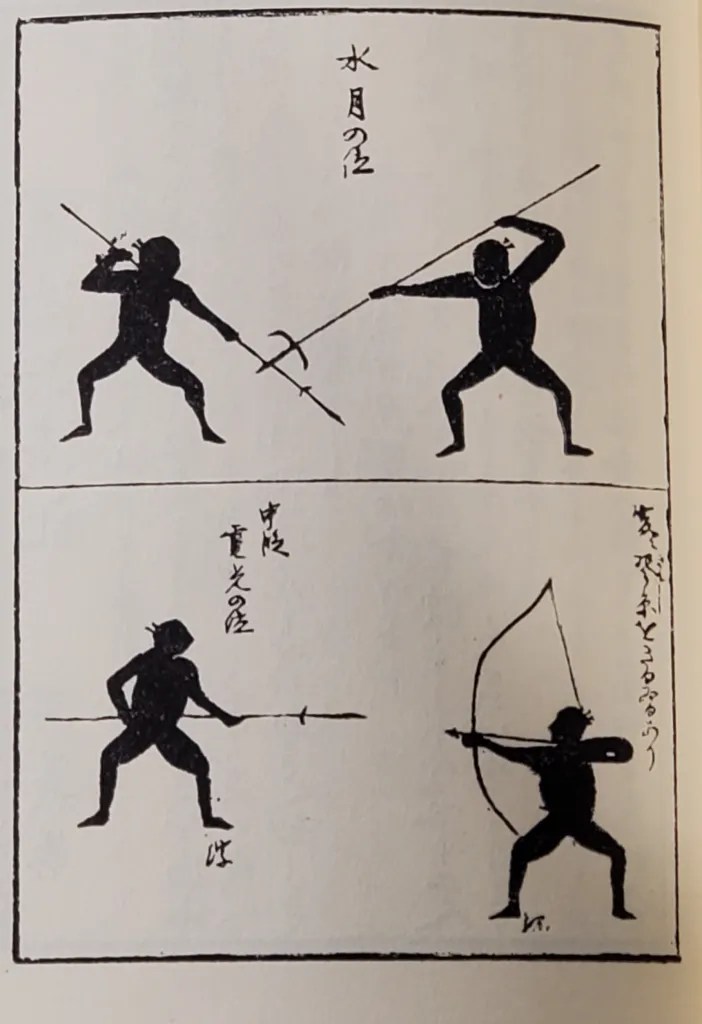
Forms regarding battles between swords and spears (鎗刀戦いかまいの形)
Diagrams of positions during battles between spears and archery (弓鎗戦かまいの圖)
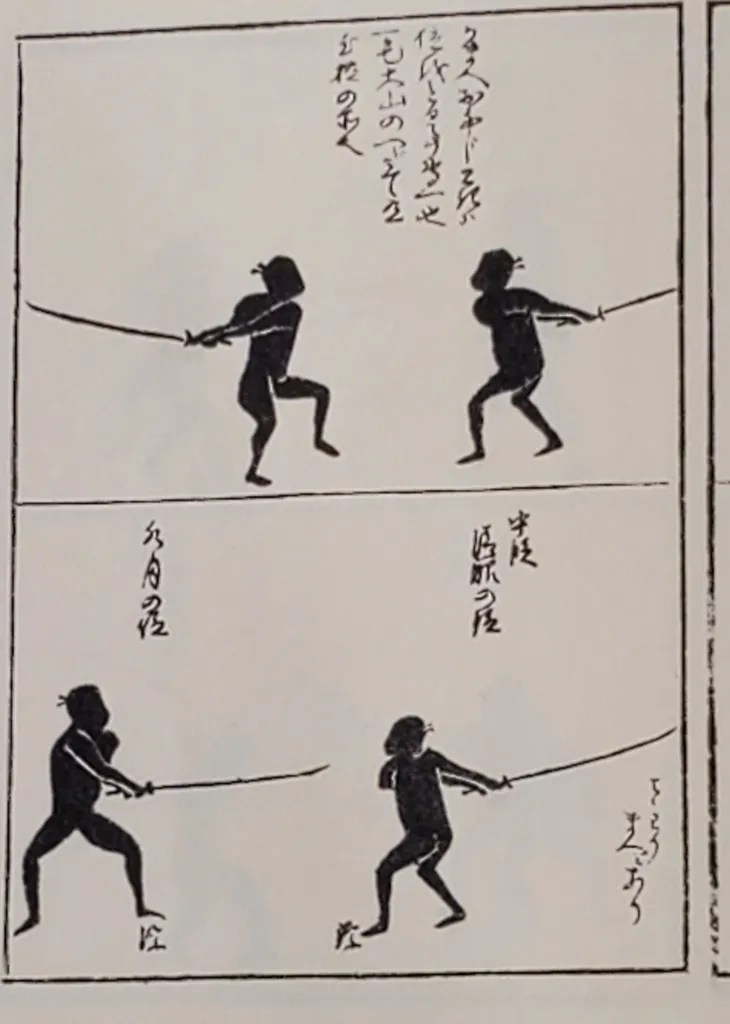
At a glance, there are similarities between each book. For example, both put a great emphasis on sword fighting. Although it is not shown above, Heihō Hidensho’s section called “Kenpō” (Method of sword fighting) has its own table of content that, if listed, would require its own separate article, while everything else can be covered together in another article. In comparison to the Gunpō Hyōhōki, the contents on sword fighting is similar as it has many teachings that focus on using the sword against another fighter with a sword, while there are also lessons on using longer weapons against each other, and a small quip on archery. Interestingly, there is a focus on using a sword against different types of foes. Here are some pics for comparison, starting with those from the Heihō Hidensho on the top row, and Gunpō Hyōhōki on the bottom row:
From another angle, Heihō Hidensho has a dedicated section on hand-to-hand combat called “Kenpō” (拳法), which focuses on using restraining techniques such as grappling and strikes against an opponent while wearing one’s swords sheathed on the side, and whether the opponent attempts to draw their sword or not. For the Gunpō Hyōhōki, it appears that there is no conversation on this. However, it does have several sections that cover this topic, which are “Torite no koto” (捕手の事), and “Jūjutsu-ate no koto” (柔術当ての事). Unfortunately, both are not accompanied with pictures, but instead are coupled with long explanations on the topic. If anything, the Torite no koto section does mention about the possibility of iai techniques during torite, so this could be compared with Heihō Hidensho. For the most part, both manuscripts use this idea of hand-to-hand techniques as more supplemental to kenjutsu.
Hand-to-hand techniques as shown in the Heihō Hidensho.
EMPHASIS ON KENJUTSU TECHNIQUES
As mentioned before, great importance is placed on kenjutsu in both documents. The direction both go with discussing the strategies while using the sword is through postures that signify an attitude or state of mind. The terms to indicate these in Japanese vary depending on the source. For instance, the word “kamae” is a common term for this. In the Heihō Hidensho the term “kensei” is another version, while “kurai” can be found in the Gunpō Hyōhōki. One thing to understand when interpreting these is that these postures, despite which label is used, are not static stances. Instead, they represent strategic points of movement in response to the situation against the enemy.
First, let’s review a list of select techniques in the form of kamae from Heihō Hidensho:
Hira jōgo kensei (平上後剣勢)
Migi jōgo kensei / Hassō (右上後剣勢)
Hira ue musubi mae kensei / Takanami (平上結前剣勢・高波)
Hidari ue musubi Mae kensei / Jōdan no Kasumi (左上結前剣勢・上段の霞)
Hidari ue mae kensei / Kissaki Oyobi (左上前剣勢・切先及び)
Hira ue mae kensei / Tōhō (平上前剣勢・当法)
Migi naka musubi Mae kensei / Chūdan no Kasumi (右中結前剣勢・中段の霞)
Hidari naka mae kensei / Yoko Seigan (左中前剣勢・横青眼)
Migi shita ushiro kensei / Sha (右下後剣勢・車)
Migi shita musubi mae kensei (右下結前剣勢)
Each of these kamae are listed on their own page, as there are thorough explanations and examples on how they can be utilized against an opponent. The name for each one is more descriptive in terms of how they are assumed, although some of them do have alternate, unique names that are expresses a concept of imagery, which are used in different martial arts schools. At their core, they are variations of kamae that most practitioners of kenjutsu, kendō, gekiken, and the like should be familiar with. For example, from left to right:
Hidari ue musubi mae kenseiHidari naka mae kenseiHidari shita musubi ato kensei
Hidari ue musubi mae kensei = Kasumi (jōdan)
Hidari naka mae kensei = Seigan (chūdan)
Hidari shita musubi ato kensei = Waki (gedan)⁴
For each kamae are explanations on how they can be utilized based on the enemy’s actions. The defender’s response isn’t as strict in terms of the counter attack, which makes things a little open-ended for interpretation. For example:
TRANS: The opponent takes the initiative and attempts to strike. Carefully watch when the opponent’s sword comes at you, then turn your body sideways with your left leg forward, pull your right leg back, and cut their right hand.
While this paints a rather clear picture in terms of movement using the attacker-defender model, it is also open-ended, for the type of the attack from the opponent is not specified, while the defender’s (us) initial position is not stated. This is pretty much how the techniques play out in this document, making it a supplemental source to any kenjutsu-focused martial arts school that can be studied upon.
Now, we turn our attention to Gunpō Hyōhōki, and look at some of the techniques mentioned:
Jōdan (2 types)
Chūdan (2 Types)
Gedan (2 types)
Denkō no kurai (電光の位)
Kasumi no kurai (霞の位)
Seigan no kurai (清眼の位)
Suigetsu no kurai (水月の位)
Yōgan (陽眼)
Ingan (陰眼)
Murakumo (村雲)
Yamatsuki (山月)
Nyūin no kurai (入引の位)
For this section, it starts off explaining the importance on 3 height levels while wielding the sword. They are the following:
Jō-chū-gedan kamae no Tachi
Jōdan (上段) = Upper stance
Chūdan (中段) Middle stance
Gedan (下段) = Lower stance
In almost all styles of kenjutsu and its modern equivalents, the idea of 3 height levels is a common principle. Illustrations show 2 ways of doing these, generally with one having the sword held in front, and the other with the sword held behind. This is abit different from what is shown in Heihō Hidensho, as there is not a great number of kamae where the sword is held behind. In the pictures provided, lengthy descriptions for these kamae and how to apply them is given based on one’s opponent’s actions. Each of the kamae are labeled according to their height level along with a unique name.
Let’s look at the following example below:
Jōdan – Denkō no kurai
This is the posture on the right. As a small explanation, in response to an enemy’s attack, the defender brings the sword above the head to the right, and strikes from overhead.
Take note that the picture sequences are not necessarily correlating with each other, especially in the later parts of the document. Each kamae, side-by-side, is significant in the Gunpō Hyōhōki; what’s important is the descriptions next to them. In a way, it’s a concise format to present lessons without using a step-by-step method.
The relation between the two documents is that Heihō Hidensho also follows the 3 height levels as specified in Gunpō Hyōhōki. Not only that, it follows the same order starting with high level postures, mid-level postures, then ending with low-level postures.
ANALYSIS
At first glance, when reading the particulars for these, it’s quite normal to think that both manuscripts are authentic & have been kept intact in terms of their original writing. This is certainly not the case for the Heihō Hidensho for a number of reasons which will be explained. As for the Gunpō Hyōhōki, this has a greater probability due to its appearance and contents, for much of the points on combat are done in a conversational manner that is not directly clear unless the reader has initiative knowledge in said topic, as opposed to very detailed, step-by-step descriptions that almost anyone can grasp. Take note that while this fits as what may be expected out of an older manuscript, just how much of it is 100% authentic as the lessons of Yamamoto, and isn’t a product of forgery, is hard to determine.
For the Heihō Hidensho, there are many points to pick up that indicate it’s not the original work. For starters, the original version, which would’ve been handwritten, is not available for view. Instead, we have a reproduction in print type of it in collection of other documents. It is mentioned to be reproduced several times, which most likely includes edits to suit the times, such as the kenjutsu kamae being compared to other unmentioned martial systems by presenting alternate names. Possibly the biggest clue is how the actual contents read; the way combat was approached was vastly different in Sengoku period in comparison to Edo period, and the way Heihō Hidensho reads coincide with the latter. For example, the hand-to-hand techniques demonstrated in it deals with situations in plain clothing and swords sheathed, which was a growing trend during martial artists during mid-to-late Edo period that were focusing more on jūjutsu and iaijutsu. Furthermore, the illustrations for the kenjutsu are not only similar to the style of specific artists during Edo period, but other pictures such as the ones used to illustrate staff techniques are not Japanese at all.
Finally, we look at the connection between both documents. Considering that they come from the same source, one can deduce that they were drafted around the same time period. Of course, this cannot hold up as an argument, since whereas Gunpō Hyōhōki looks to be a more authentic that was kept intact, we only see the typed version of Heihō Hidensho, which is a reproduction of said original source. This is even true when looking at the version in the Kai Sōsho. Despite presentation, if we compare the contents and acknowledge the similarities, (i.e. focus on kenjutsu, scenarios in which strategies for kenjutsu can be applied, etc.) what can be said about the differences? Let’s look at two points that can be considered.
Information may differ based on the person whom was receiving the manuscript – Depending on a person’s rank, or even affiliation, there are cases where one individual would get more clearer notes, while a person may get less. It can be argued that those were highly-ranked group leaders would’ve received a much more detailed documentation, as it would be necessary when training their team. However, for someone who may have been a specialist may receive a more concise version that skims the surface, which could’ve just been enough for that individual.
Manuscript may have been reproduced several times with edits – It is not uncommon that certain contents change and/or get updated by those who own it. This is true for both private documents, those passed on & used in martial arts schools, and those made for public viewing.
If we take Heihō Hidensho and consider it the same as the Gunpō Hyōhōki, then it’s possible it went through much edits and updates. This isn’t a bad thing, for if you think about it, combative knowledge should apply to the current times in order to stay viable⁵. With this in mind, it’s possible that the original lessons of Yamamoto Kansuke are maintained, but altered abit (or alot) so that it could still be applied in a society that still depended on the sword during Edo period.
CONCLUSION
It is great that there are documents written centuries ago that have been preserved for today’s generation. There are those that give credit to Yamamoto Kansuke, whether stated to have been penned by him or copied with permission. Unfortunately, researchers are faced with the task of validating the legitimacy of these, which tends to be difficult especially for those from Japan, as there’s a high chance they were produced during the peaceful times of Edo period by writers who try to pass them off as much older works. This brings our look at old manuscripts to a close. Hope everyone found this as an informative, and interesting, topic to read.
1) 長坂長閑斎. Historians believe him to be Nagasaka Torafusa (長坂 虎房), who was a retainer of Takeda clan of Kai.
2) 京流. This is one of 8 legendary sword systems that make up the collective group called Kyōhachi ryū. This was discussed in an article on this blog here.
3) This section may have been an add-on, after the development of firearms improved.
4) In this manuscript, there is no alternative name for this posture. However, I added the label here for this article due to it, from my personal experience, resembling the commonly used Waki no kamae, but done on the left side.
5) This same case was brought up for kyūjutsu (archery techniques) during Edo period, which was covered in an article on this blog here.
Today’s post is regarding recent kenjutsu training done by Chikushin group. It is more of a reiteration of verbal explanations given to students during those sessions. I also express it here for the public to get an idea of how Chikushin group conducts kobudō training.
In our kenjutsu training we’ve been studying a set of kata that focuses on defeating a stronger opponent. Within this are a few kata that uses the scenario where the both you and the opponent are in tsuba zeri-ai (鍔競り合い), which means locking swords together by the swordguard. While dependant on the martial system and their philosophy, this can be a common occurance between two sword duelists where both sides close the distance and are trying to overpower the other. Similarly, this can be seen in today’s kendō.
Example of tsuba zeri-ai in a kendō match. From Wikipedia.
When looking at these particular kata as presented in our group, they present a scenario where the defender must use specific techniques to defeat their opponent who uses tsuba zeri-ai. However, before learning these, we must spend time understanding how to properly apply tsuba zeri-ai and win with it.
In kata geiko (形稽古, practicing pre-set forms), the one who’s applying the technique as the defender may be viewed as doing the “true” style of one’s kenjutsu, while the attacker is not. This is actually not correct. In fact, we have to also study what is being done by the attacker, as it is very critical for the defender’s technique to work. In the case of tsuba zeri-ai, we initially study the finer details of this technique, from how it can occur when two fighters’ swords clash together, to how to properly initiate it ourselves. It is necessary to apply proper timing, leverage, and power in order to overwhelm another through this. In the end, tsuba zeri-ai becomes a tool in our arsenal, furthering our skill level. This is the ura (裏), or unspoken rules, in studying classical martial arts.
Example of applying tsuba zeri-ai in order to win.
There are plenty of unspoken rules not only in kata geiko, but in many of the components found in classical martial arts. It is just more apparent when training in set forms during katageiko as-is, for if we only focus on what the defender is doing, we will only get a small piece of the puzzle. On top of this, one cannot properly defend against an attack that is not there. It is up to the instructor to ensure that students learn the ins & outs of every kata properly. This includes performing a real technique by the attacker role.
Again, in the case of tsuba zeri-ai, if the attacker doesn’t understand how to apply his/her technique correctly in order to lock swords together, the defender won’t be able to feel the pressure necessary in learning the proper rhythm to counter the opponent. It is the same as blocking a simple punch; if we don’t engage in repetitive drills ahead of time regarding how to deliver a punch with proper power, speed, and from an adequate distance, kata that involve defense against this won’t work.
To get an idea of how tsuba zeri-ai is applied in motion, check out our Chikushin Arts Instagram account. There, you’ll find the exact video posted recently from which the pics above were taken from, along with the complete outcome of the scenario that was demonstrated. On top of that, you’ll also find other kobudō-related pics and videos posted regularly to keep our Instagram account active.
When studying kobudō (Japanese traditional martial arts), you tend to run into many terminology that are coded. This use of wording is a form of encryption to hide the true nature of said lessons or techniques from falling into the hands of a rivaling martial system in the past. In modern times, it is much easier to decipher such jargon due to the openness of martial knowledge by many teachers and avid students. On one hand, these coded words express a lot about the mentality of past Japanese masters based on the environment they lived in, as well as the culture they grew up with, which in itself can be lessons to enrich one’s training.
An example of coded description can be seen in this one line from a document I am currently translating called “Tsuki no Shō” (月之抄), which is a study guide for those who are training in the kenjutsu of Shinkage ryū Hyōhō (新陰流兵法). The line goes as the following:
「水月にて 座ト太体之手字ニ身ヲひねり掛ケ 一尺ヲカカへて打へし」
To summarize the line, it outlines how to go about trapping an opponent’s sword. While everything is straightforward, what is not is the part that is in red, which is read as “suigetsu¹”. This is a very common, poetic word that is used within many different fields of interest throughout Japan’s history. A general translation for this would be “water & moon”. In Japanese martial arts it tends to represent the area near one’s solar plexus. However, in the line stated above this would be incorrect. Not to be translated literally, it’s actually interpreted as “when the moon is visible on the surface water”. When read during a description of a sword dueling technique, one would be perplexed as to why this rather flowery, out-of-place visualization is there in the 1st place. Fortunately, after conversing with those who study Shinkage ryū Hyōhō, as well as doing some research on my end, I’ve come to learn that this simple word is actually a coded word for taking proper distance.
Distancing and timing are key when studying the deep lessons of kenjutsu
Much of what is learned from coded instructions require proper guidance from an instructor, as well as a great amount of training which entails going through trial & error. Just because it is understood that suigetsu refers to distance, distinguishing the point when “the moon is clearly visible on the water” still requires experience. This can be applied to even to the basics of kenjutsu. Let’s take Jōdan no kamae² (上段の構え) as an example. Jōdan no kamae is a universal posture in many martial systems where a sword is held above one’s head. It is considered to be a very strong posture due to being able to deliver a lethal blow to one’s opponent’s head. On the other hand, it is also deemed the most vulnerable, as there is little defense offered for most of the body. Even with these points explained, there are still factors that play a part in how one can take advantage of the strengths and weaknesses of Jōdan no kamae. At what range would you get cut if you assume this posture? When can you successfully strike down the opposition through this posture? Actively training and going through trial & error as you put these points to the test will usually provide an answer.
Within the kenjutsu of Kukishin ryū (九鬼神流) which my group studies, are also coded instructions. One of the 1st lessons students learn is the concept of issoku itto (一足一刀), which helps to understand the range where two people’s swords meet. Of course, it goes further than this, as students learn the proper footwork to advance or withdraw in regards to the reach of their swords. Another one can be seen in the kata called kasugai (鎹止). The name for this kata comes from a small interlocking staple-like bolt used to join two pieces of wood together when constructing buildings centuries ago in Japan. For this kata, the idea of “bolting down” one’s opponent is taken from this carpenter’s tool. Of course, the type of footwork, distance and angles required to make this happen requires proper explanation and demonstration in order to grasp this idea.
In conclusion, learning from coded terminology in Japanese martial arts can be a perplexing experience, even when guided by proper instructions. Yet, if one takes the time to understand the reasoning behind it, as well as make use of the visual representation that is part of the Japanese culture, coded instructions can help boost one’s training experience. Of course, this is a case-by-case matter, and depends on whether a practitioner is able to embrace such a manner of instructions.
1) Depending on the martial system, can also be referred to as mizoochi (鳩尾).
2) Depending on the martial system, this kamae is also referred to by different names.
This past weekend during training, I engaged in a session of Irimi Shiai1. For Irimi Shiai, this involved one person using a bokken (wooden sword), while the other uses a training yari (Japanese spear). As this was a rather free form practice, it gave us a chance to work on techniques we learn from Kukishinden ryu Bikenjutsu, and see how to apply it against the techniques from Kukishinden ryu Sōjutsu. However, as this training was focused on the concept of Irimi Shiai, there were some rules we had to abide to, in order to make it a challenging, and informative, learning experience. This also included moments of referring to wearing armor and what role it would play in our kamae, along with spots to attack if the situation was on the battlefield.
ROOTS OF IRIMI SHIAI
What is “Irimi Shiai”, exactly? Well, it is well known as a competitive engagement between a longer weapon and a shorter weapon, but in reality goes beyond this as tactical practice. After Japan moved away from the constant wars of Sengoku period and was followed by several eras that promoted a more peaceful society, many martial schools utilized different training and competitive methods to keep their styles active. One method involved closing the distance between longer weapons, such as the yari. This became more prominent in the 1800s, when most martial schools moved in the direction of Kyōgi Budo² (sports-centric martial arts), competitive engagements that featured a sword style versus a spear style became commonplace.
An artwork (low-quality version) called “Sakakibara Gekikenkai Ezu” by Kaisai Yoshitoshi (aka Tsukioka Yoshitoshi). It features many martial artists in competitive matches while wearing protective gear. In the middle-right, there are 2 individuals squaring off using training yari, while below that are two fighters, one with a shinai, and the other with a naginata. From Wikipedia.
COMPETITION RULES
In some older cases of Irimi Shiai, the kenjutsuka (swordsman) dons on padded training armor and uses either a bokken or shinai, while the sōjutsuka (spearman) uses a padded-tip training yari, and no body armor. The goal of this match was the kenjutsuka had to close the distance and get in range to strike, whereas the sōjutsuka had to keep the kenjutsuka with only the tip of the yari. The rules were usually in the favor of the kenjutsuka, whereas they have more range of techniques to use in this match, the sōjutsuka was restricted to only using thrusting techniques, and only to the armored areas on the kenjutsuka.
Having no body armor for the sōjutsuka is an interesting rule; while it insures the safety of the kenjutsuka (they will get hit a lot by the yari due to its reach), it is a nod the favor of the sōjutsuka, indicating the superiority of the yari. On the flipside, this puts more pressure on the sōjutsuka, for allowing the kenjutsuka to get pass the tip of the yari and in range to attack will put the skills of that sōjutsuka in shame…as well as in the receiving end of the shinai.
DIFFERENT STYLES
There are records of competitions with Irimi Shiai involved, most speaking in favor of those using a longer weapon such as the spear coming out as the victor. There is a documention of such competition called “Taryu Shiaiguchi Narabi ni Montai³”, written by Kasama Yasunao. In it is analyzation of a large martial arts event that consisted of 17 kenjutsu schools competing against 9 sōjutsu schools. Some well-established and renowned schools were involved, such as Shinkage ryu, Takeda Hōzōin ryu, Sekiguchi ryu, and Niten ryu. Very detailed writeup included a description of each school and their specialties, the methods some schools use to train, and the techniques used during the matches. In the end, the sōjutsu schools prevailed by having the most wins.
The settings used for Irimi Shiai isn’t just limited to kenjutsu versus sōjutsu. Depending on the participating martial schools, numerous conditions can be set featuring different weapon systems. Over the years, some of the matchups included tachi vs naginata, naginata vs yari, mokujū⁴ vs tachi, and kodachi vs tachi. Despite the weapon styles used, the idea remains the same when concerning Irimi Shiai: one side is trying to get within range to attack, while the other side is trying to maintain range and keep the other out.
COMBATIVE PRINCIPLES
While Irimi Shiai is best suited for sports-related martial arts, it’s important to remember that the principles stem from actual combat. During the long warring periods in Japan, certain weapons were considered superior both in use and the strategies applied to them, such as the yari. On top of this, many types of weapons were carried and used by an armor-clad samurai varying in length, and not always was it possible to carry the “superior” weapon at all times. When a samurai armed with an uchigatana5 has to confront an enemy who so happens to have a yari, that samurai must do what it takes to win. This is true even off the battlefield, where warriors may engage in duels with each other, sometimes facing off against specialists in a specific weapon system. Some examples include Bokuden Tsukahara defeating a renown naginata master named Kashiwara Nagato by cutting of the naginata’s blade with his tachi, and Miyamoto Musashi outbesting the famous spear play the monks of Hozoin took pride in.
In Bujinkan Budo Taijutsu, the different ryuha studied do not have a “sports” curriculum in it. This doesn’t mean that one cannot use “Irimi Shiai” as a tool to learn, but gives us an advantage of studying this with rules that are more suitable. For example, many forms and techniques found in Kukishinden ryu are designed for fighting in armor, so one can incorporate this in Irimi Shiai. Certain areas in one’s kamae and techniques are naturally protected by armor, so you can use this factor to guide your movements, as well as pick areas that are vulnerable to attacks on your opponent.
For Bikenjutsu, one can practice using their bokken as a shield to get by the blade of a yari. A practitioner can also seize the yari and hold on to both neutralize it and use their other hand to score a winning blow with their bokken. For sōjutsu, one is not limited to just thrusts with the blade of the yari, so all parts (including the ishizuka) can be utilized both offensively and defensively. Understanding the principles of one’s art, Irimi Shiai can be approached much realistically with less restrictions, yet must retain some structure in order to keep this as a method for learning.
CLOSING
This concludes my story on Irimi Shiai. It was a good experience on my end to engage in Irimi Shiai. I believe it would do wonders for others studying martial arts to challenge themselves in such a training method.
1) 入身試合
2) 競技武道
3) 他流試合口並問對
4) 木銃. The mokujū is a wooden replica bayonet for the purpose of training in Jūkendo. The techniques are heavily derived from sōjutsu.
5) 打刀. Uchigatana can be considered the predecessor of the modern katana due to similarities in blade length and shape. This was used as a close-range weapon on the battlefield.