Myths & Tales: Kyohachi ryu ~Part 1~

Today’s post is part 1 of a discussion on Kyohachi ryu, a martial system shrouded in mystery. It is said it possesses knowledge of unique yet superior techniques with the Japanese sword, such as the tachi. Many Japanese schools of old that have kenjutsu in their curriculum give credence to Kyohachi ryu. Some even claim hereditary traits to it, placing it on a platform that feels too high to ever reach. Before we get into the beginnings of this legendary martial system, let’s take a look into concept of tall tales found in many koryu bujutsu, and the reasoning behind them.

Japanese artwork
The legitimacy of Kyohachi ryu: Truth or a tale to work up the imagination? Untitled work by Utagawa Toyokuni I, from ukiyo-e.org

Those who are into the history and origin of Asian traditional martial schools (whether through research or through verbal explanations) tend to get a tale or two on a level of fantasy. This is no different with Japanese martial arts. These tales tend to present situations concerning how the founder came about with said martial system that is either surreal or plain out of this world. Examples of these tales are the following: a religious man or warrior from another country makes their way to Japan and teaches secret and amazing techniques. Or, a warrior seeking solitude in the mountains or forest for intense training and meditating for days miraculously becomes enlightened through some form of dream or revelation. Then there are those where a fighter engages with a wild animal, with the encounter helping to understand strategies in combat.

Why the tall tales? Well, one reason could be that, when establishing a martial system, there may have been a need to make it stand out and appear special. Having tales that make the founder and the course in obtaining the knowledge appear supernatural will give the teachings & techniques a more extraordinary quality. This will draw in prospect students, as well as grant employment by warlords looking for someone who is versed in winning strategies that would train his soldiers. This is especially true if the martial system is tied in with a religious practice, such as Buddhism or Shinto; techniques and strategies that have esoteric naming conventions make them feel empowered by the will of the gods.

With that little tidbit out of the way, let’s turn our attention to the beginnings of Kyohachi ryu. The time frame for this legendary martial system dates back around the end of the Heian Period1, an era where the Imperial family resided in Heian Kyo, or Capital city of “Peace and Tranquility”2. In the Northwestern area near Heian Kyo is Mount Kurama, well known for its growing religious and spiritual practices, and famous for tales of it being the home to the Tengu3. Up in Mount Kurama, an old monk versed in the way of both literary and military affairs by the name of Kiichi Hogen is said to have taught 8 priests that made their way up the mountain the mysterious secrets of Touhou, or sword methods. The priests, in return, passed on this knowledge to others by creating their own schools on sword fighting. As a whole, the 8 priests’ systems are collectively labeled as “Kyohachi ryu”, which is translated as “The 8 (Sword) Styles of the Capital”. This Kyohachi ryu, or each of the 8 martial systems, lead to the creation of many other sword schools in Japan.

Kiichi Hogen
A artwork depicting Kiichi Hogen. From kotobank.jp

So, what are the teachings received from Kiichi Hogen that would categorize under Kyohachi ryu? Unfortunately this is unknown. Were the 8 priests taught these secret lessons together? Or were they taught separately, as each one made their own personal journey up Mount Kurama? These questions are also difficult to answer without any detailed written records. It is said by historians that from the Muromachi period onward, many documentations related to Kyohachi ryu were lost, so it is difficult to accurately determine the specifics…let alone prove the existence of Kyohachi ryu at all. Yet, many stories that mention its use in the hands of swordsmen, such as Minamoto no Yoshitsune4 and Yamamoto Kansuke5, paint a picture of this sword style’s techniques surpassing others with ease. Should such high belief be placed on this elusive sword style only through tales of valor?

This here ends part 1 on the legendary sword art of Kyohachi ryu. Stay tuned for part 2, which will focus on particular individuals and martial schools dating back around the same time as Kyohachi ryu. We will look into how their involvement with Mount Kurama gives them direct ties to this legendary martial system.


1) Time frame is from 794 to sometime around 1185~1192.

2) Present day Kyoto city. Before modern times, Emperor Kammu moved his establishment from Nara to this area around the 8th century. The Imperial family lived here for many generations. As the Capital city, Heian Kyo was an important area where many migrated to live in. It was the center of Japan’s rich culture, as well as the center of many major historical conflicts between warring clans, noblemen, and religious groups.

3) A tengu (天狗) is a spirit/mythical creature that is half man, half crow. Usually depicted in the guise of a yamabushi (a mountain hermit), sometimes with the legs and wings of a crow, a red face with a long nose. There are different grades and types of Tengu throughout the history of Japan. A Daitengu (大天狗, meaning a grand or supreme tengu) by the name of Sojobo (僧正坊) is believed to have resided in Mount Kurama.

4) (1159-1189) A general of the Minamoto clan. Famous for many successful victories against the Taira clan, which ultimately lead to their demise.

5) (1501-1561) One of 24 generals of the warlord Takeda Shingen. Although described as having physical handicaps, it is documented that he was a brilliant strategist.

Musashi Versus Matabei

Miyamoto Musashi is a famous individual not only within the pages of Japanese history, but around the world through pop culture, books, and movies. Born around 1583-84, Musashi made his fame by forging himself into a skilled & fearless warrior, winning many duels, engaging in battles, and devising his own martial system called “Hyoho Niten Ichi ryu”. While one of the more prevailing images of him is claiming victory in mortal combat against other warriors like Sasaki Kojiro1 and Shishido Nanigashi2, it’s interesting to note that Musashi has won matches without spilling blood. One of those matches I will write about is against another famous individual by the name of Takada Matabei3.

miyamoto_musashi_self-portrait
A self portrait of Miyamoto Musashi by artist of the same name. Property of Shimada Museum, used from Wikipedia under their Terms of Use.

First, let’s start off with some background information. Miyamoto Musashi has been well documented for decades, so I will refrain from writing his details. Takada Matabei, on the other hand, deserves an introduction, for he is not well known as Musashi in English texts. Takada Matabei was born in 1590 in Shirakashi Mura, located in Iga Province, Japan. He trained in the martial system of Hozoin ryu, and was especially fond of yari (spear) techniques. After receiving inka4 in Hozoin ryu, Matabei would later train with other martial schools to gain further insight, and later created his own style called Hozoin ryu Takada Ha Sojutsu5 after mastering all that was taught about the yari. It is documented that Matabei didn’t care much for competition, but instead saw value in real conflict, which prompt him to take part in actual battle, such as Shimabara no Ran6. By engaging on the battlefield he became recognized for his skills as a bushi, especially when wielding the yari. His system is still taught today in Japan, being one of the well respected martial systems on the Japanese spear.

Now, for the tale about Matabei and Musashi’s encounter. There is little detail in English, other than the actual duel. In Japanese, there are slight differences in how the duel played out; sources like the Tanjihoukin Hikki7, Heiho Senshi Denki8, and Suhaku Sensei Den9 have varying perspectives from the details of the warriors’ actions to the words exchanged. However, in a recent historical publication called “Miyamoto Musashi Kokou ni Ikita Kensei”, there is a pretty extensive write up10 on both warriors’ background, first encounter, and their duel (along with some other historical details). It also appears to take details from the other Japanese sources and incorporate their points more cleanly, and presents a “complete” story.

In around 1633 A warlord named Tadazane Ogasawara (Lord Ogasawara from here on) was relocated11 to Kokura District in Buzen Province, where he was sent to rule over. Matabei was Lord Ogasawara’s vassel, and as expected was with him in this area. It just so happen that Musashi, along with his adopted son Iori12, were residing in Kokura District at the time. Matabei met them both and, training together on a regular basis, developed good relations with them.

One day, being aware about how well the 2 renowned warriors like Musashi and Matabei got along, Lord Ogasawara decided on the unexpected. He requested a friendly match between Musashi and Matabei. Although Matabei refused, Lord Ogasawara’s insistence for the duel proved to be too much to go against. In the long run Matabei had to obey his master and prepare for the match. Musashi was called to Lord Ogasawara’s castle, for the match was to take place in his presence.

Since it was a friendly bout, no live weapons would be used. Instead, training weapons were to be used to avoid bloodshed. It will follow a point system based on the person scoring a “clean” hit, whether physically or theoretically. Matabei chose a bamboo jumonji yari (in English, a cross spear), which has padding on the tip of the spear head, and a small strip of bamboo inserted about a foot under the spearhead through the shaft to act as the crossbar. Musashi, on the other hand, picked a single bokuto13, a much shorter weapon than his adversary. Due to the varying lengths of the weapons, it would play out more as an irimi shiai14, where Musashi had to get pass the spearhead of Matabei’s yari in order to beat him, while Matabei had to tag him before that happens.

Both warriors square off, with Lord Ogasawara and a small group of observers as witnesses of the match. Musashi stated that he will end the duel in 3 exchanges, claiming victory from a chuudan posture15. From a distance, Matabei also took up a chuudan posture and attacked Musashi with a thrust. Musashi, in return, evaded the attack and got pass the offense in order to close the distance. This would be considered a point to Musashi. In the second exchange, Musashi successful evaded again Matabei’s assault to close the distance. Again, a point that should be awarded in favor of Musashi. The third exchange progressed differently, where Matabei’s jumonji yari dipped down and inadvertently slipped in between Musashi’s legs. Musashi sold the idea that Matabei struck his thigh for a clean hit before he could close the distance, so he sat down onto the ground and complimented his opponent on besting him this round. However, Matabei (along with other observers) saw it differently, and believed that Musashi gave him the point. Matabei humbly replied to this, with one example as written in “Miyamoto Musashi Kokou ni Ikita Kensei” below:

“本日は御前ゆえ、それがしに勝ちを譲ってくださったのであろう”

Which I translate below:

“I guess I won this round, thanks to you.”

Before the duel could continue on, Matabei suddenly called for the duel to stop, put down his weapon and gave up. There are a few examples what was said, such as this below:

“槍は長く、剣は短い。長いものに七分の利があるにもかかわらず三合しても勝てなかった。したがって長い得物(えもの)を持って戦った私の負けでございます。”

Which is a more romantacized version from “Miyamoto Musashi Kokou ni Ikita Kensei”. My translation of this quote below is as follows:

“The spear is a long weapon, compared to the sword, which is a shorter weapon. Despite having a considerable reach advantage, I was not able to claim victory in 3 exchanges. In the end, I am bested while wielding my long prized possession.”

It is written that Lord Ogasawara, satisfied with the display of skills from both warriors, concluded the duel at 3 exchanges and called it a draw. Possibly this was done in respect to both warriors, or to not have bad blood between both men. This isn’t clear, although most accounts agreed that Musashi was the better out of the two. The number of points claimed in the 3 exchanges also varies between sources depending on from which side the writer is loyal to, for both fighters apparently didn’t physically hit each other. Some say that Musashi got all 3, but gave the third to Matabei before he could fully close the distance. Some say that it was one a piece. There are others that say no man scored a point, thus Matabei calling quits. It is agreed, thought, that Musashi and Matabei remained friends after the duel.

This concludes the duel between Miyamoto Musashi and Takada Matabei. Hope this helps to give a clearer image of Miyamoto Musashi, one that show that he, historically, did engage in many battles, but not all ending in the death of his opponent.


1) Sasaki Kojiro is said to be a famed bushi renowned for his sword skills with an exceptionally long sword called. The popular lore is that Musashi defeats Kojiro in mortal combat on Ganryu Island, although the exact details are sketchy and vary amongst the numerous historical sources on Musashi’s life. One of the more “accepted” interpretations is this: to gain the advantage, Musashi used certain psychological tactics, such as arriving very late to infuriate Kojiro, carving a long bokken out of his oar to match Kojiro’s long reach with his sword, and taking the duel out into the ocean tides. With all these tactics in place, an enraged Kojiro attacked carelessly, giving Musashi the opening needed to strike him down.

2) Shishido Nanigashi (at times, referred to as the character Shishido Baiken from “Vagabond”, a manga about Musashi and his battle-intense lifestyle) is believed to be a famous swordsman from Iga Province in Japan. Nanigashi was especially proficient with the kusarigama, which was the chosen weapon to battle against Musashi. In the long run, Musashi bests Nanigashi using his Niten Ichi ryu, which incorporates a tachi in one hand and a wakizashi in the other. This episode is mentioned in the “Nitenki”, a biographical book written about Musashi’s adventures by Toyota Kagehide. However, most of the tales written there are based on heresay and have little evidence to back their validity.

3) Birth name is Takada Yoshitsugu (高田吉次). He is commonly referred to as Takada Matabei (高田又兵衛), where “Matabei” is a nickname.

4) Old fashioned certification stating complete transmission of a martial system has been learned.

5) Loosely translates to “Takada System of Spear Techniques, of the Hozoin Style”

6) Translated as “The Rebellion at Shimabara”, the uprising and rebelling of peasents, ronins, and Christians due to overtaxation, famine, and the persecution of followers of Christianity in the Southwestern part of Japan. This happened from 12/11/1637 to 4/12/1638.

7) A book on the life of Miyamoto Musashi written by Tachibana Houkin in 1727. He was the 5th successor of Chikuzen Niten ryu, a branch of Miyamoto’s martial system.

8) Another book on Miyamoto Musashi written by Niwa Nobuhide in 1782. He was the 7th successor of Chikuzen Niten ryu, and the grandson of Tachibana Houkin.

9) An autobiography written by Matabei, under the pen name Suhaku.

10) The writeup is entitled, “Musashi to Taiketsu Shita Sannin no Bugeisha Houzoin Ryu Takada Ha Sojutsu Takada Matabei”, written by Matsubara Hideyo, and published by Shinjinbutsu Ouraisha in 11/11/2002.

11) The word used in Japanese is tenpuu (転封), which means a forced relocation of a feudal lord from one area to another, mandated by the Shogun. In Lord Ogasawara’s case, it is the same situation. Despite how rough it sounds, the feudal lord is paid by the Shogunate for this relocation, so it’s not so bad a deal.

12) His real name was Sadatsugu prior to being in the care of Musashi. One of the 2 adopted sons of Musashi, the other being Mikinosuke.

13) It is said that at this time, Musashi hasn’t fully developed his “Niten Ichi” method, thus using only a single bokuto.

14) Meaning of this phrase can be interpreted as so: “to engage in a competitive match of getting inside the opposition’s weapon and closing the distance”. In the case of weapons, usuaully referring to the individual who is pitted against a spear wielding opponent. When practicing against the yari, the underlining principle is to get in the space anywhere between the wielder and the spearhead, thus neutralizing its threat of being stabbed so to attack safely. In defense, the spearman keeps the opposition out by maintaining distance so to strike successfully.

15) Translates as “middle level”, the weapon is held up and pointing forward around midsection height.

A Glance at Satsuma’s Heki ryu Kyujutsu: Part 2

Here we continue with part 2 of the talk on kyujutsu, with the focus on the Satsuma style of Heki ryu. While part 1 focused on Heki ryu’s history and development, this time around we will look at the technical aspect of this archery system. If you have yet to read part 1, you can access it here.

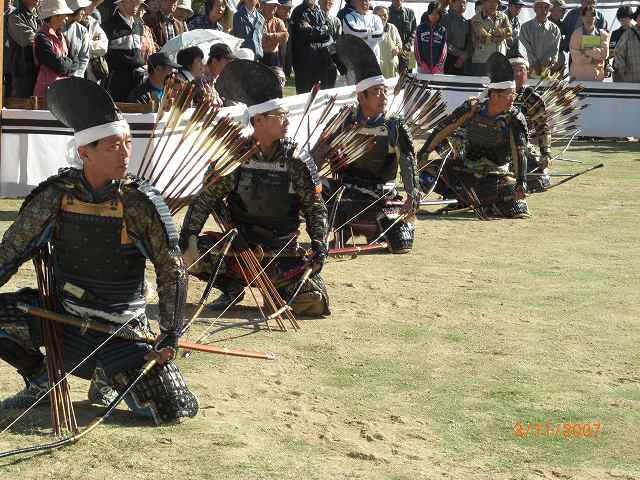
Group of archers lining up for demo
Archers wait patiently during a public exhibition. Photo from “Izumi Terebi Digest

Heki ryu is categorized as a busha style of archery, or battlefield-centric. This involves heavily structured group formations and moving in patterned sequences while shooting at targets in a wide field clad in armor. This is different from the more commonly practiced “reisha”, or ceremonial-centric, style of archery found in schools such as the Ogasawara ryu, where the attire is much lighter, and archery performed either standing up or on horseback. Kyudo, the non-violent form of kyujutsu, is heavily structured through both reisha-style and busha-style of archery and is practiced in not only Japan, but in many countries all over the world that offer classes. In kyudo, one trains in the process of shooting where archers shoot stationary at a target through form and breath in a training hall. Kyudo is studied under Heki ryu as well, and can be considered the first step necessary to learn Koshiya Kumiyumi.

Groups that train in the Koshiya Kumiyumi system perform annual public demonstrations and events. It’s here that we can get a glance at what Koshiya Kumiyumi is all about. Usually the number of participants are small (from 8 to 10 people), and they proceed to present this system’s shooting skills donning light armor all the while shooting at a row of large white board targets.

What consists of Satsuma style Heki ryu? The major component is Kumiyumi, and comprises of basic tactics such as “Koshiya”, “Sashiya”, and “Shintai Oshitsume”. There are other strategies common to archery that is designed for militaristic engagement, which is studied in manual associated with Heki ryu called “Mokuroku”1.

Starting off with Kumiyumi, this is the cooperative formation between archers and spearmen. Archers coordinate to assist in advancement towards the enemy line so that spearmen can get close enough for close quarter combat. The training in Kumiyumi is said to be very regimented; under the lead of a commander, there are signaling, movements, and formation patterns an archer must be familiar with through many hours of training. On the battlefield, from 10 to 20 archers can utilized for Kumiyumi.

Next, we turn our sights to Sashiya, which is considered the 1st stage of Kumiyumi. Sashiya is a tactic not unfamiliar to other archery schools, although its adaption here can be considered unique. A quick definition taken from the book “Heki ryu Isai Ha Hosha Kyudo Kyo Hon” written by Inagaki Genshiro states:

“さしや (差矢・指矢) 矢の種類のうち、堂前に使用するためにとくにつくった矢のこと。または差矢前、すなわち矢数多く連続して射る射法の略称。”

With my translation:

“Sashiya – It’s a particular type of arrow made for use in the training hall. Or, it’s the abbreviation of “Sashiya Mae”, a title given for a shooting method where many arrows are repeatedly launched.”

The highlighted portion of the definition more suitably fits here. Under Koshiya Kumiyumi, Sashiya involves archers forming a line that runs parallel with the opposing side. They release a fast, steady stream of arrows one after the other, to pin the enemies down and keep them on the defensive. This tactic is especially focused on keeping the enemy archers at bay, behind their barricades or shields2. Warriors on their own side can mobilize under the cover of the arrows and assault the neuralized enemies.

Archers demonstrating Koshiya
Archers demonstrating Koshiya. Photo from “Heki ryu Koshiya Sashiya

Now we move on to Koshiya, considered the 2nd stage of Kumiyumi. The archers are now advancing, moving in 2 groups. Both groups are intertwined with each other, but can be distinquished as so through this example: In a line of 10 archers, the 1st archer on the farthest right represents group 1, while the 2nd archer after the 1st from the right side is part of group 2. Using the sequence of odds and evens, every other archer on the line going towards the left that is an odd number belongs to group 1, while the even number archers part of group 2.

There are two roles the groups assume, which are Mae Yumi (Front Archers) and Ato Yumi (Back Archers). For example, if group 1 is the Mae Yumi, they will advance several paces, kneel down and shoot. While this is taking place, group 2 will take up the role of Ato Yumi, and prep their arrows. As group 1 finishes and prepares for the next shot, group 2 advances past, kneels down and prepares to shoot. The roles switch, with group 2 taking the role as Mae Yumi, and group 1 hanging back as Ato Yumi. The sequence continues as so, with this duality in the roles guiding the archers forward. This advancement pattern helps to assist in closing in on the enemy soldiers steadily so the spearmen can engage.

What makes Koshiya stand out is the intricate use of low postures. As a whole, Koshiya represents a methodology of being in a low posture involving kneeling down with the left knee down & right knee up, and with the arrows bunched together and angled tip-down towards the back of the right hip in the ebira, or a box-shaped quiver. The bow is held in the left hand, while it is drawn with the right hand. In this posture, one is stable while shooting an arrow, which is keen in different types of terrains and weather conditions. After taking a shot, archers compact themselves for protection with their bow and the armor shoulder flap on the left arm, while moving the right leg to get clearance to retrieve another arrow from behind the right hip. Standing up to advance, and kneeling down once again can be done seamlessly and without falter while maintaining one’s shooting structure. An archer can also lay down to make themelves an even smaller target, all the while in perfect position to pull out another arrow with their right hand. Koshiya is systematically and strategically designed with the idea of offense and defense through both one’s weapon and armor, staying low to be a difficult target to hit, and covering angles necessary for an archer to do his job.

Other tactics involve the use of “Shintai Oshitsume”. Looking at the 1st component, “Shintai” means to move, either advancing forward or retreating. A perfect example of this is during Koshiya, where the archers meticulously advance forward while shooting arrows. This helps the other soldiers to get in for upclose skirmishes. In return, the archers can cover retreats by keeping the enemies back with their arrows and slowly drawing back while the other soldiers can pull away quickly without worrying of pursuit. The 2nd component, “Oshitsume”, stands for packing in the targets together into one spot. In order for the spearmen to successfully fight the enemy soldiers, the archers not only pin down the opponents, but make sure they don’t fan out and surround their side by picking off flankers. This is done by the archers at the ends of the line, called Hidari Hashi no Musha (Left-End Warrior) and Migi Hashi no Musha (Right-End Warrior) respectively. While the other archers’ stick to their primary goal and shoot forward, the Hidari and Migi Hashi no Musha archers can turn at different degrees to shoot at targets coming from the sides.

The tactics used in Koshiya Kumiyumi are well devised for a team of archers, but are not 100% original. Togo Chozaemon Sanetaka, the one credited for the creation of Koshiya Kumiyumi, was inspired by researching military tactics in the 19th century. At this time, matchlock guns such as the Tanegashima were viewed as having a more larger role for the battlefield, thus had an inclusion in troop formations. A statement on the webpage “Heki ryu Koshiya Sashiya”3 mentions a theory behind the source of Koshiya Kumiyumi’s inspiration, quote:

“織田信長の用いた鉄砲のニ段構えの戦法より考案されたものであろう。”

With my translation:

“It’s believed that this archery style borrows concepts from the Ni Dan Kamae4 specialized by the gun troops utilized by Oda Nobunaga5.”

Despite the resistance against being overshadowed by firearms, it is a bit ironic that gun troop formations actually helped in keeping Heki ryu Kyujutsu viable. This is present through Koshiya Kumiyumi.

This concludes the in depth look into Satsuma Heki ryu Koshiya Kumiyumi, one of the branches of Heki ryu Kyujutsu. Below is a video that provides a demonstration, along with explanations of each sequences, although in Japanese. The video is pretty old and grainy, but it’s easy to understand what’s going on. It also captures the essense of discipline and skills to perform Koshiya Kumiyumi. I am also including my explanations of the narration that are marked with time stamps below the video. I had originally gave an explanation of this video on my dojo’s FB page knowing that there are a few fellow archery lovers who would get a kickout of it. Hope there are more who will find not only the vid explanation, but the entire post useful.

(0:18) The archers are demonstrating Sashiya, which involves shooting a volley of arrows together in a line.

(1:22) When approaching the enemies in the tactics of Koshiya, archers used a 2-line formation where there are Mae Yumi (Front Archers) and Ato Yumi (Back Archers). In a specific pattern, the Mae Yumi move forward and shoot, then the Ato Yumi move forward to become the Mae Yumi and shoot, while the previous Mae Yumi take the role of the Ato Yumi and prep their next arrow, and repeat.

(2:57) Ei and ya signals allow the archers to communicate with each other. For example, yelling “Ei!” after shooting, then laying low to prepare your next arrow by yelling “Ya!” not only tells the others of your actions, but allows another archer close by to take their shot, knowing that you are out of the way.

(3:34) In line shooting, the archers on the far ends are called the Hidari Hashi no Musha (Left-End Warrior) and Migi Hashi no Musha (Right-End Warrior) respectively. They can turn 90 degrees to 180 degrees to shoot arrows at approaching enemies so to cover the other archers.


1) “Mokuroku” (目録), also called “Heki ryu Yumi Mokuroku” (日置流弓目録), is an ancient documentation/scroll of 60 entries essential for archers of Heki ryu that range from principles regarding one’s posture with a bow, wearing armor and carrying other weapons, to how to deal with wet weather conditions.

2) Shields were used differently than those in Europe. Instead of handheld shields, the Japanese primarily used large rectangular wooden boards that were planted on the ground with use of a prop called a “kaidate”.

3) This webpage is part of the website “Furusato Izumi”, and is managed by Uchinoura Akira. Webpage can accessed here, while the website can be viewed here.

4) Loosely translated as “2-Tier Stance”. Gun troops equipped with matchlock rifles (aka Tanegashima) were utilized greatly in Oda Nobunaga’s army. To cover the reload time of rifles, Oda used a strategy of 2 teams where one is shooting while the other team is reloading their rifle, giving the sense of continuous fire.

5) Oda Nobunaga (6/23/1534 ~ 6/21/1582) was a powerful warlord during the Sengoku Jidai, or Warring States Period, who strove to unify all territories in Japan under his control.

A Glance at Satsuma’s Heki ryu Kyujutsu: Part 1

Japan has a long history of the bow and arrow. A prestigious weapon when feudal lords were at conflict for the unification of Japan, many bushi were required to learn the art of shooting an arrow, called kyujutsu in Japanese. Several martial schools became famous for their instruction on kyujutsu, such as Yamato ryu and Ogasawara ryu. One school in particular, called Heki ryu, has strong roots in warfare and was systematically devised to be used in the hands of both the elite warriors and infantry. It is unique in that the traditional methods of battlefield tactics is still preserved today, which is visible in the Satsuma style of Heki ryu.

Japanese bow with arrows
A Japanese bow with arrows, dating back to Edo period. From Wikipedia.

Let’s take a brief look into the history of Heki ryu to understand its roots, and it’s further development as a battlefield-focused archery system under the Satsuma style. The founder of Heki ryu is Heki Danjo Masatsugu  (bet. 1440-1505), an individual famed as the “pioneer who revitalized the archery of Japan”1. A student versed in the archery of Henmi ryu2 coupled with experience using the bow & arrow in war, Danjo established his form of archery later in his life during the the Muromachi Period3. Danjo’s archery style was adaptable to the battlefield, so many soldiers and high-class families sought to learn it. There are many branches of Heki ryu that claim to be derived from Danjo’s teachings due to his reputation.

Heki ryu Kyujutsu spread into Satsuma no Kuni (present day Kagoshima Prefecture) through Hongo Yoshinori.  He and his lord, Ukita Hideie, sought refuge there after being on the losing side in the battle of Sekigahara4 in the year 1600.  Yoshinori would later become a vassel to the Shimazu family, the rulers of the Satsuma Domain5, as well as the archery instructor in the area due to his hardened skills with the bow and arrow. Members of the Shimazu family also became proficient in Heki ryu, took pride in the archery abilities in their area, and were proactive in maintaining the effectiveness of Heki ryu Kyujutsu by helping to have many warriors in the land learn it.

Heki Danjo Masatsugu with disciple
Heki Danjo Masatsugu teaching Yoshida Shigekata kyujutsu. From Wikipedia.

There was another individual, named Togo Chozaemon Shigehisa, who’s exceptional talent in archery contributed to further development of Heki ryu Kyujutsu in Satsuma Domain.  A vassel of Shimazu Yoshihiro, Shigehisa’s talents were quickly recognized by his superiors. Viewed as a  protege, he was directed to receive deeper instructions of Heki ryu under Hongo Yoshinori in the early 17th century. Later, after Yoshinori passed away, Shigehisa was sent to Kyoto under apprenticeship of Yoshida Issuiken Insai Shigeuji6, in order to study all there is to know about Heki ryu Insai Ha7. In time, Shigehisa received his license in the Insai method of archery.

Shigehisa returned years later back to Satsuma Domain. He became the 1st instructor of Heki ryu Insai Ha Kyujutsu, and included what he learned to the Satsuma Heki ryu, vastly improving the archery within the area.

tanegashima
A Tanegashima on display. From Wikipedia.

The final stage of Satsuma Domain’s development of Heki ryu Kyujutsu happened around the 19th century, a time where the advancement of guns was well recognized. Looking at the history of guns in Japan,  their value rose steadily over time as they became more accurate in hitting their mark. With the increase in availability and overall simplicity in usage, guns such as the tanegashima8 saw more use in the years of skirmishes, utilized in group tactics to send volleys of shots to mow down soldiers. Commanders willingly included this weapon in their own units, which changed the way battles were engaged in. The high status of the bow & arrow started to wane over time; an age-old weapon that took years to master was losing its taste, for common tactics such as releasing a rain of arrows at the same time couldn’t compare to the direct and consistent damage guns were capable of.

Shimazu Nariakira, the 28th head of Satsuma Domain, didn’t sway to the reputation of guns so easily, nor was he ready to give up on archery. He rallied to his countrymen to not drop their bows, quoted stating9:

“弓術は我が邦武術の根本にして、由来久しく最重要のものなり、・・・敵合の射術の如き、徒らに、書伝のみに秘し置かず、広く門弟中に師事せざるべからず”

With a translation done by myself below:

“The roots of our country’s warrior arts is in kyujutsu. It has played an important role in our history for a very long time, …we have to teach and spread kyujutsu to many students. If not then it will become useless, for its effectiveness cannot be preserved just on paper. Archery is the way to battle against the enemy. “

Togo Shigemochi
A picture of Togo Shigemochi. From the webpage Satsuma Heki ryu on the website Heki To ryu

To ensure the future of Japanese archery, Nariakira assigned the task of remaking archery essential on the battlefield to Togo Chozaemon Sanetaka, the 14th successor of Satsuma Heki ryu. Sanetaka, accompanied by Togo Genjiro Shigemochi, traveled to Edo10 for a year to observe military-related drills and procedures. Returning to their hometown, Sanetaka added to Satsuma Heki ryu a new core component called Kumiyumi. New unit formations help with the concept of Kumiyumi, including those that have archers working side by side with spearmen to ensure successful advancement towards the enemyline. With this restructuring came the birth of Satsuma Heki ryu Koshiya Kumiyumi.

This here ends the brief look into Heki ryu Kyujutsu’s history and its settling in the Satsuma Domain. Stay tuned for part 2, which will cover detailed explanation and examples about Satsuma Heki ryu Koshiya Kumiyumi.


1) A translation done by me, of the original phrase “吾国弓術中興始祖也”. The phrase comes from the Honcho Bugei Shoden (本朝武藝小傳) written by Hinatsu Yasuke Shigetaka (日夏弥助繁高). Further information can be found here.

2) The first kyujutsu system in Japan developed by Henmi Kiyomitsu (6/27/1110 – 8/12/1168) in the 12th century.

3) (approx. 1336 – 1573) The period in which the Ashikaga (Muromachi) shogunate had control over Japan.

4) A major battle on 10/21/1600 between the Eastern Army (Feudal lords from Eastern parts of Japan led by Tokugawa Ieyasu) and the Western Army (Feudal lords from Western parts of Japan, loyal to the Toyotomi clan). Outcome marks the beginning of Ieyasu to claiming power over Japan in 1603.

5) Present day western part of Kagoshima Prefecture

6) (1562-1638) Creator of Heki ryu Insai Ha

7) A branch derived from Heki Danjo Masatsugu’s teachings of Heki ryu Kyujutsu

8) A matchlock type of arquebus firearm introduced to Japan by the Portuguese in 1543.

9) Quote is from the webpage “Heki ryu Koshiya Sashiya”, on the website “Furusato Izumi”, which is managed by Uchinoura Akira. Website can be visted  here.

10) Present day Tokyo, Japan

A Different Path of Koppojutsu

In Bujinkan Budo Taijutsu, one of the hand-to-hand martial systems taught is called koppojutsu1. Koppojutsu that we study comes from certain ryuha inherited by Masaaki Hatsumi, such as Koto ryu, and has a history of originating from China and being brought over to Japan by a group of soldiers and monks. While many practitioners are familiar with that which is taught in the Bujinkan, there are others in Japan that claim to teach a form of koppojutsu with a completely different history.

There are actually a good number of schools in Japan that claim to have their own version of koppojutsu. Some are of a modern invention, usually by an individual who either presented this new style after studying for years in a similar style (i.e. Bufu ryu Koppojutsu, developed from Koto ryu Koppojutsu by Nobuyoshi Takenouchi), or claims a legitimate inheritence, but proven to be otherwise (i.e. Kenkagei Koppo by Seishi Horibe). Few have been discontinued and are no longer in practice (i.e. Shinto Sakkatsu ryu Koppo Taijutsu of the Nanjo family). Then there are those that claim a historical background, but with very little concrete info to go by. Here is one such case I will talk in depth about, a system called “Koden Koppo Taijutsu Genryu Tenshin ryu2″.

Let’s start off with current information and how it still exists today. Koden Koppo Taijutsu Genryu Tenshin Ryu seems to be part of a bigger system, like a sogo bujutsu3 type of format under the organization “Nihon Koshiki Budo Kyokai – Kentokai”, where other arts such as karate, jujutsu, kenjutsu, many weapon arts, etc. are taught. It is a fairly big organization involved with an even bigger organization called “Dai Nippon Butoku Kai4″, where many martial arts schools and systems join forces to preserve and represent the true budo spirit of Japanese martial arts. I won’t touch on this too much, as it is not the focus of this post. I will say this, while the structuring of these organizations is very business-centric, and is completely fine, I am personally interested in the different martial arts systems, such as how this Koden Koppo Taijutsu is sustained and transmitted.

The honbu dojo (or main branch) of this organization is called “Kensei Kai Karatedo Renmei”, which is located in Osaka, Japan. It was created by the late 17th soke, Tanaka Tenshin. The history of Koden Koppo Taijutsu Genryu Tenshin ryu that this organization claims goes according to the following below5:

“江戸時代末期の中興の祖14世宗家・巴天心が自流のルーツを調査研究し、その時流儀名を古伝骨法体術源流孤流天心流と名付けたとされる。その後、現在の流儀名”古伝骨法体術源流天心流”になったとされている。”

Here’s my translation of the text:

“In the late Edo period, Tenshin Hamon6 (14th successor of a martial arts system he was trying to revive7) investigated and researched the roots of his family style. At the time, it went by the name of “Koden Koppo Taijutsu Koryu Tenshin ryu8″. The name was then changed to “Koden Koppo Taijutsu Genryu Tenshin ryu”, as it is known by today.”

There are no known scrolls or manuscripts for Koden Koppo Taijutsu Genryu Tenshin ryu. It is possible that, being a family style of martial arts, it was taught through Isshi Soden9. However, as Japan moved into peaceful times in Edo period, a generation or two may have been missed as the need to fight and carry on the tradition was on a decline. Thus Tenshin Hamon’s attempts to revive this system. As this is a hypothetical guess on my part, it could very well be wrong. One thing that stands out similar to the koppojutsu of the Bujinkan is that Koden Koppo Taijutsu’s “koppo” originates from the martial teachings of India and China.

Now, you may notice that the system in discussion uses the word “Koppo Taijutsu” instead of “Koppojutsu”. An explanation of this follows below10:

“骨法体術とは、古伝骨法術・古流唐手(尚手)・柔術・武器術などその他様々な武術が融合しており”

And here’s my translation:

“Koppo Taijutsu is the combination of many different fighting arts, such as Classical Koppojutsu, Koryu Karate11 (shoushu), jujutsu, and weapons”

In essense, Koden Koppo Taijutsu isn’t solely koppojutsu, but a fusion between koppojutsu and other older systems. Possibly it retains the principles of “koppo”, but merged with other methodologies.

Let’s look again at how Koden Koppo Taijutsu is presented at  Kensei Kai Karatedo Renmei. It is not the main art, but taught in conjunction with others. One of the influences on Koden Koppo Taijutsu included in a sogo bujutsu-type of format today is based on a decision made by the 16th successor, Tenshin Koga. It is written that after inheriting Koden Koppo Taijutsu, he traveled around Japan and took part in many cultural exchanges between him and many different martial arts experts around Japan. Thus, Koden Koppo Taijutsu being an option of study alongside with other martial systems.

Is this tale of Koden Koppo Taijutsu Genryu Tenshin ryu true? Difficult to say. History-wise, it is quite possible, as there are many family-style martial systems that died out over time, and it is said that this system was revived. Furthurmore, its koppojutsu is mixed with other martial systems, thus it isn’t truly a koppojutsu-centric system…it just retains its koppo. In ending, I share a video demonstrating koppo taijutsu by two students of Kenshin Kai. Kenshin Kai is run by the 18th successor of Koden Koppo Taijutsu Genryu Tenshin ryu, whose name is Kenshin Mori. The demonstration starts from the beginning up until the 2:20 mark.


1) Generic translation, “Techniques of the Bone Method”

2) Loosely translates to “Tenshin Style of the Original Method of Classical Koppo Taijutsu”

3) “Combination of Different Martial Systems”. Or, in a sense, can be defined as mixed martial arts.

4) http://www.dnbk.org/

5) From Wikipedia here

6) Not 100% sure on the pronunciation of the kanji “巴” to be “Hamon”. This is an old name that is no longer in use. “Hamon” is but several possible naming conventions.

7) It is not an unusual scenario where a family-style martial system may became lost or forgotten a few generations when a suitable successor cannot be found or the system is of no use anymore

8) “Transmission of knowledge between parent and child”

9) Loosely translates to “Tenshin Style of the Traditional Methods of Classical Koppo Taijutsu”

10) See #5

11) “Traditional Method of The Chinese Fist”. This karate (Chinese Fist) is not the same as modern karate (Way of the Empty Hand).

Yari: The Rise and Fall of the Japanese Spear

Bushi, the label given to warriors of Japan. The bushi were skilled with many weapons, especially with the Japanese sword1. While the sword is claimed to be the soul of the samurai2, there was another weapon that held this spot and received more higher acclaims at a much earlier date in Japan’s history: the yari.

various yari
Different types of Yari from left to right: Kagi Yari (Hook Spear), Oomi Yari (Large Spear), and Su Yari (Normal Straight Spear). From Wikipedia

The yari, or spear in English, is a long-range polearm many bushi depended on. It dominated during skirmishes in big battles in both its reach and overwhelming offense in group formations. From the Kamakura period3 onward it was reserved to high-ranking soldiers as a symbol of pride and rank4. Pitted against a swordsman, the yari was considered to have the advantage at keeping distance and maintaining range.

Despite the prestige held for the yari, bushi were not one dimensional and a loyalist to just the yari alone; most warriors were trained to be well versed with other weapons. For example, It was common place for a high ranking soldier to go into a battle wielding a yari, and having a daisho5 at their side. This ensured that in the event where the yari is lost or rendered useless, they could always draw their uchigatana6 or yoroi-doushi7 and continue to fight.

Let’s take a look at an individual who was considered to be a master of the yari, yet capable of casting it away when his life depended on it. Going by the name Katsuhisa Umataemon Saito8, Umataemon was a skilled bushi with many weapons, and exceptionally proficient with the yari. He went as far as creating his own system called “Oouchi Muhen ryu Sojutsu”, with yari being the main component.

In written records it is told that Umataemon went on a kaikoku shugyo (training journey) with one of his students. During the way they ran across a swordsman, who too was out to hone and test his skills with the sword. Both in agreement, Umataemon and the swordsman decided upon a duel to the death. Below is a text in Japanese describing the incident from when they clashed9.

“…突き出した槍を千段巻きの部分から切断されてます。亦右衛門は咄嗟に石突きの部分で刀を払い退け、小手を打ち抜刀して相手を斬り捨て勝負には勝ちましたが、その後槍術を止めて棒術の修行に専念して無辺要眼流棒術を作りました。”

Here’s my translation of the text:

“…the blade of his yari was cut off at the sendan maki10 when he thrust at his opponent. Umataemon then reacted in an instant by sweeping the katana back with his broken yari’s ishizuki11, followed by a strike to his opponent’s hand, and then finishing him off by drawing his own sword and swiftly cutting him down, which secured his victory. However, later on Umataemon turned to training in bojutsu (staff techniques) and created a new style called “Muhen Yogan ryu Bojutsu” after giving up on sojutsu (spear teachniques).”

Yari anatomy
Anatomy of Umataemon’s yari in regards to specific areas according to the story, using my training yari as an example: 1) sendan maki, and 2) ishizuki

In this incident one can understand that despite how good he was with the yari, if Umataemon didn’t study other weapons prior to this duel, the outcome could’ve been different. Umataemon surely had the advantage in reach alone, yet his opponent was able to turn the tide in his favor by neutralizing the yari, making it near impossible for it to kill in this duel. In the end, Umataemon was resourceful enough to carry multiple weapons, so to keep on fighting in the event his trusted yari failed on him.

From the Edo period onward, with the ban on long battlefield weapons by the Tokugawa Bakufu, the yari saw little usage as an actual fighting weapon. While many martial systems preserved the techniques and strategies of the yari, those of the warrior class began to depend greatly on the katana. Many sword specialists emerged, which in turn increased the knowledge and techniques with the sword, as well as gave birth to new martial systems that focused on the sword to train both the body and the spirit.

In closing, the bushi were trained to be skilled in many areas of combat. At certain points in Japan’s history some weapons were seen as a necessity to be proficient at due to their advantageous usage in warfare. The yari saw many years through actual battles as being a superior weapon. Even then, the Japanese sword remained close on the side of bushi, to cover the yari when it was out of use. Martial artists today should learn from this, and strive to be versed in all forms of weaponry, but not be solely depended on just one no matter how advantageous it may be.


1) Depending on time period, the Japanese sword went under different names due to shape, length, style, and purpose

2) Another word for bushi, refers to a warrior who lays his life on the line for his lord or master

3) (1185-1333) The period which the Kamakura Shogunate ruled Japan. Beginning of the importance of the warrior caste (samurai) due to the rise in feudalism.

4) Low ranking soldiers, such as ashigaru (aka foot soldiers), also used the yari, but possibly of lower quality and not designed to match the bearer’s reach and size

5) ”Long sword and short sword”, 2 swords of different lengths that a warrior carried at their side

6) ”Skirmish Sword”, was used on foot in the battlefield at close range. Predecessor of the katana.

7) ”Armor Piercer”, a short dagger designed primarily to fit through openings of Japanese armor

8) Katsuhisa is his given name, while Saito is his family name. Umataemon could possibly be a name given to him based on where he was stationed for work. In Japanese it would follow the word order of “Saito Umataemon Katsuhisa” (斎藤亦右衛門勝久)

9) Taken from a discussion here

10)Tight reinforced cord wrapping under the blade along the upper part of the yari’s shaft. This helped with gripping just under the blade for control.

11) A metal piece or fitting at the base of the shaft of a polearm weapon, used for striking or planning the polearm upright in the dirt

Making Training Buki: Then and Now

For the last 3 years I’ve been feverishly making training buki. Not just for myself, but for those at the dojo I train at. I’ve always been a believer that training buki, or training weapons for martial arts, are important to one’s growth and understanding about combat. To actually make them, on the other hand, was never a direction I was interested in going, but is turning out to be a hobby I enjoy a great deal.

kyoketsu shoge
Kyoketsu Shoge

As I became involved in martial arts, I never had a problem to just purchase the necessary items, including training buki. Sure when I was young and first starting out, I made what I could in order to emulate what I saw on TV and in the movies. This included using scrapped pieces of wood and rope for a pair of nunchaku1, broomsticks for a bo, and halved dowels for bokken. Once in my teens, I spent a good amount of time and money going to the various martial arts shops in NYC. The closer the training buki are to the real thing, the better.

Around 8 years ago when Muzosa Bujinkan Dojo was still in Queens, a bunch of us were talking about training with the kusari fundo in class. Since using the real version is dangerous, normally a rope version is preferred to ensure safety for both the user and for training partners. Unfortunately, weight and balance are sacrificed with a rope kusari fundo. During the conversation I had an idea to not only train safe, but have the weight similar to the real deal. I told everyone that I would make these training kusari fundo and bring them in next weapons class.

kusari fundo
Pair of kusari fundo, can be customized for more weight

I took the time to list the items necessary for these special kusari fundo, which included soft yet heavy braided rope, small thick screws, and crazy glue. These were bought at Home Depot, and I spent about a week making these when I had the time. The screws were made as separate weights by being bunched together, then wrapped with pieces of rope to cushion impact. A separate long piece of braided rope had these weights glued on each end. The finished product, designed after a metal version I bought years ago, were a near identical version to a real kusari fundo, and were perfect in my eyes…or so I thought.

The day came and I brought in the training kusari fundo to the dojo, and passed out a bunch for my fellow training buddies and teacher to try before class began. Everyone was very impressed with the way they looked and feel, but once the were put to the test, disaster followed. Most of them fell apart*, with the weights separating from the ropes either upon impact with a target or just by being whirled around. It was pretty embarrassing, as well as disappointing at my failure. Although it was my first try at it, I felt I couldn’t make anything worthy to supplement my peers’ training, and decided not to make anymore training buki.

5 years later, as shopping for weapons became harder due to lack of quality and availablilty at the local shops, I began thinking about supplementing my own training by making training buki once again. Safety was a major factor, but I also didn’t want to sacrifice design and weight. I started off with making senban, which were abit wider than the real ones I own, and didn’t have define points to ensure safety against getting an eye poked out. It wasn’t bad, and decided to also make some for a few people at my dojo. Also made safe shuko (no straps, stubs instead of spikes) for myself and others. Feedback was good, but overall I wasn’t satisfied with either.

various handmade training gear
Four pairs of shuko, and colored senban for outdoor training

As more of my friends and peers became exposed to my hobby, there was a strong urge to design much closer to how real weapons look without sacrificing safety. Also, I wanted to ensure durability, and improve quality. So within the last three years a lot of my time was spent designing training buki, from the physical looks, to comparing & planning supplies that needed to be bought. A good amount of testing was conducted, from my own personal sessions, (conducted either at my home, the park, or in the storage room which I manage at my workplace) to during classes I ran while being an assistant instructor. As the concept of making training buki became more of a reality, I’ve moved up from making small kakushi buki-style items (concealed weapons) to polearms.

Kama yari and a kyoketsu shoge against a tree

Today my routine continues to include making training buki. I look into acquiring custom-made parts. Designs are now drawn, as construction is getting more complicated. New weapons to challenge and design dance in my head every now and then as I finish up current works. As I look back at it all, I learned that our 1st attempt may end up in failure, but to keep going forward. Learn from the experiences and stay trying.


*There was at most two that survived, if I remember correctly. One which I had in my hands but didn’t use, and another one of my training brothers used but didn’t fall apart. Apparently he still has it. The one I had was probably scrapped years ago iirc. Now I’m trying to convince the possessor of the remaining kusari fundo to part ways with his…especially since I make better ones now.

Kaikoku Shugyo

A topic I wish to touch upon deals with a Japanese word “kaikoku shugyo1”. It is not a common word heard about in English. What does this word mean, and what does it pertain to? Here’s an explanation about it, followed by a few examples of it utilized in Japan’s history.

Woodblock print depicting  Kaikoku Shugyo by Kunisada Utagawa
Woodblock print depicting different individuals on a Kaikoku Shugyo. By Kunisada Utagawa. Property of Museum of Fine Arts

Kaikoku shugyo (廻国修業) translates as “going on a warrior’s expedition throughout the land for the sake of refining one’s skills”. Or, can simply be stated as a “training journey”. A practice during the Sengoku Period2 that became more common during the peaceful times of early Edo Period3, many warriors would pick up and leave their homes and families for long periods of time traveling throughout the different areas in Japan engaging in duels, military-driven services, and small-scale conflicts. Some were out for fame, either by dominating others as a means to demonstrate the strength of their skills, or by expanding their system through gathering new students and opening up more dojos around the lands under their name. Others did this to test their own system, and refining it by learning from masters stronger than them, creating the process of adding new techniques to replace ineffective ones. Then there are those who searched for work to raise their status, whether it be an in house kenjutsu teacher or a military advisor.

Those committing themselves on a kaikoku shugyo sacrifice the comfort and ease of a normal lifestyle in their hometown where things are safe and familiar, for a very harsh one on unfamiliar roads filled with fatigue, lack of nutrition, malnutrition, illness, and the constant danger of being robbed or attacked. More than just a test of skills, warriors condition themselves mentally and physically on these journeys, testing their willpower to survive the extreme elements, rugged lands,  and the fate of being cut down in mortal combat. Those who do return back to their homes are said to be different: tempered in body, sharpened in skills, and enlightened.

Statue of Tsukahara Bokuden
Statue of Tsukahara Bokuden, within Kashima City. From Wikipedia

A famous warrior renown for his adventures through kaikoku shugyo goes by the name of Bokuden Tsukahara. Bokuden was born in 1489 as the second son of the Yoshikawa family, who resided in the Hitachi Province of mainland Japan. His father, Akikata Yoshikawa, was a Shinkan (Shinto Priest) of the Kashima Shrine, as well as one of the four Karo (Chief Retainers) to the powerful Kashima family of the Kashima Castle. After his 5th birthday, Bokuden was adopted by Yasutomo Tsukahara, and resided in the Tsukahara residence from there on.

At a young age, Bokuden was exposed to the divine swordplay of the Kashima Koryu4 through his father, and later, the famous Tenshin Shoden Katori Shinto ryu5 from his adopted father. Although he grew up in a wealthy environment, Bokuden left it behind after his 16th birthday and embarked on his 1st kaikoku shugyo. The purpose of this was to increase his abilities through challenging other martial systems, as well as to make known the sword style of Kashima throughout Japan. In his lifetime, he left on three kaikoku shugyo, each one lasting over 10 years. When he returned home, he brought back with him new students, as well as strategies & knowledge to expand the sword skills of Kashima no Tachi.

Bokuden Tsukahara pitted his might against other swordsmen in arranged matches with bokuto6 , as well as dueling with shinken (live swords) to either maim or kill. Not all of his opponents wielded swords; in written records of his feats during one of his kaikoku shugyo is one where he defeats Nagato Kajiwara, a warrior famous for winning duels using a naginata7 against swordsmen with ease. At the start of their duel, Bokuden cuts off the blade below the tsuba8 of his opponent’s konaginata9 in one sweep of his tachi10, and claimed victory. Through understanding the strategies of warfare, Bokuden dispelled the belief to those present that the longer the reach of the weapon the most advantageous.

Another incident demonstrating Bokuden’s ability to adapt and survive took place at the estate of Takayori Rokkaku11, where he attended a banquet. After a night of drinking, Bokuden was making his way to the entrance of the estate to head home carrying his two swords in his belt (a tachi and a wakizashi12), when suddenly a swordsman who, previously losing to Bokuden in a match where bokuto were the weapons of choice, jumped out from behind a folding screen close by and rushed towards him brandishing a drawn sword. Leaping back to avoid the sudden assault, he drew his wakizashi and cut his assailant down. When questioned by a witness why he chose his wakizashi to protect himself instead of his tachi, Bokuden answered with the following, quoted in Japanese:

“敵があまりに間近におったるゆえ、とっさに脇差を用いました”13

Which translates to “It was faster to utilize the wakizashi since my enemy was very close upon me”. His situational awareness, along with clear judgment on what is required to handle life & death situations is what earned him the title “Kensei”14.

Events like the ones Bokuden Tsukahara, along with many other warriors, faced were commonplace in the past. Eventually, this practice of kaikoku shugyo took a severe decline when the ruling Tokugawa Bakufu banned all forms of mortal combat through live weapons. Since staking their lives for the sake of martial superiority was forbidden, there was a gradual shift towards more formally established dojos, the development of safer ways of competition through items such as shinai15 and padded body armor, and the development of new martial systems to fit in more with the increasing peaceful times in Japan.

There are many written books and documents on the feats of warriors who made their name and fame in Japan history through kaikoku shugyo in Japanese, as well as in English.


1) An equivalent to this word that is more commonly found in English is Musha Shugyo (武者修行)

2) (1467 – 1603) The period where Japan was under constant military conflicts as different various feudal lords fought for unification of and complete control over the lands

3) (1603 – 1868) The period where the Tokugawa shogunate ruled Japan and ushered in peace through strict laws

4) “The Classical Martial Arts of Kashima”

5) Considered to be one of the oldest martial systems in Japan. Regarded highly for exemplifying the true spirit of classical bujutsu (martial arts).

6) “Wooden sword”. Another name is bokken, with the same translation.

7) “Halberd”, or “Glaive”

8) “Sword Guard”

9) Type of naginata with a smaller blade and shorter shaft

10) A long battlefield sword predating the katana

11) A feudal lord residing in Oumi Province (present day Shiga Prefecture), who is famous for participating in the Onin war

12) A shorter sword that usually is paired with a longer sword

13) From the book “Nihon Kenkaku Retsuden” written by You Tsumoto

14) “Sword Saint”, in reference to a swordsman whose skills are above the rest

15) “Bamboo sword”

#1

Hello! This being the very first post, figured I’d use it as an ice breaker, mainly for myself. Sorta like a motivation to write, and to keep writing so long as I feel there is value in my words.

For friends and family who have endured many years of my ramblings about historical tidbits and martial arts chatter, here’s a great big “thank you”. For those who are newcomers, I hope you find contents of your liking.

Well then, here I go!