During the years of studying martial arts, I’ve reached a point where I value the long repetitive sessions of technique and form. So much that it’s an ideology I believe is suitable for anyone seeking to become proficient in their chosen art. The benefits are vastly rewarding, it just takes a lot of patience, trust, and enduring what many may consider a mundane and boring period.
Traditionally, for the many styles of martial arts around the world, practitioners are expected to spend years going through the same motion, within specified contexts. Of course there will be chances of variations to better understand the philosophy of the art being studied; most would even allow “free play” (such as sparring, randori, kumite, etc) to promote growth and development of the ability to use what they are learning on a personal level. What remains constant, however, is the need to “repeat” what you are learning on a regular basis, and to embrace this as a norm.
Handwriting of the phrase “Sen Tan Man Ren”. Graciously done by Yoko A.
There is a phrase in Japanese that states “Sen Tan Man Ren¹”. What this means is to properly train techniques through repetition for a minimum of 1000 days, so to ingrain the movements into your body. Once this is accomplished can one then learn how to properly utilize the movements by drilling them for 10,000 days. The numbers shouldn’t be taken too literally², but serve to stress the point that the longer you practice in a correct format consistently, the chances of actually developing one’s skills increases. This is imperative to conditioning your body to remember the art you’re studying, as opposed to just cramming it into your mind. It’s like walking, for when we start as an infant we continue to walk until we die. This is a physical phenomenon, which our body gets better at the more we do it without putting too much thought to. Same for martial arts.
For example, the art I’ve spent the most time in is Bujinkan Budo Taijutsu. For this art a great emphasis is placed on learning the kihon (basics), which consists of Kamae (postures), Taihenjutsu (rolls), Sanshin no Kata (3 Hearts Form), and Kihon Happo (8 Fundamental Methods on Striking and Grappling). These kihon are classified as the building blocks essential in understanding this art even during advanced lessons. Below are some points on the approach in studying these kihon.
① In the beginning we are required to drill these kihon dedicatedly during and outside of class for a long time. At first we stick to the form and applications with little deviation, which is to ensure the development of a “taijutsu body”, where we move dictated by these basics on a subconscious level.
② Later we incorporate these kihon under different conditions to learn further the numerous ways in which they can be utilized. This includes different angles, distance, and height.
③ As time goes on, we are instructed on applying these kihon during kata geiko (training in preset movements), and discovering where the kihon is in our movements and techniques.
This is a years-long process, where even as our skill set increases, the kihon are to still be applied through sessions of repetition. Even though the movements become familiar, we must continue to approach these sessions deliberately in a steady, unrushed pace for the sake of developing a good foundation. No amount of mentally trying to remember where at and how the kihon works will facilitate the results of proficiency through years long of dedicated training.
To reiterate on the concept of “Sen Tan Man Ren”, going through the motion of a technique or form for 1000 days will surely help your body remember it, but this is only possible through consistency. Having sessions where we pace ourselves in slow but steady movements, mixed with sessions that are strenuous so to learn how to endure stress, will bear fruitful results. It is recommended we study our art on a daily basis. For me, I do my best to go through the kihon and engage in kata geiko on a daily basis to better my taijutsu…of course time permitting. There are days I can dedicate 2+ hours, other days slightly shorter. Time duration is important, but keep in mind that everyday doesn’t have to be a full training session. As long as you are activily training your body frequently, you will improve.
In closing, martial arts is a physical engagement much like any activity. Just like anything else, a lot of time is required doing the same motions over and over again. There is room to embrace mental learning, but this should not take precedence over our body’s physical development. You will get better the more you repeat…it just takes time that’s worth it in the end.
1) 千鍛万錬. Can also be pronounced “Sen Tan Ban Ren”.
2) A rough estimate, 1000 days = 3 years, while 10,000 days = 30 years. Certain aspects like leap years may change the values.
Kukishinden ryu is a martial system from Japan that has connections to the Kuki family. This family, who are still active today, have a long, and often considered complicated, history. The Kuki family are very invested in religious practices, but not much in martial arts. Along with training in the martial system that bears their name, I’ve spent some personal time putting in research about the Kuki family, primarily because I find their story (and some of the odd and hard-to-explain points in the Kuki history) intriguing.
There is website called “Sengoku Busho no Kamon”1 which has a good amount of background information about this family’s beginnings, history, and events representatives of the Kuki family were involved in. Below is an insert from this site in Japanese, followed by my own English translation.
Picture of Kumano Hongu Taisha, one of the three grand shrines in Kumano, Wakayama Prefecture. From the book “Shinden Bujutsu” (神伝武術) written by Takatsuka Eichoku.
“The characters used in the name “Kuki” originally stood for cliffs or peaks. Thus, this name made reference to cliffs, mountains, and valleys. On a different note, it is stated that the ki of “Kuki” had the meaning of fortification (柵2), with roots stemming from where fortresses were built upon.
The Kuki family is known as a reputable clan from Kii Province, as descendants of Shinto priests from the Kumano Hongu Taisha (one of three grand shrines in the mountain region in Kumano). From a different angle of their story, Kuki Takazane, the Kumano Betto (head priest) of Kumano Hongu Taisha, was able to expand his family line successfully through Kuki Ura3, located in Muro Valley, Kii Province. Along with this, Takayoshi, the son of Takazane, set his residence in Shima Province and was able to expand the Kuki line to this area.
In the Kuki records, it is mentioned that the Shingu family, who were one of eight manor owners that made up Kumano Hasshouji, are a branch of Betto Takazane’s Kuki line that belongs to the “Kumano Sanzan” (3 grand shrines in the mountains of Kumano)”.
Key points to take from this:
① The “Kuki” name has, possibly, been changed several times. There are indications that the Kuki name once referred to the type of area they lived at, such as around cliffs and mountains.
② As history goes, they have roots deep in religious practices. Part of their line does get into military/martial/piracy practices, but in the end religion is an integral part within the Kuki lineage.
③ Kuki Ura is a location on the eastern shores of Owase city in Mie Prefecture. Along with Kuki Ura, other areas such as Kuki Mura (Kuki Village), Kuki Zaki (Kuki Peninsula), and Kuki Jinja (Kuki Shrine) were established. What is interesting about these areas is that their Kuki name was also written as “九木” (9 Trees) at some time.
④ There was once an influential family in Kii Province who had control over an area called Shingu on the eastern edge of Kumano Wakayama prefecture (not to be confused with Shingu City) from Nanbokucho period to Sengoku period (between 1300s to ending of 1500s/early 1600s). This family took the name “Shingu”. What was their original name, and how they are connected to the Kuki line needs some further verification.
⑤ The Kumano Hasshouji is a collection of fairly large land areas called manors that were once owned by retired imperial and aristocratic families. These manors help those in their religious studies and pilgrimages to the many shrines around the Kumano area. While some had other several usages over the course of history (i.e. supporting military causes), today they serve to promote tourism.
⑥ Kumano Sanzan refers to the 3 grand shrines found along the mountainous region of Kumano in Wakayama Prefecture. These are the following: Kumano Hongu Taisha, Kumano Hayatama Taisha, and Kumano Nachi Taisha.
This is first of several posts that are geared towards topics concerning Kuki history not normally touched upon. On another note, those interested in more about the Kuki family, especially related to their religious practices, check out “The Spiritual Influence of Ninjutsu”, written by Don Roley. You can find this, and more of his works, under “Books for Sale” at the link below:
We have finally arrived to the last post regarding Kyohachi ryu. So far, I have covered not only numerous points of mystery for both Kyohachi ryu and the martial schools tied to it, but how they are elevated to supernatural heights due to these points in stories and literature. Yoshioka ryu, the martial system being discussed about today, follows in suit just like the others. What makes this martial school special is that not only the details concerning the techniques of this kenjutsu school are nowhere to be found, the family who developed this system left little traces of their existence other than what others had documented about them.
A stone sign with the words “Miyamoto Yoshioka Kettou no Chi” etched in it. It is a marker in Ichijouji Sagarimatsu, a location made famous by tales of the final showdown between the Yoshioka clan and Miyamoto Musashi. From Wikipedia.
CLAIM TO EXCELLENCE
During the 1500s to mid 1600s, there lived a family by the name of Yoshioka in the former Capital city (present day Kyoto Prefecture). Through their connection with the Ashikaga shogunate, gained a prestigious reputation. Taking advantage of their current situation, they created their own martial system called Yoshioka ryu, which bears their family name. Interestingly, the strength of Yoshioka ryu on the battlefield doesn’t appear to be documented. However, with claims of its techniques based on the teachings of Kiichi Hogen, not only is attention drawn to this family martial system, but its excellence was sealed on the same level as legendary. However, on what grounds does Yoshioka ryu stake its claim as having roots in Kyohachi ryu? Let’s take a look back at how this art started.
MILITARY ROOTS
The Yoshioka clan’s exploits begin with their military career. This history starts, as far as it is recorded, with Yoshioka Naomoto. He was employed as a sword instructor for the Ashikaga shogunate sometime during the early-mid 1500s. Years later, his brother, Yoshioka Naomitsu, would also follow in the same footsteps and take up the same position. To gain such a position in the service of the shogun is a great honor, and possibly a testament to Yoshioka ryu’s strength as a martial system. Between the two, however, it is recorded that Naomoto actually saw combat on the field and earned merits for it. Naomitsu, on the other hand, established the family dojo in Imadegawa (in the western part of Kyoto not too far from the Imperial Palace) while still serving the shogun. This family dojo, called Heihoujo1, is where he and future generations would teach Yoshioka ryu.
BEST SWORDSMAN IN THE LAND
In Yoshioka ryu’s lineage, Naomoto is recorded as the 1st successor, while Naomitsu is the 2nd successor. The 3rd successor, Naokata, continues with maintaining the family dojo in the late mid 1500s. He would continue the family’s tradition and work as a sword instructor for the Ashikaga shogunate, albeit part time. In certain books such as “Nitenki”2, Naokata is described as “the best swordsman in the land”3, implying that he made a quite a reputation for himself. With such a label, one would expect he must have faced many challenges against other swordsmen. There isn’t much info regarding this, save for one. It’s a duel he had with an individual by the name of Shinmen Munisai.
Screenshot of the many graves found in Rendaino.
Shinmen Munisai, a seasoned warrior and master of his own style called “Touri ryu”4, came to Kyoto and had a match arranged between him and Naokata. It was scheduled to happen on the outskirts of Kyoto at Rendaino, a large area of land where parts of it was used for vegetation, and burying the deceased. Many witnesses were there, including the shogun himself. Both men pit each of their style’s techniques against one another using bokken, and through 3 exchanges, Munisai came out as the winner as he won 2 of the exchanges. The shogun not only declared Munisai the winner, but also endowed him with the title “Unrivaled warrior in Japan”5. While considered a significant piece of the puzzle in Yoshioka’s history, it is a shame that there are no detailed descriptions on how the match progressed, or the techniques used that define Yoshioka ryu.
For Naokata, to be bested in competition in front of the shogun was probably a major blow. This doesn’t mean the ending of the world for him or Yoshioka ryu, for in defeat opens the door for growth and improvement. This defeat possibly cost the Yoshioka family their position as sword instructors for the Ashikaga shogunate, unfortunately, for there is no more talk about the future generations doing such work. One thing to point out on behalf of Yoshioka ryu, is that during the duel Naokata won the 1st exchange. To his credit, if this were a fight to the death Naokata would’ve been the sure victor. A nod in favor of a martial system representing Kyohachi ryu, perhaps?
REVIVAL OF YOSHIOKA RYU
Possibly the most talked about member is Yoshioka Genzaemon Naotsuna. Featured in many Japanese programming, books & novels, and games, Naotsuna can be considered the face of the Yoshioka clan. While his birthdate and time of death are listed as unknown in official documents, it is estimated that he lived from the last quarter of 1500s to early-mid 1600s. In “Yoshiokaden”6, it states that Naotsuna assumed the role of 4th successor of Yoshioka ryu and, through reviving this martial system7, takes charge in running the family dojo in Kyoto. Through his efforts, he launched the reputation of his family style by winning several duels, some to the death. It is even stated that he claimed the title “Best Swordsman in the Land”8.
Faith would have it that Naotsuna’s new found fame would be put to test by another who wanted to make a name for himself, who so happened to be Miyamoto Musashi. Traveling throughout Japan at the age of 21, Musashi arrived in Kyoto in 1604 and, learning about the Yoshiokas’ reputation, sought out their residence and issued a challenge to Naotsuna. What makes this an encounter of faith is that Musashi is the son of Shinmen Munisai9, the same man that defeated Naotsuna’s father, Naokata, in a duel in front of the Shogun.
YOSHIOKA CLAN VS MUSASHI
The highlight of Yoshioka ryu is the the famed duel(s) between the reputable Yoshiokas and the ambitious young swordsman named Miyamoto Musashi. This encounter was recorded years after the incident in numerous written sources by different writers, each with varying views depending on which side of the combatants they were most loyal to. Due to this, none of them are considered 100% factual since certain details10 and outcomes vary based on which source declares which side the winner. In the end, this point in the Yoshioka history is where they are most remembered, as this story is revisited in novels, movies, TV series, and comics for years in Japan despite them all telling it from differentiating viewpoints. Here’s a quick summary of two of the more well known versions, with one supporting Musashi’s side11, and the other supporting Yoshioka’s side.
Poster for the movie “Zoku Miyamoto Musashi Ichijouji no Kettou” that debuted in Japan in 1955 by Toho Studios. Tells a version of Miyamoto Musashi and his duels with the Yoshioka clan. From Wikipedia.
MUSASHI’S SIDE: Musashi and Naotsuna have their duel at Rendaino using bokken. During their exchanges, Musashi deals Naotsuna such a devastating blow that knocks him cold. Waking up later at his residence after being carried home by his students, Naotsuna is filled with grief from his defeat that he gives up walking the path of a warrior. His younger brother, Mataichi Naoshige, issues a challenge to get revenge on Musashi. Meeting at the Sanjuusan Kandou, a famous building due to its long design, Naoshige waited inside brandishing a very long bokken12. Musashi, seizing the right moment, wrestles the long bokken away and in turn beats Naoshige to death with it. A third challenge is issued by the Yoshiokas to take place at Ichijouji Sagarimatsu in Kyoto, this time with Matashichiro, the son of Naotsuna, put up for the fight. Matashichiro is only a kid, however, and would most likely be no match for Musashi due to inexperience. This fact is what the students of Yoshioka ryu were hoping to make Musashi drop his guard, as around 70 of them lie in wait around the area, wielding various weapons with intent to murder Musashi. However, Musashi caught on to this plan and, proceeding to the location unnoticed, not only cut Matashichiro down swiftly, but fought off the many students before making his escape. Thus the extermination of the Yoshioka family and the ending of Yoshioka ryu.
YOSHIOKA’S SIDE: Accepting the challenge, Naotsuna and Musashi arranged their duel to take place in front of the Kyoto Shoshidai, a government administrative building. Both using bokken, they battled intensely. At some point both men struck at each other, with Naotsuna’s bokken cutting into Musashi’s eyebrow and leaving a big bloody gash. Since stopping the blood flow was an issue, the duel had to be concluded as a draw. Naotsuna later requested another match in hopes to finish their duel appropriately, but Musashi insisted that, instead of Naotsuna, he could pit his might against the next senior of the dojo. This happened to be Naoshige. Accepting the new challenge, Naoshige and fellow students of Yoshioka ryu made their way to the designated location for the duel. They waited all day, but Musashi was a no show. In the end, Naoshige was declared the winner.
OTHER TALES CONCERNING YOSHIOKA FAMILY
Whether the Yoshioka family truly battled with Miyamoto Musashi is still up for debate. If such a thing took place, discerning the true winner is another task difficult to approach. One thing that is certain, however, is that the Yoshioka family did survive this event and Yoshioka ryu was still active during the rest of the 1600s. There are written accounts of their later engagements, still being tied to Yoshioka ryu. I will list them in order according to dates.
In this woodblock print entitled “Honcho Kendo Ryakuden Yoshioka Kanefusa”, Yoshioka Matasaburo Kanefusa is shown fighting with the local authorities. Drawn by Utagawa Kuniyoshi, and published around 1846.
① In 1614, some members of the Yoshioka family were part of a public attendance for a sarugaku performance at the Imperial Palace in Kyoto13. One of the members got into an altercation which later got the palace guards involved and, by drawing out a hidden short sword, escalated the matter into a fight. This rash action ultimately leads to his death. There are several versions of how the commotion was started, but they all end the same way.
Most sources say that this member was Yoshioka Kiyojirou Shigekata, who was the younger brother of Naotsuna and Naoshige. Despite being a criminal act within the Imperial Palace, it didn’t mean the end of the Yoshioka family; it was only one member who fought the guards, while the others weren’t involved. Whether it’s because they didn’t know what was happening or realized the severity of accompanying their fellow brethren in a losing battle, it isn’t made clear.
② During the winter of 1614, some of the Yoshioka clan members participated in the Osaka no Jin (aka Seige of Osaka). Sources say that they were Naotsuna and Naoshige. Joining the Toyotomi forces, they assisted in protecting Osaka Castle against the army of Tokugawa Ieyasu. Ultimately Osaka Castle was overtaken, forcing the Yoshiokas to withdraw from the battlefield. Returning back to Kyoto, it is said that the Yoshioka clan left the life of bujutsu behind, and instead turned their full attention to their dye business. What is this dye business and why would they get involved in such a labor all of a sudden? More on this later.
③ In 1632, there was a bujutsu competition called “Kanei Gozenjiai”14 that took place in the Edo castle. Being a friendly competition, many representatives of various martial schools participated to demonstrate their style’s strength against others. Yoshioka Matasaburo Kanefusa, a reputed kodachi expert, participated in this event as a representative of Yoshioka ryu. There are few details about this competition, and whether it really happened is still up for debate. Still, the fact that Kanefusa is even mentioned is a positive nod to Yoshioka ryu still being an active system past the point most believe it to have died out.
⑤ Speaking of Yoshioka Matasaburo Kanefusa, he appears to be a legendary figure within his clan. He been featured in various works, primarily solo from his other well known siblings…that is if he truly bears any relations with the main Yoshioka family line. For example, Kanefusa appears in a woodblock print drawn by Utagawa Kuniyoshi (shown above). There is also a book on his adventures called “Kodachi Meijin Yoshioka Kanefusa Matasaburo” (小刀名人吉岡兼房又三郎), which was published by Hogyusha Toko in 1897. In it, Kanefusa is described as a master of Yoshioka ryu Kodachijutsu (short sword techniques).
④ In a book called “Mukashi Banashi”15, a Yoshioka Kahei16 is featured in one of the stories. It is here where Kahei explains that he is a descendant of the Yoshioka clan, and discusses abit about Yoshioka ryu Kenjutsu. No other distinguishing details about Kahei or his family.
⑤ Along with martial arts, the Yoshioka family had a separate business, where they produced a unique dye. This dye, which is called “Kenpo Iro” (Kenpo Color), is a special dark-brown color that only the Yoshioka family was able to produce for many years. It is written that one of the students of Yoshioka ryu, who was originally from China17, was very talented in producing this special dye. A dye production shop was started at Shijou Nishidouin18 in Kyoto around the mid 1600s. Today, there are few shops that have the ability to reproduce Kenpo color. There is a particular shop owned by Yoshioka Sachio who, despite bearing the same family name and sharing tales of the Yoshioka clan, claims no blood relation. You can visit Sachio’s website here.
CONCLUSION
This sums up the chapter on Yoshioka ryu. There isn’t much detailed documentation about this system, other than being a representative of Kyohachi ryu, and recollections of the incidents the Yoshioka family were involved in. Are there any scrolls, manuscripts, or training equipments that can be considered as relics of this lost art? If there are, they have not been disclosed. At this point, we can only imagine what type of kenjutsu was developed that made the Yoshioka family famous.
With this post ends my discussion on Kyohachi ryu. It is indeed a legendary methodology of kenjutsu and combat that is hard to concretely pinpoint its form and lessons. In a sense, the tales surrounding Kiichi Hogen and the 8 martial systems have lasted much longer than the techniques believed to be unbeatable.
1) 兵法場
2) 二天記. This was written by Toyota Kagehide (豊田景英) in 1776.
3) The original statement, found in the Kokura Hibun (小倉碑文), is written as “fusou daiichi no heijutsu Yoshioka” (扶桑第一之兵術吉岡). Fusou (pronounced as Fusang) is an ancient name used in China in reference to Japan.
4) 当理流
5) 日下無双兵法術者. Literal translation would be “Unrivaled warrior under the sun”. The sun reference is two-fold: 1) Japan is known as the “land of the rising sun” and 2) anything under the sun is where mortal beings (such as humans) reside, whereas “divine beings” (aka certain gods and spirits in Asian lore) live above (up in the heavens). Depending on interpretation, the phrase paints Munisai’s skills as unbeatable on a human level. However, this is only in Japan.
6) Yoshiokaden (吉岡伝) is a biography of sorts that recollects historical details of the Yoshioka family. It was written in 1684 by Fukuzumi Doyu. Certain details, however, have abit of fantasy to it, so its contents are difficult to accept as 100% trustworthy.
7) Some questions arise with Naotsuna’s claims. For starters, it indicates that Naokata had at some point retired from life as a swordsman, most likely at an early date. Books such as ” Kokura Hibun” claim that he had given up on kenjutsu after his loss to Munisai. However, due to the writters’ affiliaction with the winning side (being Miyamoto’s adopted son, Iori) there is a possibility of bias in this statement. It is abit unusual to claim reviving a martial system in Naotsuna’s case, especially since he is the next immediate generation. Maybe the real meaning is that Naokata, at some point, wasn’t actively teaching publicly. It is a possibility, but if this is the case, at least Yoshioka ryu wasn’t so inactive that it needed to be recreated.
8) 天下の兵法者 (Tenka no Heihosha). Apparently, this statement is made in Miyamoto Musashi’s book “Gorinsho”, and not by Yoshioka Naotsuna himself.
9) Historians over the years have had disagreements over discrepencies concerning Munisai’s relation with Musashi. It stems primarily on when Munisai died, who Musashi’s mother was, and the correctness of his identity. Some sources, based on a gravesite, say he died in 1580, which means he died a few years before Musashi’s birth. Others claim the date of death is incorrect, and that Munisai was alive during Musashi’s conception. Next, Munisai married twice, bearing children with his first wife. Some sources say that with his 1st wife they had a daughter and a son (Musashi). Others say that it was actually two girls, while a third child, being a boy, was adopted from another family. This boy is said to possibly be Musashi. Lastly, Munisai’s true surname is Hirata (平田), whereas Shinmen was adopted later. Apparently Munisai changed his name due to his friendly associations with a certain Shinmen clan. Identifying him to be the same can be tricky, for he may be known under one during important historical events, but then go by another later on.
10) It is not really clear what Musashi and Naotsuna used. For example, in the book “Korou Chawa” (古老茶話), it mentions that they used shinai (bamboo sword). In other sources, however, it is mentioned that bokuto (wooden sword) were used.
11) Possibly the biggest issue are the names used for the Yoshioka family in the works that support Musashi’s version. For example, Naotsuna’s name is written as “Seijurou” (清十郎). Why use different names? The reasoning is never given, thus the difficulties in learning what really happened between Musashi and the Yoshioka family. In any event, I am sticking with the names used by default for the Yoshioka family in this post for the sake of consistency and to avoid confusion.
12) The length of the bokken is stated as being 5 shaku (1 shaku = 0.9942 ft). In kenjutsu standards, this is not a normal sword size. Utilizing this bokken would be similar to that of an oodachi or nodochi, 2 types of Japanese long swords that saw more usage on the battlefield.
13) Sarugaku (猿楽) is a theatrical performance once valued in the old days of Japan. Note that normally the public are not granted entrance into the Imperial Palace to watch this, or for any event, unless on special circumstances.
14) 寛永御前試合
15) 昔咄. This book on various stories of old was written by Chikamatsu Shigemori sometime in the 1700s during Edo period.
16) 吉岡加兵衛
17) The name of this student is Li San Guan (李三官).
Today, we continue on with one of the remaining martial systems tied to Kyohachi ryu. This post focuses on Kurama ryu. Bearing the name of the place mentioned numerous times in my posts as the starting grounds of Kyohachi ryu, one would assume that this system would be the perfect representative. However, as we look into its history, you’ll see that this isn’t quite the case.
THE BEGINNING
Kurama ryu is, not surprisingly, another segment of Kyohachi that bears an unusual past. For starters, Kurama ryu is supposedly the martial system as taught on Mt. Kurama. Actually, claims by the Shuseikan dojo (where Kurama ryu is currently taught) have it that its full original name is Kuramahachi ryu1. Furthermore, it is said that, under this title, it is the alternative name of Kyohachi ryu. As being a collection of martial combat and strategies from Kiichi Hogen as taught at Kurama Temple, this makes sense. The teachings of Kurama (hachi) ryu consists of many areas of combative arts, including kenjutsu, sojutsu, bojutsu, and battojutsu, to name a few. Kenjutsu, however, seems to be the prime focus in talks related to Kyohachi ryu, and “Kurama ryu” as discussed further down in this post is no different.
Sketch of the type of bokken used in Kurama ryu. It’s unique due to its straighter shape, and thick wooden tsuba. Sketch done by Neal H.
When did the knowledge kept sacred on Mt. Kurama become organized into an actual school called Kurama ryu? An individual by the name of Ono Shougen (1573-1592)2 is said to be the originator of a specific version of Kurama ryu. The original titles of this martial system are “Shougen Kurama ryu”, and “Kotengu Kurama ryu”3. Interesting, Musashi Enmei ryu also has a story stating that Kurama ryu (aka Kuramahachi ryu) was originally devised by Minamoto no Yoshitsune4. In the history of Shougen’s Kurama ryu, Yoshitsune is also recognized for his talents in utilizing the knowledge of Kyohachi, mainly as a pioneer.
Shougen’s version of Kurama ryu kept the kenjutsu portion, and survived 14 generations of successors, perservering the war torn Sengoku period up until the more peacefully stable Meiji period. Kaneko Sukesaburou, the 14th successor, is said to have been a vassel to the shogunate during Meiji Period. There isn’t any information mentioning him running a dojo actively teaching this system. What is known, however, is he would take up a student under his wing and teach him what he knew of Kurama ryu. That one student is known as Shibata Emori.
SHIBATA LINE
Shibata Emori (1849-1925) was born in Nakatomo town, located in Yotsuya, Edo.5 Before becoming a student of Sukesaburou, Emori was learning Honshin Kanchi ryu Sojutsu (spear techniques) at a young age from his father, Shibata Masao. For how long it is not mentioned. When he began receiving training from Sukesaburou (as well as from his son, Kuma Ichiro), Emori was 8 years old. How this was set up it is not explained, but he would stick with his Kurama ryu teacher and train dedicatedly for 10 years. He would not only earn menkyo kaiden, but also be appointed as the 15th successor of Kurama ryu, starting a new chapter in the history of Kurama ryu. Later, Emori continued his studies and trained in another system called Onoha Itto ryu6. In his career he would also join the Rikigun7 and participate in the Seinan Senso, or better known as the Satsuma Rebellion8. Despite holding the position of kangocho (chief nurse), Emori had the opportunity to study many skills such as kenjutsu, sojutsu, jujutsu, and torinawajutsu.
After his time of service, Emori returned to Yotsuya, and would then open up the Shuseikan dojo9. He also gained employment as an instructor at the town’s police department10 helping to manage their gekiken11 and martial arts training. Kurama ryu would continue being taught by the Shibata family successfully at the Shuseikan dojo for 2 more generations until an unforeseen incident occurred. In 1945, during the time when the 17th successor Shibata Tetsuo was actively in charge, the Shuseikan dojo was burnt down in a great fire by fire bombings during the Pacific War. It is said that everything related to Kurama ryu, from specialty training weapons, scrolls, and key documentations were lost in the fire. Shuseikan dojo and Kurama ryu would once again be rebuilt and revived by Tetsuo, and continue to be an active martial system even to this day.
While Kurama ryu was recovered, essential information about Ono Shougen were lost. It’s possible that within those burnt documents are details regarding how he organized the kenjutsu teachings kept in Kurama Temple into a complete system, from whom he trained under, and why he only received the kenjutsu of Kurama ryu. These documents are possibly the only legitimate way to verify the the contents of Kurama ryu, as well as the names and stories behind the other successors who are missing in the lineage chart12. While these missing pieces won’t hinder the continuation of Kurama ryu, it is a shame to lose a piece of history.
Screen capture of a recent public demonstration at Kashima Shrine, in Ibaraki Prefecture, Japan.
MODERN TIMES
Today, Kurama ryu is maintained at Shuseikan dojo by the 18th successor Shibata Akio, in present day Tokyo. As far as it is known, there is but one active line of Kurama ryu, which is the Shibata line. On the dojo’s own personal website13, the story of Kurama ryu is also explained here (in Japanese). Along with Kurama ryu, kendo is taught there as well. Shuseikan dojo is especially well known and respected for it’s participation in the kendo world for many years, for since Emori’s time the students of this dojo participated in many gekiken competitions around Japan. Shibata Akio is also a current member of the Nihon Kobudo Kyokai. Like many koryu schools, Shuseikan dojo participates in public demonstrations, not just in Japan, but in other countries primarily in Europe.
While it’s a respected martial system in and outside of Japan, Kurama ryu’s position as a classical system is shaky due to its lack of documented history, which causes it to be viewed as a revived school. With an incomplete lineage, and lost of important materials to a fire, how accurate are the teachings of Kurama ryu to that of what was taught at Kurama Temple can only be accepted as what is verbally accounted for by the Shibata family.
Photo of the Shuseikan dojo’s sign.
SPECIALTIES OF KURAMA RYU
Compared to the more agile & dynamic swordplay attached to the image of Minamoto Yoshitsune, Kurama ryu as demonstrated by the Shibata family is very simple and straight forward. This does not detract from its strong and solid traits, however. Like a traditional school, the movements and strikes in the kata hide deep and insightful principles essential for understanding Kurama ryu’s methodology of kenjutsu.
Some of the more well known specialties of Kurama ryu include the use of a kidachi14 that has a hamaguriba15, a kata called “Seitouken”16 said to influence the shomen uchi used in kendo, and a technique called “Henka”17 that is a downward twisting strike18 also said to be incorporated in modern kendo.
ENDING WORDS
This concludes the story of Kurama ryu. As one of the few schools related to Kyohachi ryu that is still active today, you can do a search on it to see more visuals of this martial system (i.e. Youtube) and current information. The final page of Kyohachi ryu will be on Yoshioka ryu, a martial system that had gained popularity through many exploits related through stories even in present time.
1) 鞍馬八流
2) 大野将監. On many English websites the given name is written as “Shokan”, but this is incorrect.
3) Kotengu Kurama ryu (小天狗鞍馬流) and Shougen Kurama (将監鞍馬流). It is said that Kotengu was a nickname given to Minamoto Yoshitsune when he was little, possibly in regards to rumors of him being taught extraordinary sword skills by a tengu.
4) Minamoto no Yoshitsune is said to be a creator of many different martial systems, most not in existence. There are many tales tied to him, possibly due to his legendary portrayal in numerous books and stories. You can read more about his relationship with Kyohachi ryu here.
5) Nakatono Town (中殿町) is an old name for an area in Yotsuya, Tokyo. This name is no longer in use. Edo is an old name for the area which is known today as Tokyo.
6) 小野派一刀流. A kenjutsu style started by Ono Jiroemon Tadaaki. Tadaaki was the successor of Ito Ittosai Kagehisa, the originator of Itto ryu (also known as Ittosai ryu). It is said to have roots in Chuujou ryu, a martial system considered one of the 8 styles of Kyohachi ryu.
7) 陸軍. An older name for the Imperial Japanese army.
8) Seinan Senso (西南戦争) is written as “Southwestern War”. A war that lasted a bit under a year (1877), Saigo Takamori was the leader of many samurai and warriors who resisted the new Imperial government. Most of these samurai took residence in Satsuma Domain, located in the southwestern part of Japan, when their position in society became obsolete.
9) 習成館道場
10) 警視庁, which literally means police department. For a more appropriate naming scheme, this particular branch is called Tokyo Metropolitan Police Station.
11) 撃剣. Also pronounced as gekken. This form of gekiken is part of the martial system used by the Japanese police called Keishi ryu (警視流).
After a short hiatus, we now set our attention to the final chapters on my discussion regarding Kyohachi ryu. Originally, this post was to cover the last 3 martial systems connected to Kyohachi ryu in one shot. However, due to how voluminous the info gathered from researching, I decided to make separate posts showcasing each of the martial systems. What makes these 3 schools connected is their claim to direct transmission to the military strategist Kiichi Hogen’s martial teachings on Mt. Kurama, but have a serious gap or inconsistency that says otherwise.
KYO RYU
The martial style called Kyo ryu1 would sound like it has an automatic connection to Kyohachi ryu. The name meaning “(Sword) style of the Capital”, Kyo ryu gives a nod at being a martial system born in the rich culture of Heian Kyo, Japan’s Capital during the Muromachi period (1336~1573). Due to the residence of the Imperial family, as well as rich and infuential families, anything coming out of the Capital was regarded as high quality. This included instruction of martial systems found there…one case being Kyohachi ryu.
Artwork of Yamamoto Kansuke by Matsumoto Fukou. Dated late 19th century. From Wikipedia.
The story of Kyo ryu begins with Yamamoto Kansuke Haruyuki (1493-1561), commonly referred to by his nickname Kansuke2. Born in Hoi District in Mikawa Province (present day Toyokawa City in Aichi Prefecture), he was one of Takeda Shingen’s3 famed 24 generals4. Kansuke is recognized for his contribution to many written works related to both the military and martial field in the Takeda house, such as Rodanshu5 and Heiho Hidensho6. He was also a major contributor in the development of Takeda Shingen’s army and the tactics they utilized, as well as gave lectures to certain high ranking individuals on topics to ensure that the might and influence of the Takeda house throughout Kai Province and neighboring lands stays constant.
Opening the book Heiho Hidensho by Yamamoto Kansuke. The version in my collection was published by Keibunsha.
Written accounts such as “Koyo Gunkan”7 and “Bukou Zakki”8 describe Kansuke as being skilled at martial combat, as well as an accomplished strategist. It’s here where claims of his personal system being called Kyo ryu are mentioned. Tales speak of Kansuke as very skilled and fearsome warrior, some of them making him bigger than life. For example, feats such as outbesting a certain Ishii Tozaburou9, who wielded a live sword, with only a mere stick10. Also, a popular portrayal of him is using a naginata for support in walking like a cane to compensate for his lame leg. Tales like these are the perfect precursor to being tied to Kyohachi ryu, whether real or not. His abilities contrast with his physical state, however, for his appearance is considered quite appalling. Kansuke was blind in the right eye, had damaged fingers, lame in the left leg, and had many scars on his body due to the rough life he endured during his journey.
In sources like “Heihoden Toroku”, it is stated that Kansuke’s first exposure to martial and military studies when he was little11 is through his foster father, Oomori Kanzaemon, and military strategist named Suzuki Hyuuga-no-Kami Shigetatsu, who was a colleague of Kanzaemon. Kansuke learned a lot from the 2 of them, enough where he could pit his might against other warriors to test his skills. After the death of his mother, Yasu, Kansuke journeyed around different parts of Japan in his 20s for about 10 years as a rounin12, in order to further his training as a warrior. He was also able to study many areas concerning warfare and strategies, such as heiho (martial combat), chikujoujutsu (castle construction and defense), and jintori (tactics against armies). What he learned during this period is possibly the makeup of Kyo ryu, although there are no scrolls or manuals that verify this under such a title.
Art work named “武田二十四将図”, the feudal lord Takeda Shingen (top, middle) is shown sitting amongst his trusted 24 generals. Yamamoto Kansuke is present in the bottom row, 2nd to the left. Scanned from “Furin Kazan: Sengoku no Yo o Kakenuketa Meiso ‘Takeda Shingen’ to Gunshi ‘Yamamoto Kansuke'”.
The connection to Kyohachi ryu is speculated to happen before Kansuke’s employment under Takeda Shingen, through his foster father Kanzaemon and the strategist Shigetatsu. The story in Heihoden Toroku states that around mid 1300s Kanzaemon was employed as a Daikan (prefectural governor or magistrate during Edo period) at the Takabashi Manor located in Mikawa country (present day Toyoda City in Aichi prefecture). Chuujou Nagahide13 was also employed in the same area, and taught his system, Chuujou ryu. At the time, Chuujou ryu is said to pertain the touhou (sword methods) of Kiichi Hogen. It is believed that Kanzaemon, as well as Shigetatsu, spent some time training in Chuujou ryu, and in turn taught this to Kansuke. If this is true, then Kansuke’s kenjutsu is based on Chuujou ryu, and Kyo ryu can rightfully be said to represent Kyohachi ryu. However, there are no official records of Kanzaemon and Shigetatsu studying at the Chuujou dojo in historical documents, thus making this more of a theoretical speculation.
If Kyo ryu did exist, is it possible that Kansuke had students to pass down this knowledge? Some sources give a nod to this possibility. For example, in the book “Honcho Bugei Shoden”14, a warrior by the name of Maebara Chikuzen-no-Kami 15 is written to have been a skilled swordsman of Kyo ryu, who could cut down numerous sensu (folding fans) tossed at him. Apparently he learned kenjutsu and other skills of combat from Kansuke.
A depiction of Yamamoto Kansuke on the battlefield. From the art series “甲越勇将傳 武田家二十四将”. Artwork by Utagawa Kuniyoshi made between 1848-49.
In honesty, Kyo ryu’s existence is legendary, as it is tied with one of Japan’s respected historical figures, Yamamoto Kansuke. While there are documentations of Kansuke’s knowledge on kenjutsu and other areas of combat and strategy, which contributed immensely to the success of Takeda Shingen’s military campaigns and shinobi network16, there is no concrete documentation about Kyo ryu and its curriculum. Did it truly exist? Until new authentic discoveries are made, this is hard to say.
This sums up the discussion on Kyo ryu, a system just as mysterious as Kyohachi ryu. The next post will cover the history of Kurama ryu, which bears the same name as the location where Kyohachi ryu is said to have been born.
1) “Kyo” of Kyo ryu is written in 2 ways. One is with the Chinese character “京”, which stands for Capital. The other is “行”, which has several meanings including “to journey”, “to carry out a task”, “line”, and “bank”. Which of these is the intended meaning is not mentioned. It is also possible that the pronunciation using the second character would change to “Gyo ryu” or “Ko ryu”, but this is an assumption on my part.
2)山本勘助晴幸. He acquired many other ways of writing Kansuke (勘助), where the phonetic stays the same, while the Chinese characters are written differently. He also has a religious name upon his entrance into priesthood later in his life, which is Doukisai (道鬼斎).
3) Takeda Shingen (1521-1573) was a daimyo (feudal lord) famous for his numerous successes in military campaigns, and the skilled & resourceful individuals he kept in his company. Well known by the nickname “Kai no Tora” (Tiger of Kai Province) due to his reputation as a powerful lord.
4) Takeda Shingen ran a very strict and organized househould and army. To ensure things go smoothly in his pursuit of power, Takeda kept certain individuals close that he trusted dearly. There was around 24 of them who were appointed as generals to help keep his army in top shape, as well as manage his numerous spies that keep tabs on his enemies around Japan.
5) Rodanshu (老談集) is an illustration scroll that shows hand drawn tools and weapons said to be used by shinobi.
6) Heiho Hidensho (兵法秘伝書) is a 5-volume documentation written around the mid 1500s. It is a collection of notes and pointers by Yamamoto Kansuke regarding weapon usage (ranging from the sword, staff, and bow & arrow), and strategies on and off the battlefield.
7) Koyo Gunkan (甲陽軍艦) is a collection of about 20 scrolls covering the achievements, battles, rules & punishments, and strategies of the Takeda house. It also covers the skills, ideals, preparations, and other important points for those of Koshu ryu, a martial system derived from Takeda Shingen’s military force.
8) Bukou Zakki (武功雑記) is a war journal written by Matsuura Shigenobu (松浦鎮信), a 4th generation lord of Hirado Domain in Hizen Province (divided into present day Saga prefecture and Nagasaki prefecture). Compiled in 1696, it covers the accomplishments of certain warriors and warlords that were active between 1573-1624.
9) A practitioner and swordsman of Shinto ryu (新当流).
10) 心張り棒. A short or long stick used to secure windows and doors. It is propped at an angle and wedged between the door frame and floor for a door, or the side and base of a window frame.
11) Another source of his training is credited to his uncle, whose name is Yamamoto “Tatewaki” Nari (山本帯刀成). However, it cannot be considered completely viable as there is so little info on him. On top of that, there are supposedly other relatives and/or students of Kansuke who bear the nickname “Tatewaki”, so it’s possible that the whole former point is erroneous.
12) 浪人, which means “a wandering masterless samurai”
13) Chuujou Nagahide’s Chuujou ryu is counted as a martial system related to Kyohachi ryu. This was covered in a previous post here.
14) Honcho Bugei Shoden (本朝武芸小伝) is a collection of 10 volumes of books about various fields, topics, and individuals pertaining to martial arts. It was written by Hinatsu Shigetatsu (日夏繁高) in 1714.
15) 前原筑前守. Chikuzen-no-Kami was a samurai who is said to have studied combat and field tactics from Yamamoto Kansuke as a student of Kyo ryu. He was under the employment of the Obata family in Kouzuke Province (present day Gunma prefecture).
16) Takeda Shingen developed his own group of shinobi by using the knowledge of shinobi no jutsu from Iga and Koka regions, and adapting it to his area of rule, Kai Province (present day Yamanashi Prefecture). It was a well knit system that had both in-house shinobi & civilians used as spies, all serving as the eyes of Takeda.
In an unexpected continuation from a previous post here, I decided to take a 2nd shot at making fukuro shinai. My previous attempt was very informative, and was more of a practice run using materials I had stashed for future projects. This time around, 2 bamboo poles are used in an attempt to make real sturdy fukuro shinai.
First task was to cut the bamboo poles to the appropriate lengths. I used one of my longer bokken as a guide for this. Following this was a bit of sanding. Next was to split the bamboo poles several times from the top down to where the tsuka (sword handle) would be. I used a few methods, including one my wife showed me she grew up with when she was living in Japan. This involves using a knife with a strong & durable handle, place the knife edge at the top of the bamboo, and striking the knife’s handle with a hammer. If done right, on can cut down along the bamboo very quickly with just a few solid strikes. This can be done with a razor/box cutter as well. Just as a word of caution, I don’t advice using a knife or razor with a metallic handle, or one that is not designed for work entailing heavy labor.
I found it easier to use one of the bamboo’s joints as a marker to where to stop, as long as it was close to the tsuka. I did so because since the joints tend to be thicker, they won’t further break and split due to impact. Of course, since each bamboo are slightly different from each other, this varies how far down each one would be split. The variation isn’t too vast, fortunately.
The slivers of bamboo were then taped at 3 points. Then a padded wrap to serve as a “fukuro” was devised and wrapped around the slivers. A strap was also attached to the fukuro to serve as a tsuka wrap, if needed.
And voilá! 2 fukuro shinai are made and ready for use. While I followed the Shinkage ryu method of making a fukuro shinai (otherwise called a “hikihada shinai”), I did not add the red lacquer, so these look more like Yagyu Shinkage ryu versions (being the color white, that is). I didn’t pre-tie the strap to work as tsuka ito (cotton threads used to wrap a sword handle) like the way most fukuro shinai are designed, for I prefer a wrapless tsuka. However, that may change in future.
Recently I became interested in adding fukuro shinai1 to my training. Gathering some materials together, I managed to make my own working versions. This is a great substitute for a bokken in one’s kenjutsu training, permitting you to actively strike at your training partner trying to outbest him/her with technique without the need to stop inches away to avoid seriously damaging one another. This is pretty much the roots to the conception of this safe training tool, which I will explain in detail below.
Two fukuro shinai I recently made, as an experiment. A little bigger (fatter?) than intended, but works as intended.
The fukuro shinai was developed by a strategist and warrior named Kamiizumi Ise-no-Kami Nobustuna (1508? – 1577). Born in Joshu2 during Japan’s tumultuous era of constant warring called Sengoku Jidai, Nobutsuna studied bujutsu from various martial schools such as Kage ryu, Nen ryu, and Shinto ryu. He would also take part in battles and other means to hone his skills before starting his own system, Shinkage ryu Heiho.
A demonstration of kata using fukuro shinai (hikihada shinai) at Itsukushima Jinja in Japan. Taken by Nyuyen Thahn Thien on 11/2005. From Wikipedia.
There is a theory of how Nobutsuna came up with the idea of the fukuro shinai within the school of Shinkage ryu. It is said that Nobutsuna would go on “shokoku rurou no tabi”3, or training expeditions, with a few of his top students. They would carry with them specific weapons, primarily a sword. Since these are real swords, they are subjected to all sorts of harsh conditions, such as dirt, rain, moisture, and collisions with nature. To protect their swords, they would put them in a soft, padded case called a saya fukuro4. While training, normally blunted swords or bokuto would be used, but practioners would have to hold back so not to hurt (or kill) each other. To remedy this, Nobutsuna decided to get bamboo from a bamboo forest, insert it in the saya fukuro, and use it in place of a real sword. Thus the birth of the fukuro shinai. Now, warriors can go all out and strike each other with these fukuro shinai and utilize the kenjutsu techniques they’ve studied for years, and not worry about serious injuries.
Historically, the fukuro shinai was called “Hikihada shinai”5 under Shinkage ryu, where the shinai is covered with a bag-like leather sleeve from the tip down to where the handle starts. Many other koryu schools adopted this type of fukuro shinai. There are other types of fukuro shinai out there. For example, Jiki Shinkage ryu’s fukuro shinai is covered from tip to about halfway point of the shinai. Others may use a tsuba (sword guard), although Shinkage ryu does not utilize this.
A screen capture of practitioners of Kashima Shinden Jiki Shinkage ryu using a variation of fukuro shinai during the 33rd All Japan Kobudo Demonstration.
Here’s a short rundown on the process for making the fukuro shinai that is used in Shinkage ryu, according to a related blog6:
① Bamboo is collected as it is grown outdoors during the winter time. It is cut from its joint at the desired length.
② For a year, it is dried in a shaded area until all water and moisture is gone.
③ Once it dried and cleaned, it is then split several times, from 6 to 8 times7. The splits happen from the tip of the bamboo down to the midway point. This allows the fukuro shinai to bend with impact.
④ The slivers of the bamboo are then taped at 3 points. These points are not taped tightly; the tape is applied just enough where the slivers have space inbetween each other, and can compact upon collision.
⑤ The handle part is then made fine with sand paper.
⑥ The fukuro, or cover for the bamboo is cow hide that is painted with a red lacquer. It also comes with a kawa himo8, which acts like handle wrap if needed.
⑦ The fukuro is then sewn to fit like a sleeve. The stitching acts as an indicator for the blade.
Speaking of safety, the fukuro shinai actually predates the shinai, a similar safe training tool utilized in kendo. While they both share similarities (most obviously both being made out of bamboo), the differences stand out more. For example, fukuro shinai is wrapped with a slip on cover, where as the shinai doesn’t, but instead is padded heavily at the tip. Construction of the shinai differs abit as well (i.e. split 4 times, much more sturdier, a wire attached from tip to tsuba to indicate back of blade, etc.), while a tsuba and a wrapped tsuka is considered the standard. Possibly the main difference between the two lies in how they are used; while the fukuro shinai is swung in a slashing motion, the shinai is primarily used in a stabbing motion.
The shinai, used in kendo. From Wikipedia.
In kendo, bougu9, or protective gear, is used to keep practitioners safe. The reason being that since kendo is sport-oriented and practitioners score points striking specific areas such as the hands, face, and chest, protective gear is a must to avoid internal injuries as practitioners competitively strike and (more fatally) thrust at these areas with force. For koryu bujutsu, on the other hand, protective equipment is usually not necessary, possibly because training one’s sword cuts is still systematic and controlled.
In ending, the fukuro shinai is an essential training tool for those who study classical Japanese martial arts, for it is supple and designed to not do harm (at least, not too much) upon impact. It is something I will be using more when engaging in randori-like sessions with training partners.
1) 袋竹刀. Commonly read as “Encased Bamboo Sword”, this was not always the case. While “fukuro” (袋)remains the same, at one point “shinai” was represented by the Chinese character “撓”. This character, used as a verb pronounced as “shinau”, means to bend and be flexible, with a nuance towards the bamboo. So fukuro shinai can be written as (and is at times so in Japan) “袋撓”.
Possibly the original writing for fukuro shinai in Shinkage ryu was “韜”. A rather complex character that is rarely used in Japan, it possesses a multitude of rather deep & intricate meanings depending on how it is used , such as “strategy”, “hidden talent”, and a “weapons-carrying bag”. It seems that in the case of the fukuro shinai, the 3rd meaning may have been the intended use.
The Chinese characters “竹刀” are actually read as “chikuto”, with the proper meaning of “bamboo sword”. There are records of this word being used as so with said pronunciation. So why is it that “竹刀” represents the “shinai” phonetic? Not sure, but in Japan’s history it was not unusual to use the phonetics of one character and attach it to a completely different character for the sake of written comprehension. Sorta like having 2 meanings both verbally and written form.
On a similar note, “shinai” is the same pronunciation of another Japanese word written as 死ない, meaning “not to die”. Since the purpose of the fukuro shinai is to avoid death while training in kenjutsu, I wonder if this word also had an influence on how this training tool was named…?
2) Also called Kozuke no Kuni (Kozuke Province) in the past, now known as Gunma Prefecture.
3) 諸国流浪の旅. A journey where warriors would be away from home for months’ (or years) end in the wild for the sake of training their skills. Same as kaikoku shugyo.
4) 鞘袋
5) 蟇肌竹刀, or correctly written as 蟇肌撓 in Shinkage ryu. The name means “Toad-skinned Bamboo Sword”. Although originally cow’s hide or deer skin was used for the the leather sleeve, once the red lacquer was applied it would resemble the skin of a hikigaeru (Japanese common toad).
6) From the blog “Shinkage ryu Heiho”, run by Mouri Keisuke. This can be accessed here.
7) Some schools are known to split the bamboo as few as 4 times, and as much as 8 times.
Today I present a topic concerning translating old Japanese text. For those who can read Japanese or have a knack for historical information may find this blog especially useful, for there will be a good amount of notes and references. I will be using a famous transcript concerning ninjutsu and military affairs known by the title “Bansenshukai”1, originally compiled by Fujibayashi Samuji Yasutake in 1676.
Bearing a title meaning “many rivers that join together expand into an ocean”, the Bansenshukai is a collection of many secrets and trades from multiple families of the Iga and Koga regions involved in shinobi2 activities during times of conflict & war, ranging from philosophy, astrology, tools & weapons, medicine & poisons, and rations. A work done before the modernization of Japan, it is written in an archaic style filled with many specialized terms not used today.
There have been few versions in Japan of the Bansenshukai that where attempts to give modernized commentary to help the general public understand the contents. The version in my possession is the latest one entitled “Kanpon Bansenshukai”3, which was produced by Nakajima Atsumi. A historian on koryu bujutsu (traditional martial arts) and ninjutsu, Mr. Nakajima’s book is an example of years of pure dedication, for he not only has scans of the original text, but also has the same text typed for easier reading, as well as a “modernized” interpretation of the original text with notes to make it more comprehensive for today’s generation.
Pics of “Kanpon Bansenshukai”. Click on each one for descriptions.
To produce an English translation of such an old text on the same caliber would be a tremendous task, for not only does the translator need to be proficient in reading the text (the original writing + a modernized interpretation would be essential), but countless of hours of research to understand the culture and way of life of Mid-century Japan. On top of that, many resources would be needed in deciphering outdated and coded terminologies–many which can be foreign to the Japanese language itself. Using Mr. Nakajima’s version makes the task easier, but not entirely stress-free.
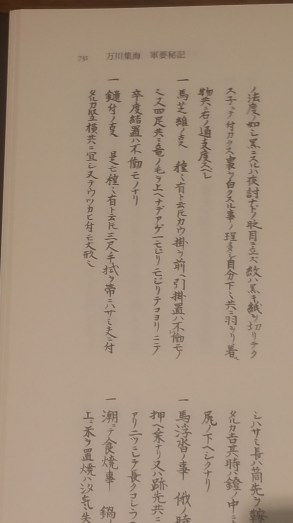
While I’m not attempting to produce a full translation of the Bansenshukai (I will leave it in the hands of those far more capable with full resources at hand), I do want to share some of the work needed in order to attempt translating old text into your native language, from the viewpoint of a translator myself. Let’s take a small snippet about horses from one of the chapters in Bansenshukai called “Gunyo Hiki”, a section that instructs on conduct, activities, preparation, and other activities while serving in the military. Below is the original text from the Bansenshukai, which is written in Kanji4 and Katakana5:
Next is an easier-to-read version of the original text from Mr. Nakajima’s book. It is still written in a kind of old Japanese fashion, but with Hiragana6 in places where one gets a better idea about how the words should be read.
Now, here it is written, phonetically, in the English alphabet:
Uma Shibai no Koto
Shushu ari to iedomo, kougake (w)o mae (h)e hikkake okaba, ugokazaru mono no nari. Mata shisoku tomo ni ryu no ke (w)o ue (h)e nade ni age, ichi mojiri mojirite, koyori nite sotto musubi okaba ugokazaru mono nari.
Before doing a thorough translation, let’s focus on the actual text. Giving a very rough and literal description, this text talks about tying a horse in place using a rope or cord by “something”, and then brushing up and twisting repeatedly the “dragon’s hair” of a four-legged creature, and tying it to also keep a horse from moving. Certain points are vague in description, while others use words that make it very difficult to know what is being reference. To fill in the gaps, it is important to learn the nuances and contents of what’s being discussed. Research on the topic of cavalry during the history of Japan, for example, is essential so to understand the topic at hand and get an idea of what’s missing in those gaps. Having access to books when looking up archaic words not in use is also a must, such as a specialized Japanese dictionary. The internet is also a good resource, as there is a vast amount of information at one’s fingertips, especially if you research in the native language, in this case being Japanese. However, you need to know how to narrow your searches down to queries most close to what you’re researching on, as well as decipher true information from false. When you have an idea of specific sources, libraries (both physical locations and online) can be a translators’ best friend.
An example of basou, or riding equipment for a horse. Photo taken by Alun Salt. From Wikipedia.
Here are some areas of interest from the text above that need to be addressed:
- Uma Shibai: The kanji used for this is unconventional. It is a combination of 芝(shiba; grass, or turf) +維(i; rope or cord). It may very well be a play on words to indicate its true meanings, such as 芝居 (shibai, to tie) and 仕場 (shiba, activities done on the battlefield). Since the information in the original text is geared towards those working in the military, we get an understanding that the horse will be tied and secured outside in the field.
– Kougake: In the text the word “something” is written as こう掛. Pronounced as “kougake”, “kou” is written in Kana7. Since the topic deals with tying a rope or cord to the horse, we can deduce that “gake” refers to something that is worn or hung on the horse. But where? Kou, as it is written, is vague and tells us nothing we can work with. If one studies the basou8 (riding equipment used on horses) used in times of war in Japan, you’ll find that in the head gear called omogai9, there is a leather strap that wraps from the top of the horse’s neck down across the horse’s face. This leather strap, which happens to be called “kougake”, is written as “首掛”. The kanji for kou should be “首”, which stands for neck. Nowadays it is pronounced as “kubikake”, and is used not only for horses, but for various accessories people use that can be slung from the neck, such as a pouch or guitar strap. Getting back on topic, we have clarification that kougake in the Japanese text refers to a leather neck strap.
– Shisoku: when one first reads it, it’s easy to assume this is in reference to the four legs of a horse. It sorta does, but not in the literal sense. Short for “shisoku dobutsu”10, shisoku basically stands for a four-legged animal. Thus, a shorthand for horse in the text. Simple as that.
– Ryu no ke: This translates to “dragon’s hair”. What does that have to do with a horse? Well, one thing to understand is that there are many types of labeling in reference to dragons in Asia since dragons are seen as wise and calm, full of wisdom, and good fortune. Originating in China, the concepts of dragons, as well as many references to them, also trickled down into Japanese culture. For example, “dragon’s beard”11 is a common word used in Chinese society for things that resembled the whiskers of dragons depicted in artworks, such as a type of snack12, and a flexible weapon with 2 hooked blades13. The same “dragon’s beard”14 is also used in Japan, for it is a nickname for a type of plant15, as well as when a long silver strand(s) of hair grows on the back of one’s neck16. Hair that is let down to flow wildly is also described to be like a dragon. This is where a horse comes into the picture. Horses in Chinese history have been compared and associated with dragons, from being called a dragon based on Chinese measurements17, to being combined with one another18. Furthermore, a horse’s mane, as well as other animals with long fur, are compared to that of the hairs of a dragon. Thus, “ryu no ke” is a reference to a horse’s mane.
– Ichi mojiri mojirite: There is no kanji in the text for “mojiri mojirite”, but there is a reason. Not a conventional use, this is a case of a verb being repeated twice, which is “mojiru”. The kanji normally associated with this is 捩. The verb has several meanings based how it is used, such as to twist something, to make a parody of something, or to make something excruciating. So which meaning is the correct one? When it is written in Kana form, the sound of the word indicates a physical action, which is a twisting motion. Since it is repeated twice, this motion is emphasized even more. So, in the case of the horse’s hair, we understand it is being twisted, or braided, together.
A picture of the original text of the Bansenshukai, scanned in the back of Nakajima Atsumi’s book. The text featured in this blog is the middle on the top row.
With those areas now made clear, below is a proper translation by me of the text from the Bansenshukai:
Matters Concerning the Tying of Horses on the (Battle)field
There are numerous ways to do this. One way is to bring the “kougake” (leather neck strap part of its head gear) forward and tether from there so to keep the horse in place. Another way is to brush up the horse’s mane, twist it into a braid, tie it with a koyori (a type of paper string), and tether from there to secure the horse so that it will not move.
This here concludes this topic on translating old documents in Japanese. I aim to do more entries like this on other Japanese documents and manuals in the near future. Possibly a few more entries from the Bansenshukai will make their way on my blog again.
1) 万川集海, also written as 萬川集海 in earlier times. While most commonly pronounced as Bansenshukai, it is also read as “Mansenshukai”. To which is the proper pronunciation has not been agreed on, and tends to be debated by linguists and ninjutsu historians. For example, Nakajima Atsumi primarily uses “Mansenshukai”. For the sake of consistancy, however, I will use “Bansenshukai” when addressing this work.
2) Shinobi (忍び) is one of older titles used in reference to those who took part in covert activities and specialized in unconventional tactics. More specifically, a specialist in this field would be called a shinobi no mono (忍びの者), while the skills they used was called shinobi no jutsu (忍びの術).
3) “Bansenshukai – The Complete Edition”.
4) Chinese-originated characters used for writing, adopted by Japan. One of the main writing systems. A little over 10,000 kanji are in use today, but the total count of Kanji used throughout Japan’s history is around 50,000.
5) A type of phonetic script made up of 48 characters derived from Kanji in Japan, it is one half of the Kana system that is a major component of Japan’s writing system. In modern times, some of its uses include representing foreign-based words, accented speech (different from Japanese), emphasizing movements and actions, and scientific words.
6) The other half of the Kana system, Hiragana is a type phonetic script made up of 46 characters. Primarily used, alongside with Kanji, to write Japanese native words, as well as a substitute for Kanji in specific cases.
7) The phonetic writing system made up of both Hiragana and Katakana.
8) 馬装. This is regular gear for the horse. This is different from uma yoroi (馬鎧), where the horse gains a layer of light armor.
9) 面繋. The omogai is one of the three major components of a horse’s equipment, the other two being the munagai (胸繋, chest gear), and shirigai (尻繋, rear gear).
10) 四足動物
11) Written as 龍鬚 (lóng xū) in Chinese (Mandarin).
12) 龍鬚糖 (lóng xū táng)
13) 龍鬚鉤 (lóng xū gou)
14) 龍の髭 (ryu no hige)
15) Dwarf Lily turf (Ophiopogon japonicus) in English. Along with Dragon’s Beard, it is also referred to as Snake’s beard (蛇の髭, ja no hige).
16) Superstitiously believed to be a sign of good luck and fortune. Generally called Takara ke (宝毛) or Fuku ke (福毛).
17) Found in an old bureaucratic writing on duties and organization of officers called “Rites of Zhou” (周禮, Zhouli) dating back as far as 2nd Century BC in China. Broken into 6 parts, the measurements are located in line 126 the 4th part called “Offices of Summer” (夏官司馬, Xiaguan Sima). This can be found in the “Chinese Text Project” under “The Rites of Zhou” here.
Part 3 of our discussion on Kyohachi ryu will focus on two martial schools that are representatives of this mysterious system. Both were started by 2 of the 8 monks who are said to have received direct teachings from the source, being Kiichi Hogen. Or is the “8 monks” claim a figurative statement? These two schools are known as Nen ryu and Chuujou ryu, which are 2 schools out of the 8 of Kyohachi ryu that share a direct connection with each other.
NEN RYU
Let’s start off with Nen ryu, which can be considered the “senior” of the two schools. Nen ryu’s history begins with its creator, who goes by the name Souma Shiro Yoshimoto. He is well known under, and generally referred to by a few names he’d pick up over time such as “Nenami” and “Jion”, but for this blog we will stick with his given name. There are a lot strange points concerning his history, and details that cannot clearly be verified. Most of these uncertainties evolve around his age when he embarked on his journey to studying kenjutsu, how he achieved enlightenment in the way of the sword, to the numerous names he is known under. How he acquired the knowledge of Kyohachi ryu is also one of those points, which will be addressed below.
Yoshimoto was born in Souma of Oshu (present day South Souma City in Fukushima Prefecture) in around 1350. He came from a well to do family, for his father, Souma Shiroemon Tadashige, was a busho (military commander) in employment of Nitta Yoshisada, and had earned merits in serving time participating in numerous battles. Tragedy struck, unfortunately, for Tadashige was murdered, although there are no details accounting to how or why. Yoshimoto was 5 years old when this event took place. For safety sake, Yoshimoto and his nursing mother escaped to Imajuku in Musashi no Kuni (present day Yokohama City in Kanagawa Prefecture).
At the age of 7, Yoshimoto became an apprentice to a Yugyo Shonin1 from Soushu Fujisawa2 and had his name changed to “Nenami”, thus his entrance into priesthood. This also is the start of his journey to get revenge on his father’s murderer by studying the ways of the sword3. At the age of 10, it is said that he climbed up Mount Kurama (accompanied by his fellow elder priests…?)in Kyoto, and met an “ijin”4 or unusual individual, in Kurama Temple. From this individual Yoshimoto received training in unique yet mysterious sword methods that define Kyohachi ryu.
Not making Mount Kurama his last stop, Yoshimoto would leave around the age of 16 and continue his martial studies over the years at Kamakura under a holy priest (named Eiyu/Yoyu…?), and later at Anrakuji in Tsukushi, until finally reaching a state of true understanding of kenjutsu. Yoshimoto also succeeded in getting revenge after leaving his religious duties for a short time and returned back to his hometown. Later, he would resume his Buddhist practices as a Zen monk and change his name to “Jion”, and establish his own temple called Chofukuji in the Namiai Village of Ina City, located in Shinshu (present day Nakano prefecture). Being well versed in his martial studies, Yoshimoto taught his knowledge to 14 personal students. Different martial schools were established based on his teachings, many under their own names.
While Yoshimoto’s martial training expanded to a few different places, his time at Mount Kurama is key to the discussion on Kyohachi ryu. Who exactly did he study under at Mount Kurama? Who is this “unusual individual”? No records available can clearly identify this person. There are speculations that this person could’ve been Kiichi Hogen, but this is impossible. While there are no clear dates for either his birth or death, records about Kiichi Hogen indicate him being alive in the 1100’s, and describe his as an elderly man when Minamoto no Yoshitsune encountered him (around 1170). Since Yoshimoto was born around 1350, and goes to Mount Kurama around the age of 10 (1360), then Kiichi Hogen would have to have been alive almost an extra 200 years on top of however old he was! So, whomever Yoshimoto studied under had to have been someone else, most likely another monk of Kurama Temple.
A screen capture of “Maniwa Nen ryu Kagami Biraki” a public demonstration that takes place on January of the new year.
Today, Nen ryu survives under the title “Maniwa Nen ryu”. In this system kenjutsu, sojutsu, naginatajutsu, and yadomejutsu5 are the primary focus. Since it is still active, we have a means to learn about it in public demonstrations the current practitioners participate in. (these can be viewed on Youtube, especially if you type “馬庭念流” as your search query) Some unique traits of Maniwa Nen ryu are the Mu Gamae (a low posture used to intercept incoming attacks), the handling of the naginata and yari with a tachi grip (right hand closer to the spearhead while left hand is closer to ishizuki), and a rare method of deflecting arrows with the tachi. This school is also well known for using protective gear for the head and hands when engaging in training similar to gekken6. As a koryu, Maniwa Nen ryu is respected as a martial system whose main intention is self-protection for the common people, as well as for its simple yet efficient movements and techniques, especially in its kenjutsu. There are no long, drawn out sequences in their kata. Instead, what is demonstrated are short exchanges, some resulting in a parry to get in, others being a counterattack after evading a sword cut at the last moment. Are these examples of the secret lessons from Kiichi Hogen that makes up Kyohachi ryu? Possibly, but this is difficult to discern due to a lack of sources to compare it to.
CHUUJOU RYU
Next we set our focus on Chuujou ryu. This can be considered the “junior” of the two schools in this blog. In order to explain this, we need to briefly shift our attention back to Nen ryu.
Amongst koryu schools in Japan, Nen ryu is labeled as a “Sandai Genryu”, or one of the 3 martial schools responsible for the birth of other kenjutsu-centric schools. Many schools can trace back one way or the other as having roots in Nen ryu kenjutsu, such as Ittou ryu, Kyosui ryu, and Kanemaki ryu7. This all started when Souma Shiro Yoshimoto (at the time was known by the name of Jion) had 14 prominent disciples, whom he taught the secret sword techniques revered as the teaching of Kiichi Hogen. These students in turn started their own martial system, and expanded this knowledge throughout the lands in Japan. One of those disciples is said to be Chuujou ryu’s founder, whose name is Chuujou Hyogonosuke Nagahide.
The family crest “Ichimonji”, used by the Chuujou clan. While it represents the number one in Japanese, the meaning as a family crest is “undisputed” or “unrivaled”. From Wikipedia.
A resident of Kamakura in Soshu (present day Kamakura City in Kanagawa Prefecture), Nagahide was born into the reputable and influential Chujou family sometime in the 1300s. He was already versed in, as well as the successor of his own family’s martial system called “Chuujou ryu Heiho”8 before meeting Yoshimoto. While it was a system designed for warfare and had strategies with the use of weapons such as the naginata and the yari, Chuujou ryu Heiho also had a section for sword techniques called “Chuujou Kadenrai no Kenjutsu”. Despite inheriting an established system, Nagahide must’ve been in need to further his knowledge on sword fighting, for he left home possibly to find some means to do so.
Now, let’s see how Chuujou ryu becomes intertwined with Nen ryu. The more common story in Japanese sources tell that Nagahide set out and met Yoshimoto at Jifuku Temple, which is located not too far from him in Kamakura. Nagahide was taken in as a disciple, and learned the sword methods of Nen ryu9. Whether or not he also studied Buddhism this is not clearly explained. After a few years, Nagahide took what he learned of Nen ryu and incorporated it into his family’s martial system, making it more complete than it was before. Nagahide would later become an appointed sword instructor for the shogun Ashikaga Yoshimitsu10 to train his soldiers, as well as gain employment in the Hyojoshu (State Council) of the Kamakura Shogunate. His activeness in both military and government affairs helped Nagahide to not only promote his martial system, but also make a name for himself. Chuujou ryu grew in reputation, attracting potential students who, in turn, would open their own schools under the name of Chuujou ryu, and teach the techniques of the martial system. There were other students as well who would open up their own schools under a different name, yet still have a kenjutsu curriculum that is based on what was learned under Chuujou ryu.
Chuujou ryu’s history, for the most part, doesn’t have any major events, for not only did the family line end in this martial system with Nagahide (he had siblings, yet chose an individual named Kaibuzen no Kami Kagehiro, a non-relative, to be the successor), but many dojos that represented Chuujou ryu also are closed down11. Although no longer active, there are many martial schools that derive from the teachings of Chuujou ryu today. Most notably are the numerous lines of Ittou ryu, Toda ryu, and Togun ryu, which are all still active. These schools’ kenjutsu should reflect the kenjutsu of Chuujou ryu, but that depends on how much has been retained over the years along with what new materials and changes made by the different successors.
A demonstration of Onoha Ittou ryu Kumidachi at Ise Jingu (or Ise Great Temple) in 2015. One of the kenjutsu schools said to derive from Chuujou ryu.
There are scrolls in the possession of certain collectors that have a list of the techniques and forms of Chuujou ryu, but how they are physically performed has been lost. Interesting to note, there are about 33 forms that consist of a short tachi12 used against a longer tachi in those scrolls. This is very similar to Minamoto no Yoshitsune’s sword methods, which also incorporated a short tachi13. It is not clear if Chuujou ryu originally utilized a short tachi, or if this was incorporated after Nagahide’s training in Nen ryu. Is this a special skill set found in the secrets of the sword that originates in Mount Kurama?
While Chuujou ryu is considered a representative of Kyohachi ryu, there are some points to consider. Chuujou Nagahide, just like Souma Yoshimoto, never met Kiichi Hogen, so the secrets of Touhou, or methods of the sword, were not directly transmitted to them from the main source. Mount Kurama is next in line to being a source of this knowledge, which is where Yoshimoto had trained at, and most likely learned from one of the monks at Kurama Temple. However, there is no mention that Nagahide made the climb to Mount Kurama. It is possible that since Yoshimoto did and had the knowledge himself, that just being a direct student of him was good enough for Nagahide to get that knowledge…although age-wise, Yoshimoto was in his late teens to early 20s and was also in training himself while in Kamakura. Or, the association of being a martial system with knowledge of kenjutsu learned from the great capital of Heian Kyo automatically earns the position of being a Kyohachi ryu representative. This appears to be more so for Chuujou ryu.
This here ends the discussion on the beginnings of Nen ryu and Chuujou ryu, and how they both were the foundations for other kenjutsu schools. Their reputations are fitting to put them as representatives of Kyohachi ryu. Stay tuned to the final part on Kyohachi ryu, which will focus on other martial systems whose claims to direct heredity to the secrets sword methods of Kiichi Hogen are just as mysterious and questionable as the source itself.
1) Yugyo Shonin can translate to “traveling priest”, but there is more to this. This is a label for a Buddhist priest belonging to the Shojoko Temple, located in present day Fujisawa City. This temple, also known as Yugyo Temple, belongs to the Jishu sect (時宗) of the Pure Land Buddhism. This temple was founded by Ippen Shounin (1239-1289), who is famous for traveling around Japan with his followers promoting his religion to the people through such acts like handing out pamphlets and performing dances of invocation. Ippen helped to promote the idea that anyone can reach the road of salvation after death simply by reciting “Namu Amidabutsu” everyday, whether you were a believer of Buddhist faith or not.
2) Modern day Fujisawa City in Kanagawa Prefecture, Japan.
3) Interesting, in this time period, many temples were associated with the upkeep of martial-related training and documentations, especially those concerning the sword, which works as an essential path for Yoshimoto.
4) Ijin (異人) is a phrase in Japanese that has several nuances. Literally it stands for “outsider” and “foreigner”, yet these descriptions are not a clear cut as one would think. Before being a unified country, Japan was made up of different territories and “countries” in the past, so traveling up north from, say, south east would mark you as an outsider. Coming from overseas would also mark you as an outsider. On a social level, ijin can mean “someone who is different”. For example, in the olden days there where those who pulled away from society and became recluses, making their habitats in the wild or mountainside while seeking enlightenment. These individuals, called yamabushi (mountain ascetic), can also be labeled as outsiders.
Despite which context it is used, the use of ijin here is to indicate a person of extraordinary skills and ability. Their identity remains a mystery, possibly to give more power to the idea that this “outsider” possesses knowledge unfathomable. Thus, to train under such a person would mean you possess amazing skills, and in turn, elevating you and your martial system’s reputation.
5) “Techniques for stopping arrows”.
6) Gekken, also known as gekiken, is a form of fencing using kenjutsu. Unlike kendo, there is little restriction on what targets you can aim for.
7) Kyosui ryu currently has no schools or successors, but its kenjutsu appears to be taught in one of the Shinkage ryu lines. Kanemaki ryu’s line actually originates from Chuujou ryu, but is sometimes tied to Nen ryu. Today, Kanemaki ryu is a battojutsu-centric school, for its kenjutsu curriculum (Kumitachi) has been lost as the successor died during WWII and didn’t pass down this knowledge.
8) Nagahide’s birth date is in question, but nothing verified. What is known that he lived until 1384. Nagahide, along with his family style Chuujou ryu Heiho, were active in the Muromachi period (1336 – 1573).
9) Popular stories accept this version. However, there is another version that disputes this, stating that Nagahide studied under Yoshimoto’s teacher at Jifuku Temple, a holy priest named Eiyu (Yoyu?). If this is so, then the relationship between Nen ryu and Chuujou ryu could be debunked.
10) 3rd ruler of the Ashikaga Shogunate from 1368 to 1394.
11) The Chuujou ryu line lasted until the middle of the Showa period (1926ー1989), in the possession of the Yamasaki family.
12) Can be referred to as a kodachi (小太刀). Sometimes is referred to as a wakizashi (脇差).
We continue today with part 2 on the topic about Kyohachi ryu. The focus of discussion will be on people who have direct ties to the legend of this sword system. If you missed out on the previous discussion on the beginnings of Kyohachi ryu, you can read it here.
First on our list is Minamoto no Yoshitsune. A famous general of the Minamoto clan on his own merit and deeds, Yoshitsune is viewed as a possible representative of Kyohachi ryu. There are some speculations that he may have been one of the eight monks whose style collectively represents Kyohachi ryu. There are, unfortunately, no solid proof regarding this. The reason behind these possibilities has to do with how close he was to the source.
Let’s set our sights to the early years of his life, when Yoshitsune was known by the name of Ushiwakamaru. Around 1170, Ushiwakamaru was sent to reside in the Kurama Temple around the age of 11 up in Mount Kurama. There, under the care of the monks, he was fed, clothed, and educated in various things, including bujutsu.
Artwork called “Ushiwaka-maru training with the tengu”. (鞍馬山での修行, created in 1859 By Yoshikazu Utagawa) Features Ushiwakamaru (middle, top), Daitengu Sojobo (right, pale skin, red attire), and other tengu of different ranks. From Wikipedia.
It is written that he was very talented and skilled in the martial arts, particularly with the tachi. It is even fabled that he was taught an unusual sword method by a tengu, due to his unique sword play. However, in some written accounts it is said that the “tengu” was actually Kiichi Hogen1. This is most likely the case, since Kiichi Hogen is associated with Kurama Temple. The Gikeiki2, a written account on Ushiwakamaru’s (Yoshitsune’s) life, features detailed accounts regarding Ushiwakamaru and Kiichi Hogen’s history together. There is even an account of him stealing one of Kiichi’s prized manuals and studying it to understand the secrets of warfare3. However, the many accounts in Gikeiki are not all considered factual, so some things have to be taken with a grain of salt.
A sketch of Minamoto no Yoshitsune’s kuruma dachi (車太刀), which can be found on “Kuramadera“, the official website of the Kurama Temple here. Sketch by Neal H.
While there are no descriptions on a systematic level in regards to what was learned while residing at Kurama Temple, what has been passed down in documentations are descriptions of Yoshitsune’s display of skills. For example, Yoshitsune apparently wielded a short tachi4 with great mobility. A description of it from Wikipedia illustrates his kenjutsu as:
「敏捷性を生かし、短い刀を用いて素早く敵の懐に入る剣術」
Which I’ve translated as:
“A sword art that incorporates a short sword to quickly trap his adversary through the use of agility”
Described as being quick, yet crafty & tactful at a young age, Yoshitsune was a force to be reckoned with. Could it be that this is a representation of Kyohachi ryu? Did he utilize this same unusual sword method to defeat the likes of individuals such as the warrior monk Musashibo Benkei5, and the thief Kumasaka Chouhan6?
Artwork entitled “Ushiwaka and Benkei dueling on Gojo Bridge” (五条の大橋, 1881 by Tsukioka Yoshitoshi). From Wikipedia.
As an adult, Minamoto no Yoshitsune is said to have been a skilled fighter and strategist during the Genpei Gassen, or the Genpei War7. His skills with the sword is fitting with the premise Kyohachi ryu is based on. Is it possible that some form of records or inheritance of his kenjutsu exist? There are several guesses. One of them, for example, is that Yoshitsune inspired the development of martial system known as Yoshitsune ryu. It is also known as Kurama ryu in some sources, but this is highly debated, and will be addressed at a later time.
There are no known detailed records of Yoshitsune ryu’s history or contents, which makes verifying its existence even harder. On a positive point, it is mentioned in old documents pertaining to other martial schools, Musashi Enmei ryu being one of them. Musashi Enmei ryu, which specializes in kenjutsu and iaijutsu, gives credence to several sources for its foundation, which are Shunjoubou Chougen (founder of the main line Enmei ryu), Miyamoto Musashi (founder of Musashi Enmei ryu), and none other than Minamoto no Yoshitsune. Here’s a brief summary (in my own words) of what is explained in this school’s history8.
“In the Heian period, Minamoto no Yoshitsune received training on Mount Kurama from the Daitengu Sojobo, as well as studied many military manuals. (Kiichi Hogen’s presumably…?) Later in the years, he developed Yoshitsune ryu. Shunjoubou Chougen too trained under the same Daitengu, and through the tutelage from Yoshitsune, was taught the inner secrets of his Kurama ryu (aka Yoshitsune ryu). From this, Chougen developed his own sword system, Enmei ryu.”
Since Musashi Enmei ryu, a branch to the original Enmei ryu, traces back to the knowledge of sword play from Yoshitsune himself, one would think that it’s possible to get an understanding of the great sword methods passed down from Kiichi Hogen. Perhaps. But with many arts that have a long history, there is a strong chance that the contents have changed based on the times, the necessity of certain techniques, and the vision the successors of the time may have had on Enmei ryu. Or association with a legendary figure like Yoshitsune may have been used as an angle to give more credibility to this sword school.
Here ends part 2 on the discussion of Kyohachi ryu and Minamoto no Yoshitsune’s connection with this sword system. In the next part, we will continue further with particular individuals said to be one of the 8 monks that received their sword training from Kiichi Hogen himself.
1) In martial arts, stories about being trained by tengu implies how extraordinary the techniques are. This also implies that the individual receiving the training was supernaturally skilled. Since there are many tales regarding Yoshitune achieving feats that seem impossible, it is most fitting to tie his abilities to be the making of the tengu.
2) Gikeiki (義経記) is a book on military-related tales concerning Minamoto no Yoshitsune. It is believed to have been written and compiled sometime between the Nabokucho period and Muromachi period.
3) Rikuto (六韜, pronounced as Liu Tao in Mandarin), which translates as “The 6 Secret Strategies”, is a famous Chinese military manual written by Jiang Ziya, believed to have been first penned in the Zhou Dynasty. (circa 1100 BCE) This is 1 of 7 writings on warfare from China, which as a collection are referred to as “The 7 Military Classics of Ancient China”.
4) The name of Yoshitsune’s sword written in kanji (Chinese characters) is “車太刀”. This is read as “kuruma dachi”, and is very akin to the kodachi (short sword). According to the book “Koshirae – Japanese Sword Mountings” by Markus Sesko, this type of sword was possibly designed for use in confined spaces, such as while riding a coach-like vehicle. The sword length of Yoshitsune’s kuruma dachi is 53 cm with a rather wide curvature.
5) Musashibou Benkei, a famous sohei (warrior monk) who was a loyal companion to Yoshitsune. A rather large and brash monk who is usually portrayed wielding a naginata, Benkei proved to be a great support in the many adventures of Yoshitsune till the very end. While there are conflicting accounts as to when, where, and how the two became acquaintances, one of the more popular versions from the book “Nihon Mukashi Banashi” (written by Iwaya Sazanami in 1894) tells the story as the following: On the Gojo Daibashi (Gojo Bridge) Musashibo Benkei was terrorizing any warriors that attempted to cross by beating them, and confiscating their swords. Benkei amassed 998 swords and would stop once he acquires 999 total. His 999th encounter so happened to be with Ushiwakamaru (Yoshitsune). Although Benkei tried intently to smite his young opponent, Ushiwakamaru used light footwork and agility to evade his attacks, and defeated him with his own counterattack. Amazed, Benkei gave full devotion to his young superior, and from there on joined Ushiwakamaru’s company.
6) Kumasaka Chouhan is a legendary leader of a gang of thieves during the Heian period. A popular version of his story from the traditional performance “Eboshiori” recites how Chouhan lead a robbery attempt with his gang of 300+ thieves on Ushiwakamaru (15 years old at the time) and his merchant companion Kaneuri Kichiji as they were traveling at night to an area called Oshu. Ushiwakamaru is said to have cut down 83 of the thieves with speed and agility, as well as beat Chouhan 1-on-1 with unique yet superior sword techniques.
7) The Genpei Gassen (1180-1185) involved the rivalry between the Taira clan and the Minamoto clan. Both sides were struggling to maintain power over the Imperial court and gain control over Japan. Minamoto no Yoshitsune contributed to ending the war through offensive warfare and strategic approach during the progression of battles, which ultimately led to the eradication of the Taira clan.
8) Full explanations can be found on Musashi Enmei ryu’s official website here